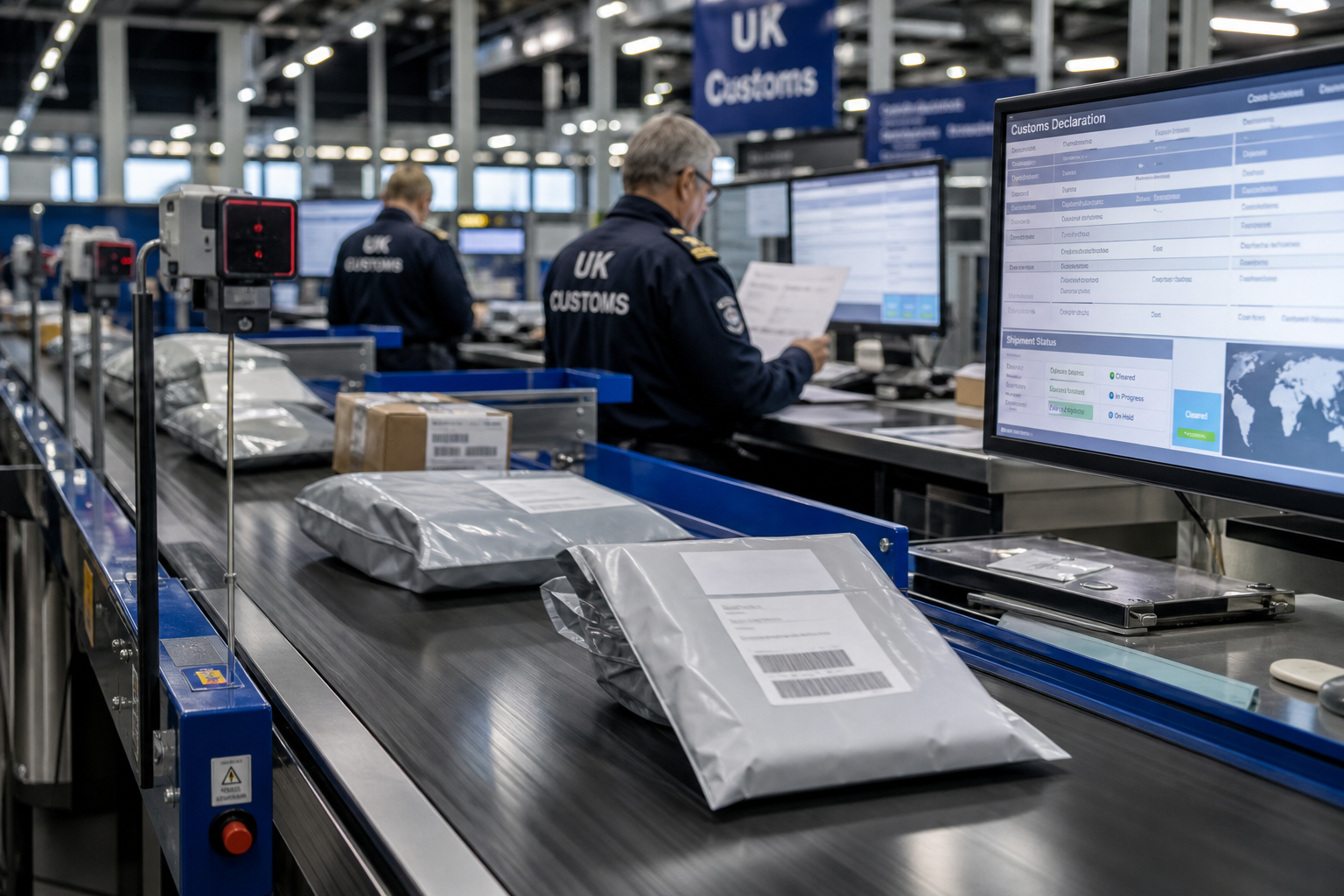
When a DHL, FedEx or UPS parcel arrives in the UK from outside the country, it doesn’t sit in a warehouse waiting for a paper form to be processed. Express couriers operate their own in-house customs brokerage, submitting electronic declarations through the Customs Declaration Service (CDS) while goods are still in transit. Clearance can happen in hours, not days.
But speed doesn’t mean exemption. The same HMRC rules apply whether your parcel arrives via express courier or Royal Mail. Customs Duty, Import VAT, Excise Duty and courier handling fees all remain payable. The difference is in the process — and in who you deal with when charges are disputed.
This guide explains how express courier customs clearance works, what you actually pay, and what to do when a courier invoice doesn’t look right. For the broader customs clearance process, see our step-by-step customs clearance guide.
The £135 Threshold: What It Means for Courier Shipments
The £135 threshold is the single most important number in UK import taxation for low-value goods. It determines whether Customs Duty and Import VAT are payable, and crucially, who collects the VAT.
For consignments valued at £135 or less (non-excise goods):
- No Customs Duty is payable
- No Import VAT is payable to the courier
- VAT should have been collected by the seller at the point of sale
This rule applies regardless of whether the goods are sent via DHL, FedEx, UPS or any other carrier. The key is the intrinsic value — the price the goods were sold for, excluding separately shown transport, insurance and other identifiable taxes.
For consignments valued above £135:
- Customs Duty is payable (unless the goods qualify for preference under a trade agreement)
- Import VAT is payable on the total value including postage, packaging, insurance and any duty owed
- The courier will contact the recipient for payment before release
Online marketplace sales: If you buy from eBay, Amazon, Etsy or similar platforms, the marketplace itself is liable for VAT at the point of sale for consignments ≤£135. This is an HMRC requirement introduced to close the VAT gap on overseas sales. The courier should not charge VAT again — if they do, it’s a duplicate charge that can be disputed.
Excise goods are different: Alcohol and tobacco are liable to Customs Duty and Excise Duty regardless of value. The £135 threshold does not apply. A £50 bottle of whisky from outside the UK will still incur duty and VAT.
What You Actually Pay: A Breakdown of Charges
When a courier invoices you for customs charges, the total typically comprises several distinct elements. Understanding each component helps you verify whether the invoice is correct.
| Charge Type | When It Applies | How It’s Calculated |
|---|---|---|
| Customs Duty | Goods >£135 (non-excise) or any excise goods | Percentage of goods value, based on commodity code and country of origin |
| Import VAT | All goods >£135, or ≤£135 if VAT not collected at sale | 20% (standard rate) on goods value + postage + packaging + insurance + any duty owed |
| Excise Duty | Alcohol, tobacco, certain fuels | Fixed rates per unit (e.g. per litre of spirits, per 1,000 cigarettes) |
| Courier handling fee | All shipments where duty/VAT is payable | Typically £8-£15 or a percentage of the duty/VAT amount |
Important: Import VAT is charged on the total landed value, not just the goods. If you import £200 of goods with £20 postage and £40 Customs Duty, Import VAT is calculated on £260 (£200 + £20 + £40), not £200.
Courier handling fees are not government charges. They are service fees levied by DHL, FedEx and UPS for advancing the duty and VAT payment to HMRC on your behalf and processing the customs declaration. These fees vary by carrier and are not regulated by HMRC. Some couriers charge a flat fee; others charge a percentage of the duty/VAT amount.
How Express Couriers Clear Customs
Express couriers differ from postal services in their clearance approach. DHL, FedEx and UPS operate as licensed customs agents with direct electronic access to HMRC’s Customs Declaration Service (CDS). This enables several advantages:
Pre-clearance in transit: Goods can be declared while still on the aircraft or vessel. By the time the parcel reaches the UK border, the declaration has already been submitted and often approved. This is why express shipments can clear customs within hours of arrival.
Electronic CDS submissions: Couriers submit declarations electronically through CDS, the same system used by professional customs brokers. This reduces errors and speeds up processing compared to paper-based systems.
In-house brokerage teams: Each major courier employs dedicated customs specialists who handle classification, valuation and origin determination. For standard shipments, this happens automatically. For complex goods (e.g. products requiring licences, restricted items, or unusual commodity codes), the courier may contact the importer for additional information.
Comparison with postal clearance: Royal Mail and Parcelforce handle customs through their International Logistics Centre at Langley (Heathrow). Postal clearance tends to be slower because volumes are higher and the process is more centralised. Royal Mail does not operate as a customs broker in the same way — it acts as an intermediary between HMRC and the recipient.
The practical difference: With express couriers, you’re dealing with a commercial operator that has invested in customs infrastructure. With postal services, you’re dealing with a government-adjacent process that prioritises volume handling over speed.
The Paperwork: What the Sender Must Get Right
The commercial invoice accompanying a courier shipment is the foundation of the customs declaration. If it’s wrong, the declaration is wrong — and the recipient pays the price in delays, incorrect charges or seized goods.
Essential commercial invoice contents:
- Full description of goods: Not “gift” or “sample” but “men’s cotton t-shirts”, “plastic kitchen utensils”, “replacement parts for industrial machinery”
- Accurate value: The price paid or payable. Undervaluation is a common cause of customs delays and can lead to penalties
- Commodity code (HS code): The 6-10 digit code that determines the duty rate. Senders should use the UK Trade Tariff tool to find the correct code
- Country of origin: Where the goods were manufactured, not where they were shipped from
- Incoterms: Who is responsible for transport, insurance and customs charges (e.g. DDP = Delivered Duty Paid, DAP = Delivered at Place)
- Weight and quantity: Net and gross weight, number of items
CN22/CN23 forms: These are postal customs forms used by Royal Mail and other postal operators. Express couriers typically use their own commercial invoice formats, but the information requirements are similar.
Consequences of errors:
- Undervaluation: HMRC may revalue the goods based on market prices, leading to additional duty and VAT plus potential penalties
- Wrong commodity code: May result in incorrect duty rates (over or under). Underpayment can lead to back-charges; overpayment requires a refund claim
- Missing or vague descriptions: Goods may be held for inspection, delaying delivery by days or weeks
- Incorrect origin: May disqualify goods from preferential duty rates under trade agreements
Gifts, Samples and Personal Effects
The rules for gifts are often misunderstood. HMRC’s gift relief is narrow and specific.
To qualify as a gift for customs purposes:
- The parcel must be sent from a private individual to another private individual
- It must be unsolicited — not ordered or requested by the recipient
- It must be occasional — not part of a regular pattern of shipments
- The value must not exceed £39 for Import VAT relief
What does NOT qualify:
- Goods purchased online and sent direct to the recipient (this is a sale, not a gift)
- Business samples sent to potential customers
- Regular shipments between family members (HMRC may view these as commercial)
- Gifts containing alcohol or tobacco (excise goods are never eligible for gift relief)
Multi-gift packages: If you send multiple gifts in one parcel to the same recipient, HMRC aggregates the value. Five £10 gifts in one box = £50 total, exceeding the £39 threshold.
Personal effects: Used personal belongings (clothing, books, household items) brought into the UK by individuals moving residence may qualify for Transfer of Residence relief. This is separate from gift relief and requires a different application process.
Disputing Charges and Claiming Refunds
If you believe you’ve been overcharged by a courier, you have recourse — but the process depends on which carrier you’re dealing with.
For Royal Mail/Parcelforce deliveries: Use form BOR286 to dispute charges or claim refunds. This form is specific to postal deliveries and is available on the GOV.UK website.
For all other courier/freight deliveries (DHL, FedEx, UPS, etc.): Use form C285. This is the standard HMRC form for disputing customs charges on non-postal imports.
Evidence you’ll need:
- The original commercial invoice
- Proof of payment (bank statement, credit card statement)
- The courier’s invoice showing the charges
- Any correspondence with the seller or courier
- Photographs of the goods and packaging (if relevant)
Time limits: HMRC requires claims to be made within specific timeframes — typically three months from the date of payment for VAT disputes, and up to three years for Customs Duty overpayments. Check the form guidance for current limits.
Keep everything: HMRC explicitly advises keeping all wrappings, labels and documents until the claim is settled. If goods are seized or destroyed, you may need physical evidence to support your case.
Courier vs HMRC disputes: Remember that courier handling fees are charged by the carrier, not HMRC. If you’re disputing a handling fee, you’re dealing with the courier’s customer service team, not HMRC. If you’re disputing duty or VAT, you’re dealing with HMRC via the C285 form.
Key Takeaways
- The £135 threshold determines liability: Goods ≤£135 (non-excise) incur no Customs Duty and no VAT to the courier if VAT was collected at point of sale. Above £135, full charges apply.
- Import VAT is charged on the total landed value: This includes goods, postage, packaging, insurance and any Customs Duty owed — not just the goods value.
- Courier handling fees are separate from government charges: Typically £8-£15 or a percentage of duty/VAT, these are service fees levied by the carrier for processing the customs declaration.
- Express couriers clear faster than postal services: Electronic CDS submissions and in-house brokerage enable pre-clearance in transit, often resulting in same-day or next-day clearance.
- Gift relief is narrow: Only applies to private-to-private, unsolicited, occasional shipments under £39. Online purchases sent direct to recipients do not qualify.
- Use the correct dispute form: BOR286 for Royal Mail/Parcelforce; C285 for DHL, FedEx, UPS and other couriers.
FAQ
Why was I charged VAT on something I already paid VAT on?
This happens when an online marketplace fails to collect VAT at point of sale for a ≤£135 consignment. Under HMRC rules, the marketplace should have collected VAT. If they didn’t, the courier will collect it on import. You can reclaim the duplicate VAT from the seller or marketplace, but you must pay the courier first to release the goods. Keep all receipts and submit a refund claim to the seller.
How do I avoid courier handling fees?
You can’t avoid them entirely if the courier advances duty/VAT on your behalf — it’s part of their service. However, you can:
- Use DDP (Delivered Duty Paid) Incoterms when ordering, so the seller prepays all charges
- Arrange your own customs clearance through a independent broker (only practical for high-value or frequent shipments)
- Choose a courier with lower handling fees (compare before ordering)
- For ≤£135 marketplace purchases, ensure VAT is collected at point of sale so no import charges are due
What if the sender declared the wrong value?
If goods are undervalued, HMRC may revalue them based on market prices, leading to additional charges. If overvalued, you can claim a refund using form C285. In both cases, the commercial invoice is the primary evidence. Contact the sender to issue a corrected invoice if possible. For significant discrepancies, HMRC may open an investigation. Keeping accurate packing lists and commercial invoices helps avoid these situations.
Can I clear customs myself instead of using the courier’s brokerage?
Yes, but it’s rarely practical for individual parcels. For regular importers, a customs broker or freight forwarder may be a better long-term solution than paying courier handling fees on every shipment. You would need to:
- Register for CDS (requires an EORI number)
- Submit your own customs declaration before the goods arrive
- Arrange payment of duty/VAT directly with HMRC
- Coordinate with the courier for release
This process takes time and expertise. For most importers, the courier’s handling fee is worth the convenience.
What happens if I don’t pay the customs charges?
Couriers typically hold parcels for about three weeks awaiting payment. If unpaid, the parcel is returned to sender. You will not receive a refund of postage or handling fees. For high-value goods, the sender may pursue you separately for the cost of the returned shipment.
Are there any goods that couriers won’t handle?
Yes. Each courier maintains a prohibited and restricted goods list. Common restrictions include:
- Hazardous materials (batteries, chemicals, aerosols)
- Perishable foods requiring temperature control
- Live animals
- Certain pharmaceuticals and medical devices
- Counterfeit goods or items infringing intellectual property
Check the courier’s website before shipping. If goods arrive and are found to be prohibited, they may be seized by HMRC or returned at your expense.