Key Takeaways
- UK importers carry legal responsibility under UKCA/CE regulations to verify their manufacturers have completed correct conformity assessments
- A thorough factory audit covers five core areas: legal compliance, production capacity, quality systems, financial stability, and ethical standards
- ISO 9001 certification demonstrates quality management commitment but is not legally mandatory for most imports
- SAMR (State Administration for Market Regulation) records provide official verification of Chinese business licences
- Third-party audit services cost £400-£800 per day but reduce risk significantly for high-value or regulated product categories
Why UK Importers Need a Supplier Audit Checklist for China
Importing from China remains a cornerstone of UK supply chains, but the distance and regulatory complexity create genuine risks. A manufacturer that looks credible on Alibaba may lack the licences, capacity, or quality systems to deliver consistently. The consequences of inadequate vetting range from delayed shipments to product recalls — and in some categories, legal liability.
Under UKCA and CE marking regulations, the importer (not the overseas manufacturer) holds responsibility for ensuring products meet UK conformity requirements. This aligns with broader customs compliance obligations that importers must meet at the UK border. According to HMRC guidance, importers must retain technical documentation and verify that manufacturers have carried out the correct conformity assessment processes before goods reach the UK border.
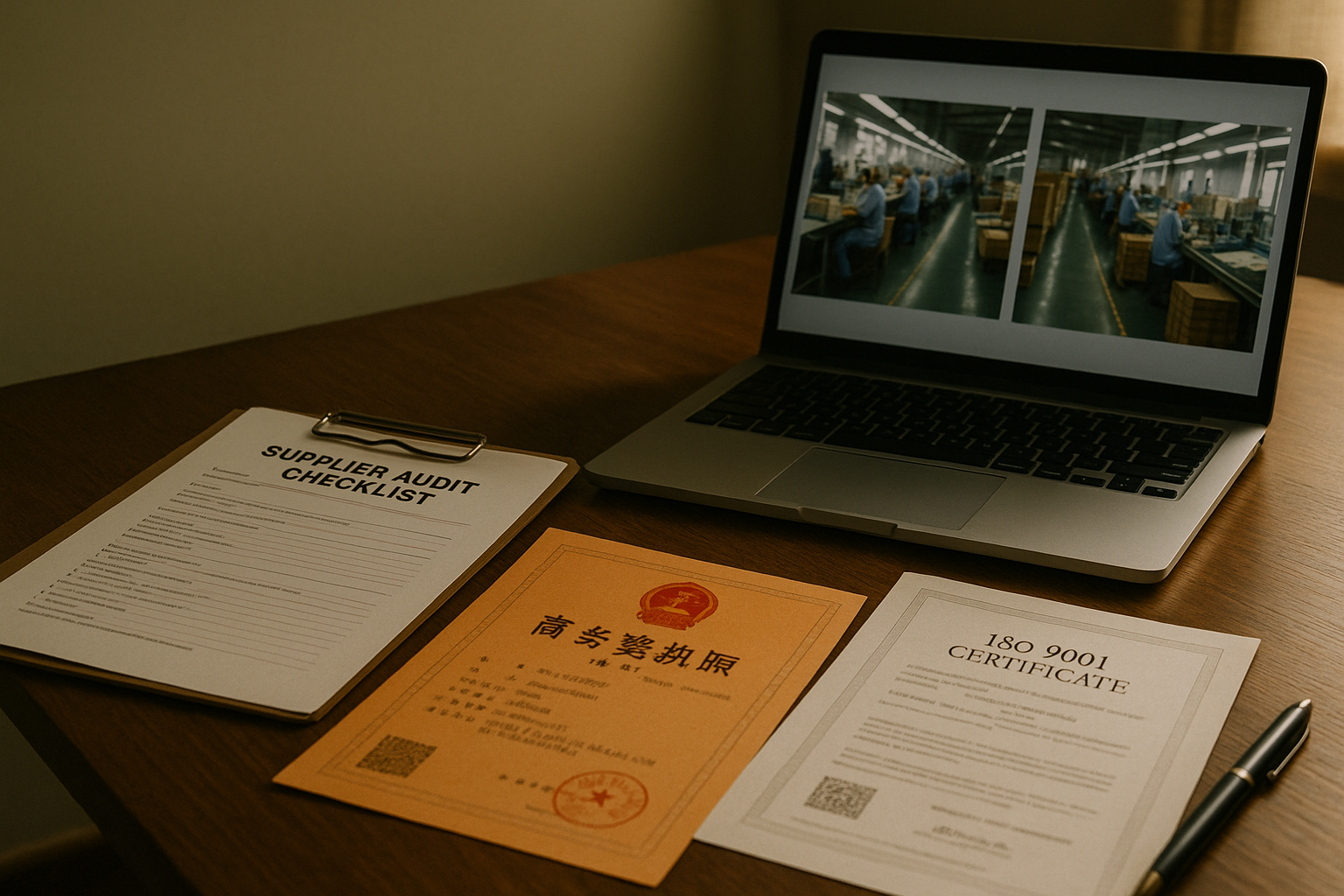
This checklist gives you a structured approach to supplier verification. It covers pre-audit document checks, on-site audit procedures, and post-audit actions. Whether you conduct the audit yourself or hire a third-party inspection company, these are the verification steps that matter. For a broader overview of the importing from China process, see our complete guide.
Legal Obligations: UKCA/CE Marking Responsibilities for Importers
Before you audit a factory, understand what you’re legally required to verify. The UK’s post-Brexit regulatory framework places compliance obligations squarely on the importer of record.
For products requiring UKCA marking (or CE marking during the transition period), you must ensure:
- The manufacturer has completed the appropriate conformity assessment procedure
- Technical documentation exists and is accessible for inspection by UK authorities
- The product meets relevant essential requirements (safety, electromagnetic compatibility, machinery directives, etc.)
- A UK Declaration of Conformity has been drawn up
- The UKCA mark has been affixed correctly to the product
HMRC can request this documentation at any point during the import process. If you cannot produce it, goods may be held at the border or refused entry entirely. The factory audit is your opportunity to verify that the manufacturer understands these requirements and has systems in place to support compliance.
For products not requiring UKCA/CE marking, the legal obligations are lighter but due diligence remains essential. BIFA’s Standard Trading Conditions 2021 include clauses on supplier verification and due diligence for members — reflecting industry best practice even where not legally mandated. Our customs broker vs freight forwarder guide explains how forwarders can support the verification process.
Pre-Audit Verification: Business Licence Checks and SAMR Records
Before booking flights or hiring an inspection company, conduct remote verification. Several red flags can be identified from your desk in Leicestershire without setting foot in a Chinese factory.
Business Licence Verification
Every legitimate Chinese manufacturer holds a business licence issued by the State Administration for Market Regulation (SAMR). Request a copy from your supplier and verify the following:
- Licence number format: Should be an 18-digit Unified Social Credit Code
- Company name: Must match exactly the name on invoices, contracts, and bank accounts
- Registered address: Should correspond to the factory address (or a legitimate headquarters location)
- Business scope: Must include manufacturing of your product category — a company licensed only for “trading” cannot legally manufacture
- Registration date: Older companies (5+ years) generally indicate stability; very recent registrations warrant extra scrutiny
- Legal representative: Should be a named individual, not “TBD” or blank
You can cross-check licence details against SAMR’s National Enterprise Credit Information Publicity System (gsxt.gov.cn). The interface is in Chinese, but browser translation tools work adequately for basic verification. Inconsistencies between the licence copy provided and SAMR records are a serious red flag.
Export History and References
Ask the supplier for:
- Names and contact details of three current UK or EU customers
- Copies of recent export declarations or customs documentation (with commercial details redacted)
- Evidence of previous shipments to the UK (bill of lading samples, packing lists)
A manufacturer genuinely experienced in UK exports will have these readily available. Reluctance to provide references — or references that only point to trading companies rather than end customers — suggests limited direct export experience.
Common Pre-Audit Red Flags
Watch for these warning signs before proceeding:
- Business licence information inconsistent across documents
- Factory address on licence differs from audit location with no explanation
- Refusal to allow third-party audits or inspections
- Inability to name any UK customers or provide shipment evidence
- Quoted prices significantly below market rates without clear justification
If multiple red flags appear, reconsider whether to proceed. The cost of an audit is small compared to the risk of a failed shipment.
Factory Audit Checklist: Five Core Areas
A comprehensive factory audit examines five distinct areas. Each should be covered systematically, with findings documented and scored.
1. Legal Compliance Verification
Confirm the factory operates legally and holds necessary permits:
- Business licence displayed on-site and matches pre-audit documentation
- Environmental permits for manufacturing processes (particularly for chemicals, metals, textiles)
- Fire safety certificates and inspection records
- Product-specific certifications (e.g., ISO 13485 for medical devices, IATF 16949 for automotive)
- Labour compliance documentation (employment contracts, working hour records)
Request to see original documents, not copies. Photographs for your records are acceptable, but verify that displayed certificates are current and not expired.
2. Production Capacity Assessment
Verify the factory can actually produce the quantities you’re ordering:
- Count production lines dedicated to your product category
- Observe current utilisation rates (running at 100% suggests no spare capacity for your orders)
- Review equipment maintenance logs — poorly maintained machinery indicates future downtime risk
- Check raw material inventory levels (low stock may indicate cash flow problems or unreliable supply)
- Assess warehouse capacity for finished goods storage
A useful metric: ask the factory manager to walk you through their production planning process. How far in advance do they schedule? How do they handle rush orders? The answers reveal operational maturity.
3. Quality Control Systems
This is often the most critical section for UK importers. Examine:
- Incoming quality control (IQC) procedures for raw materials
- In-process quality checks at each production stage
- Final random inspection (FRI) protocols before shipment
- Calibration records for testing equipment
- Non-conformance tracking and corrective action processes
Ask to see records of recent quality failures and how they were resolved. A factory with no recorded defects is either exceptionally good (rare) or not recording problems (concerning).
4. Financial Stability Indicators
You don’t need access to audited accounts to assess financial health:
- Payment terms offered (demanding 100% upfront may indicate cash flow stress)
- Staff turnover rates (high turnover suggests management or compensation issues)
- Investment in new equipment or facility improvements
- Consistency of raw material sourcing (frequent supplier changes may indicate payment problems)
Third-party credit reports from agencies like Sinosure or Dun & Bradstreet provide additional insight for high-value relationships.
5. Ethical and Social Compliance
UK retailers increasingly require evidence of ethical manufacturing. Even if not legally mandatory, these factors affect your brand reputation:
- Working hours compliance (maximum 60 hours per week under most ethical standards)
- Minimum wage verification (workers paid at or above local minimum wage)
- Health and safety provisions (protective equipment, emergency exits, first aid)
- Age verification systems (no child labour)
- Freedom of association (workers allowed to form or join unions)
Audit schemes like SMETA, BSCI, or SA8000 provide structured frameworks for social compliance assessment. A factory already certified to one of these standards has undergone independent verification.
Quality Systems Audit: ISO 9001 and QC Procedures
ISO 9001 certification is frequently cited by Chinese manufacturers as evidence of quality commitment. Understanding what it means — and what it doesn’t guarantee — helps you interpret its significance correctly.
What ISO 9001 Certifies
ISO 9001 is a quality management system standard. It certifies that the factory has:
- Documented quality procedures
- Management review processes
- Corrective action systems
- Customer complaint handling
- Continuous improvement mechanisms
It does not certify product quality directly. A factory can have excellent ISO 9001 documentation and still produce defective goods if procedures aren’t followed in practice. The Inspection Company notes that ISO 9001 certification demonstrates commitment to quality management systems but is not mandatory for most imports.
Verifying ISO 9001 Claims
If a supplier claims ISO 9001 certification:
- Request the certificate number and issuing body (should be UKAS-accredited or equivalent)
- Check expiry date — certificates are valid for three years with annual surveillance audits
- Verify against the certifier’s online registry (most maintain public databases)
- Ask to see the most recent surveillance audit report
Be wary of certificates from obscure certifiers with no online presence. Some factories display fraudulent or expired certificates.
Beyond ISO 9001
For specific product categories, additional certifications matter more:
- Medical devices: ISO 13485
- Automotive: IATF 16949
- Food safety: ISO 22000 or HACCP
- Electronics: ISO 14001 (environmental) plus product-specific safety marks
Match the certification to your product’s regulatory requirements, not the factory’s marketing claims.
Financial and Ethical Compliance: Payment Terms and Labour Standards
Payment Terms as Risk Indicators
Standard payment terms in China manufacturing range from 30% deposit / 70% before shipment to 30% deposit / 70% against copy of bill of lading. Terms outside this norm warrant scrutiny:
- 100% upfront: High risk. Only acceptable for very small orders or custom tooling
- Open account (payment after delivery): Rare for new relationships; indicates exceptional trust or buyer leverage
- Letter of credit: Common for large orders; adds bank intermediation but increases complexity
For first-time suppliers, consider using escrow services or trade assurance platforms that release payment only after inspection approval.
Subcontracting Risks
Many factories subcontract portions of production without disclosure. This creates quality and compliance risks:
- You’ve audited Factory A, but your goods are partly made at unvetted Factory B
- Subcontractors may not meet the same quality or ethical standards
- Traceability becomes impossible if problems arise
During the audit, ask directly: “Do you subcontract any processes?” If yes, request details and audit those facilities too. Include a no-subcontracting-without-approval clause in your supply contract.
Labour Standards Verification
Ethical compliance isn’t just about reputation — it affects supply continuity. Factories caught using forced labour or violating labour laws can be shut down without notice, leaving you without a supplier mid-production.
Verify:
- Employment contracts exist for all workers (request to see samples)
- Working hour records show compliance with legal limits
- Wage slips demonstrate minimum wage compliance
- Dormitory conditions (if workers live on-site) meet basic standards
Third-party social audits (SMETA, BSCI) provide independent verification if you lack resources for in-person assessment.
Post-Audit Actions: Scoring, Corrective Plans, and Monitoring
An audit without follow-up is wasted effort. Systematically process findings to drive improvement or make go/no-go decisions.
Scoring System
Use a simple scoring framework to compare suppliers objectively:
| Category | Weight | Score (1-5) | Weighted Score |
|---|---|---|---|
| Legal compliance | 25% | ||
| Production capacity | 20% | ||
| Quality systems | 25% | ||
| Financial stability | 15% | ||
| Ethical compliance | 15% | ||
| Total | 100% |
Scores: 5 = excellent (no issues), 4 = good (minor issues), 3 = acceptable (some corrective actions needed), 2 = poor (major issues), 1 = unacceptable (critical failures).
A total weighted score below 3.0 indicates the supplier is not ready for production without significant remediation.
Corrective Action Plans
For suppliers scoring 3.0-4.0, require a corrective action plan (CAP) addressing each finding:
- Specific action to be taken
- Responsible person
- Target completion date
- Evidence required to close the finding
Set a follow-up audit date (typically 60-90 days) to verify CAP completion. Do not place large orders until critical findings are resolved.
Ongoing Monitoring
Supplier performance degrades over time without oversight. Establish:
- Quarterly performance reviews (quality rejection rates, on-time delivery, communication responsiveness)
- Annual re-audits for critical suppliers
- Unannounced spot checks for high-risk categories
- Clear escalation procedures for quality failures
Document everything. A paper trail of audits, CAPs, and performance reviews protects you if disputes arise.
Using Third-Party Audit Services: When to Hire Professionals
Conducting audits yourself is possible but requires time, expertise, and Mandarin capability. Third-party inspection companies offer an alternative.
When to Hire Professionals
Engage a third-party auditor when:
- You lack in-house resources to travel to China
- The product category is highly regulated (medical, automotive, children’s toys)
- Order values justify the audit cost (generally £5,000+)
- You need independent verification for internal compliance or customer requirements
- Language barriers would limit your effectiveness
Typical Costs
Factory audit services in China typically cost:
- One-day audit: £400-£600
- Two-day audit: £700-£1,000
- Specialised technical audits (e.g., welding, electronics): £800-£1,200
Additional costs include travel expenses (if auditor travels from outside the factory’s region) and rush fees for reports required within 24 hours.
Choosing an Audit Company
Evaluate providers on:
- Industry specialisation (a textile auditor may not suit electronics)
- Auditor qualifications (engineering backgrounds, relevant certifications)
- Report quality (request sample reports before committing)
- Geographic coverage (auditors based near your factory reduce travel costs)
- Accreditation (ISO 17020 accreditation indicates recognised competence)
Reputable firms include SGS, Bureau Veritas, Intertek, and specialised independents like The Inspection Company. CN Business Forum’s 2026 supplier verification guide notes that typical factory audits in China cover 10 verification steps including business licence checks, SAMR records, factory capacity, quality control systems, and financial health.
DIY vs Professional: Decision Framework
| Factor | DIY Audit | Third-Party Audit |
|---|---|---|
| Cost | Travel + accommodation (£800-£1,500) | £400-£1,200 |
| Time commitment | 3-5 days (travel + audit) | 1-2 days (audit only) |
| Technical expertise | Your knowledge | Auditor’s specialisation |
| Language | Your capability or translator needed | Auditor typically bilingual |
| Objectivity | Your perspective | Independent assessment |
| Follow-up | Your responsibility | Often included in service |
For most UK SMEs importing under £50,000 annually, third-party audits offer better value. Larger importers may benefit from building in-house audit capability.
Key Takeaways
- UK importers carry legal responsibility under UKCA/CE regulations to verify manufacturer compliance before goods reach the UK border
- Pre-audit document verification (business licence, SAMR records, export history) identifies red flags before you invest in on-site audits
- A comprehensive factory audit examines five areas: legal compliance, production capacity, quality systems, financial stability, and ethical standards
- ISO 9001 certification indicates quality management systems but does not guarantee product quality — verify certificates against issuer registries
- Third-party audit services cost £400-£800 per day and reduce risk significantly for high-value or regulated product categories
- Post-audit corrective action plans and ongoing monitoring prevent performance degradation over time
Frequently Asked Questions
Is ISO 9001 certification mandatory for importing from China to the UK?
No. ISO 9001 is not legally required for most product categories. It demonstrates that a factory has documented quality management systems, but UK import regulations focus on product-specific compliance (UKCA/CE marking, safety standards) rather than management system certifications. Some retailers or B2B customers may require ISO 9001 as part of their supplier qualification, but it’s not a legal import requirement.
How often should I audit my China suppliers?
For critical suppliers (high volume, regulated products, single-source), annual audits are recommended. For lower-risk suppliers, audits every 2-3 years may suffice, supplemented by quarterly performance reviews and pre-shipment inspections. Increase audit frequency if you observe quality degradation, delivery delays, or if the supplier undergoes ownership changes.
What happens if a factory refuses my audit request?
Treat refusal as a serious red flag. Legitimate manufacturers with nothing to hide welcome audits — it demonstrates confidence in their operations. If a supplier refuses, either insist (making audit access a contract condition) or seek alternative suppliers. There are enough capable manufacturers in China that you need not work with opaque ones.
Can I rely on Alibaba’s supplier verification badges?
No. Alibaba’s verification (Gold Supplier, Assessed Supplier, Trade Assurance) indicates the company has paid for membership and provided basic business documentation. It does not substitute for an independent factory audit. Many verified Alibaba suppliers have failed third-party audits due to quality or compliance issues. Use Alibaba as a sourcing starting point, not a verification endpoint.
What’s the difference between a factory audit and a pre-shipment inspection?
A factory audit evaluates the manufacturer’s systems, capacity, and compliance capabilities — it’s about whether they can produce quality goods consistently. A pre-shipment inspection checks a specific production batch before shipping — it’s about whether this shipment meets your specifications. You need both: audits for supplier qualification, inspections for ongoing quality control.
Do I need to audit trading companies differently than manufacturers?
Yes. Trading companies don’t manufacture, so factory audits assess their supplier management systems instead. Verify: their supplier qualification process, quality control procedures before consolidation, ability to trace products back to original manufacturers, and financial stability. Trading companies add a layer of separation between you and production — ensure they add value (consolidation, quality control, logistics) rather than just markup.