Key Takeaways
- The Carriage of Dangerous Goods and Use of Transportable Pressure Equipment Regulations 2004 (CDG Regulations) is the UK legislation governing dangerous goods transport, implementing ADR for road and IMDG for sea freight.
- IMDG Code Amendment 42-24 entered transitional effect on 1 January 2025 and becomes mandatory from 1 January 2026 — shippers must update documentation, training and packaging procedures.
- All dangerous goods shipments require a Dangerous Goods Note with UN number, hazard class, packing group, and proper shipping name — incomplete documentation risks unlimited fines and up to 2 years imprisonment.
- Most businesses handling dangerous goods must appoint a certified Dangerous Goods Safety Advisor (DGSA) unless operating under Limited Quantities or Excepted Quantities exemptions.
- Staff involved in dangerous goods handling require role-specific training refreshed at least every 2 years; training records must be kept and produced on request.
- Many UK operators subcontract dangerous goods carriage to specialist ADR-licensed carriers rather than maintaining in-house capability.
What Counts as Dangerous Goods?
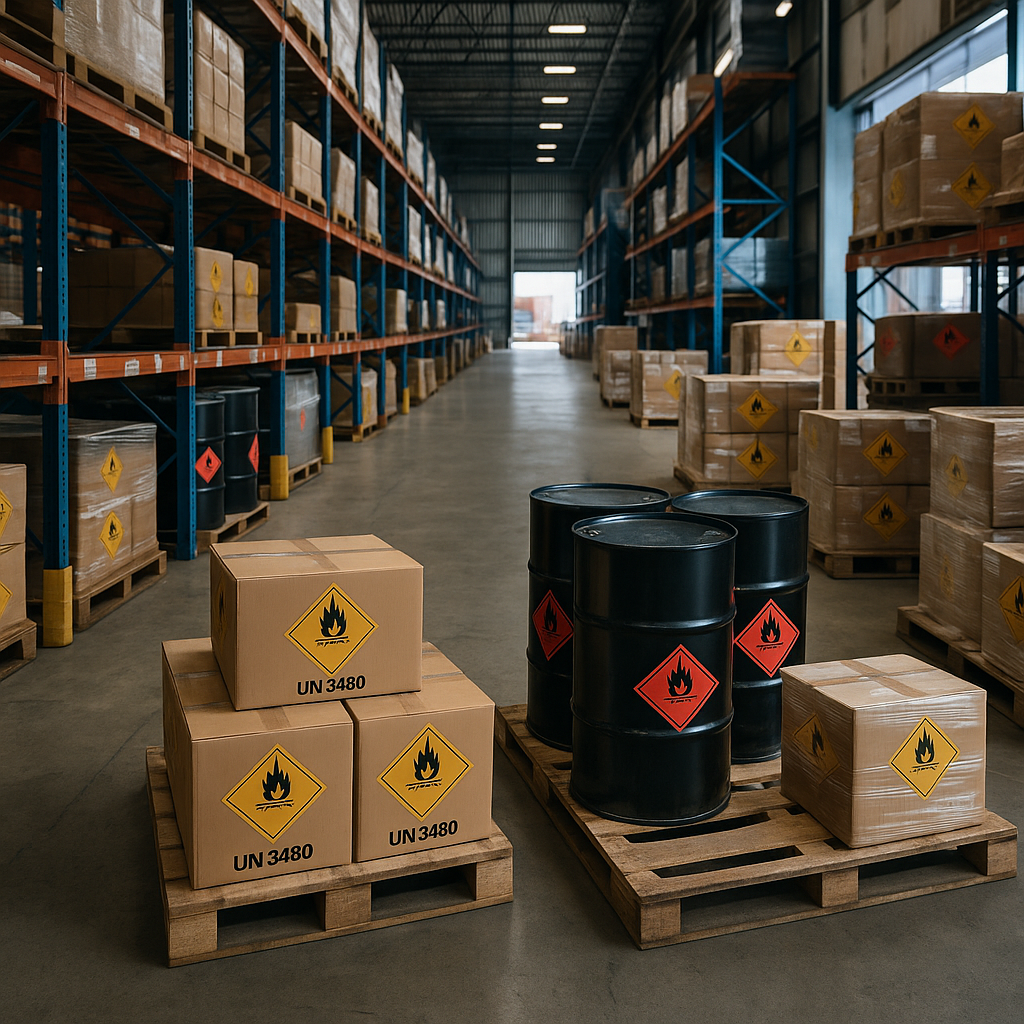
Dangerous goods — also called hazardous materials or hazmat — are substances or articles that pose a risk to health, safety, property or the environment during transport. The classification system divides dangerous goods into nine hazard classes, each with specific packaging, labelling and documentation requirements.
The nine ADR/IMDG hazard classes:
| Class | Description | Examples |
|---|---|---|
| Class 1 | Explosives | Ammunition, fireworks, detonators |
| Class 2 | Gases (flammable, non-flammable, toxic) | Propane, oxygen, chlorine |
| Class 3 | Flammable liquids | Petrol, ethanol, acetone, paints |
| Class 4 | Flammable solids, spontaneously combustible, dangerous when wet | Matches, phosphorus, sodium |
| Class 5 | Oxidising substances and organic peroxides | Hydrogen peroxide, ammonium nitrate |
| Class 6 | Toxic and infectious substances | Cyanides, pesticides, clinical waste |
| Class 7 | Radioactive material | Medical isotopes, uranium |
| Class 8 | Corrosives | Sulphuric acid, sodium hydroxide, batteries |
| Class 9 | Miscellaneous dangerous substances | Lithium batteries, asbestos, environmentally hazardous substances |
Each class may be further subdivided into divisions or packing groups (I, II or III) indicating the degree of danger — Packing Group I represents high danger, Packing Group III represents low danger. The UN number (a four-digit identifier) and proper shipping name must appear on all documentation and packaging.
For logistics operators, Class 3 (flammable liquids), Class 8 (corrosives) and Class 9 (which includes lithium batteries) are the most commonly encountered in general freight operations. Lithium batteries alone account for a significant portion of dangerous goods incidents in air and sea freight, according to HSE incident data.
UK Legal Framework: CDG Regulations, ADR and IMDG
The legal framework for dangerous goods transport in the UK rests on three pillars: domestic legislation, international road transport agreements, and international maritime codes.
Carriage of Dangerous Goods and Use of Transportable Pressure Equipment Regulations 2004 (CDG Regulations) is the primary UK legislation, as amended in 2005 and subsequently. The CDG Regulations implement international agreements into domestic law and set out offences, penalties and enforcement powers. The Health and Safety Executive (HSE) is the enforcing authority for most aspects of dangerous goods carriage within Great Britain.
ADR (European Agreement Concerning the International Carriage of Dangerous Goods by Road) is an international agreement governing road transport of dangerous goods across Europe and beyond. ADR covers vehicle requirements, driver training, packaging standards, labelling, placarding and documentation. Although the UK has left the EU, it remains a contracting party to ADR, and ADR requirements continue to apply to international and domestic road transport of dangerous goods in the UK.
IMDG Code (International Maritime Dangerous Goods Code) provides the global standard for safe sea transport of dangerous goods. Published by the International Maritime Organization (IMO), the IMDG Code is updated every two years. Amendment 42-24 entered transitional effect on 1 January 2025 and becomes mandatory from 1 January 2026, according to industry guidance from Hibiscus Plc and Gateway Cargo.
The relationship between these instruments matters for compliance: the CDG Regulations give domestic legal effect to ADR and IMDG requirements. A breach of ADR or IMDG provisions is therefore a breach of the CDG Regulations, carrying criminal penalties. For businesses importing dangerous goods, this compliance framework sits alongside standard customs procedures — see our customs clearance step-by-step guide for the full import process.
For businesses shipping dangerous goods, this means you must comply with all three layers: the international code (ADR or IMDG depending on mode), as implemented by UK domestic law (CDG Regulations), as enforced by HSE and other authorities.
IMDG Code 2026: What Changed in Amendment 42-24
IMDG Code Amendment 42-24 introduces several changes that affect shippers, freight forwarders and carriers. The amendment entered transitional effect on 1 January 2025, meaning shippers could use either the old or new provisions during 2025. From 1 January 2026, Amendment 42-24 becomes mandatory — the previous version (Amendment 41-22) can no longer be used.
Key changes in Amendment 42-24:
- Lithium battery provisions updated: New testing requirements and packaging specifications for lithium batteries, reflecting evolving safety data. Shippers must ensure battery testing summaries meet the updated UN Manual of Tests and Criteria requirements.
- Expanded excepted quantities provisions: Some substances previously excluded from excepted quantities can now be shipped under simplified requirements, reducing administrative burden for low-risk materials.
- Updated proper shipping names: Several substances have revised proper shipping names or UN numbers. Shippers must verify classification against the updated IMDG Code Dangerous Goods List.
- Enhanced segregation requirements: New segregation rules for certain class combinations, particularly affecting container stuffing and vessel stowage planning.
- Emergency response procedures revised: Updated EmS Guide references and emergency contact requirements for dangerous goods incidents at sea.
For UK shippers, the practical implication is straightforward: if you ship dangerous goods by sea after 1 January 2026, your documentation, training, packaging and labelling must all comply with Amendment 42-24. This includes Dangerous Goods Declarations, container packing certificates, and staff training records.
Freight forwarders booking dangerous goods shipments should expect carriers to reject documentation that references the old amendment after the mandatory date. The transition period is now closed.
ADR Requirements for Road Transport
ADR governs the road transport of dangerous goods across Europe, including domestic movements within the UK. The agreement sets out comprehensive requirements covering vehicles, equipment, documentation, training and operational procedures.
Vehicle requirements: Vehicles carrying dangerous goods must meet specific construction and equipment standards. This includes fire extinguishers, wheel chocks, warning panels, and — for certain classes — specialist equipment such as spill containment or ventilation systems. Vehicles must display orange reflective placards at front and rear showing the hazard identification number (Kemler code) and UN number.
Driver training: ADR requires drivers of vehicles carrying dangerous goods to hold a valid ADR training certificate. Basic training covers general awareness, while specialist training is required for tankers, explosives, radioactive materials and other high-risk categories. ADR certificates are valid for five years; drivers must complete refresher training before expiry to maintain validity.
Documentation: Every dangerous goods consignment requires a transport document (often called a Dangerous Goods Note or ADR Note) containing:
- UN number and proper shipping name
- Hazard class and packing group
- Quantity and number of packages
- Consignor and consignee details
- Any special provisions or tunnel restrictions
The driver must carry this documentation in the cab, readily accessible for inspection.
Operational restrictions: ADR imposes tunnel restrictions for certain dangerous goods, indicated by tunnel codes on the transport document. Drivers must know which tunnels are prohibited for their load and plan routes accordingly. Parking restrictions also apply — vehicles carrying certain dangerous goods cannot park in public areas without authorisation.
Many UK logistics operators do not hold ADR licences or maintain ADR-compliant fleets. Instead, they subcontract dangerous goods movements to specialist carriers. This is a valid compliance strategy, provided the subcontractor holds appropriate licences and the consignor fulfils its duty to verify carrier competence, per HSE guidance on regulatory environment.
Documentation: Dangerous Goods Note, UN Numbers and Classification
Proper documentation is the single most common compliance failure in dangerous goods shipments. Incomplete or incorrect documentation risks delays, rejection by carriers, and enforcement action.
The Dangerous Goods Note (also called a Dangerous Goods Declaration or transport document) must contain specific information in a prescribed sequence:
- UN number — four-digit identifier prefixed by “UN” (e.g., UN 1203)
- Proper shipping name — the technical name from the Dangerous Goods List (e.g., “Petrol” or “Gasoline”)
- Hazard class — primary class and any subsidiary risks (e.g., “Class 3, 6.1”)
- Packing group — I, II or III in Roman numerals (e.g., “PG II”)
- Quantity — net and/or gross mass, volume, or number of articles
- Special provisions — any applicable codes from the Dangerous Goods List
- Consignor and consignee — full names and addresses
- Additional information — flash point for Class 3, marine pollutant status if applicable, tunnel restriction codes for ADR
The declaration must be signed by the consignor or an authorised representative, confirming that the goods are properly classified, packaged, marked and labelled, and in all respects fit for transport.
Classification responsibility: The consignor (shipper) is legally responsible for correct classification. This means determining the UN number, hazard class, packing group and proper shipping name before offering goods for transport. Misclassification — even if unintentional — is a breach of the CDG Regulations. Classification shares similar precision requirements with commodity code classification for customs purposes — both require technical knowledge and carry penalties for errors. For guidance on getting commodity codes right, see our commodity code classification tips.
For complex substances or mixtures, classification may require testing or expert assessment. Safety data sheets (SDS) provide useful information but are not sufficient on their own for transport classification — the SDS Section 14 contains transport information, but the consignor must verify it against current ADR/IMDG provisions.
Common documentation errors:
- Missing or incorrect UN number
- Omitting packing group
- Using trade names instead of proper shipping names
- Failing to declare subsidiary risks
- Incorrect quantity units or totals
- Missing signature or date
Carriers and freight forwarders routinely reject shipments with documentation errors. According to Freightlink’s booking guidance, many UK operators require pre-approval for dangerous goods shipments and will not accept bookings without complete documentation.
Packaging, Labelling and Placarding
Packaging for dangerous goods must meet performance standards verified through testing. Approved packaging bears a UN marking showing the packaging type, material, performance level, and test certification details.
UN packaging marks follow a standard format: for example, “1A1/Y1.8/250/23/GB/ABC123” indicates a steel drum (1A1), tested for Packing Groups II and III (Y), specific gravity 1.8, hydraulic pressure test 250 kPa, manufactured in 2023, certified in Great Britain, by manufacturer ABC123.
Packaging must be:
- Compatible with the substance (no chemical reaction or degradation)
- In good condition (no rust, dents, or previous leakage)
- Properly closed and secured
- Appropriate for the packing group and transport mode
Packaging requirements for dangerous goods are separate from Incoterms obligations, but the two interact — under Incoterms rules, risk transfer points determine who bears responsibility for packaging integrity during different legs of the journey. For a visual guide to risk transfer under different Incoterms, see our Incoterms 2020 guide.
Labelling requirements: Each package must display hazard labels corresponding to the primary hazard class and any subsidiary risks. Labels are diamond-shaped, colour-coded by class, and must be at least 100mm x 100mm (smaller for very small packages). Labels must be durable, weather-resistant, and clearly visible.
Placarding for vehicles and containers: Vehicles and freight containers carrying dangerous goods must display placards on all four sides. Placards are larger versions of hazard labels (at least 250mm x 250mm) and must remain visible when doors are closed. For ADR road transport, orange reflective panels showing the hazard identification number and UN number must be displayed at front and rear of the vehicle.
Limited Quantities and Excepted Quantities: Small quantities of certain dangerous goods qualify for exemptions from full packaging, labelling and documentation requirements. Limited Quantities (LQ) provisions allow simplified packaging and labelling (LQ mark only, no hazard labels). Excepted Quantities (EQ) provisions are more restrictive but allow even simpler compliance — in many cases, no dangerous goods documentation is required.
The LQ and EQ thresholds vary by substance and packing group. For example, Class 3 Packing Group II substances can ship as Limited Quantities in inner packagings up to 1 litre or 1 kg per package, with a maximum net quantity of 30 kg per outer package. Shippers should verify thresholds against the current ADR/IMDG Dangerous Goods List before relying on exemptions.
Training Requirements and the DGSA Role
The CDG Regulations require that all persons involved in the carriage of dangerous goods receive training appropriate to their responsibilities. This is not optional — it is a legal requirement with criminal penalties for non-compliance.
Who needs training: Training is required for anyone whose work involves dangerous goods, including:
- Consignors preparing shipments
- Packagers and labellers
- Loaders and unloaders
- Drivers (separate ADR training requirement)
- Freight forwarders and booking staff
- Warehouse supervisors and safety officers
Training content: Training must cover:
- General awareness of dangerous goods regulations
- Recognition and classification of dangerous goods
- Packaging, marking and labelling requirements
- Documentation requirements
- Emergency response procedures
- Security awareness (for certain classes)
Training must be role-specific — a warehouse loader needs different training than a documentation clerk. Training records must be kept and produced on request by enforcement officers.
Refresher training: The CDG Regulations require refresher training at least every 2 years, or when regulations change significantly. Many employers opt for annual refresher training to ensure staff remain current with regulatory updates.
Dangerous Goods Safety Advisor (DGSA): Most businesses that consign, load, unload or carry dangerous goods must appoint at least one certified DGSA. The DGSA’s role is to monitor compliance, advise on regulatory requirements, investigate incidents, and prepare annual reports to senior management.
DGSA certification is obtained through examination administered by recognised bodies such as the Royal Society for the Prevention of Accidents (RoSPA) or the Institute of Occupational Safety and Health (IOSH). A single DGSA can serve multiple businesses, and many companies outsource DGSA services rather than employing one in-house.
Exemptions from DGSA requirement: You do not need a DGSA if:
- Your activities are limited to occasional domestic transport of small quantities
- You only handle dangerous goods under Limited Quantities or Excepted Quantities provisions
- Your core business is not the transport of dangerous goods and quantities handled are minimal
However, even if exempt from appointing a DGSA, you remain responsible for compliance with all other CDG Regulations requirements.
Penalties and Enforcement
Non-compliance with dangerous goods regulations carries serious penalties. The CDG Regulations are criminal legislation — breaches can result in prosecution, unlimited fines, and imprisonment.
Enforcement authorities: In Great Britain, the Health and Safety Executive (HSE) is the primary enforcing authority for dangerous goods carriage. Other enforcing bodies include:
- Driver and Vehicle Standards Agency (DVSA) for vehicle and driver compliance
- Maritime and Coastguard Agency (MCA) for sea freight
- Civil Aviation Authority (CAA) for air freight
- Local authorities for certain retail and storage activities
Penalties: On conviction, offences under the CDG Regulations can result in:
- Unlimited fines (no statutory maximum)
- Imprisonment for up to 2 years
- Disqualification from holding a transport licence
- Seizure of vehicles and goods
In practice, HSE pursues a graduated enforcement approach — advice and warnings for minor, first-time breaches; improvement notices for systemic issues; and prosecution for serious or repeated non-compliance, particularly where there is risk of injury or environmental harm.
Incident reporting: Any incident involving dangerous goods — including spills, leaks, fires, or exposures — must be reported to the relevant enforcing authority. The DGSA is typically responsible for preparing incident reports and ensuring they are submitted within required timeframes.
Insurance implications: Beyond regulatory penalties, non-compliance can invalidate insurance cover. Insurers may refuse claims arising from incidents where dangerous goods were improperly classified, packaged, or documented. This can leave businesses personally liable for cleanup costs, third-party damages, and business interruption losses running to hundreds of thousands of pounds.
How to Book Dangerous Goods Shipments
Booking dangerous goods shipments requires advance planning and complete documentation. Most carriers and freight forwarders have specific procedures for hazardous cargo.
Pre-booking checklist:
- Confirm classification (UN number, class, packing group, proper shipping name)
- Verify packaging meets UN performance standards and is correctly marked
- Prepare complete Dangerous Goods Declaration
- Ensure staff involved are trained and records are current
- Confirm DGSA oversight (if required)
- Check carrier-specific requirements and cut-off times
Carrier requirements: Many carriers require dangerous goods bookings to be submitted 48-72 hours in advance. Some require pre-approval before accepting any hazardous cargo. According to Freightlink’s guidance, carriers typically require:
- Copy of Dangerous Goods Declaration before booking confirmation
- Confirmation of packaging compliance
- Emergency contact details
- Any special handling instructions
Subcontracting option: If you do not have in-house ADR capability, consider subcontracting to a specialist dangerous goods carrier. This is common practice — many UK logistics operators maintain relationships with ADR-licensed subcontractors rather than investing in compliant vehicles, equipment and driver training.
The consignor remains responsible for correct classification and documentation even when using a subcontractor. You cannot delegate your legal duty to ensure goods are properly classified and declared.
Cost implications: Dangerous goods shipments typically incur surcharges for handling, documentation, and specialist equipment. Sea freight may require dedicated stowage positions; road freight may require dedicated vehicles. Factor these costs into your pricing and lead time estimates.
Frequently Asked Questions
Do I need a DGSA for my business? Most businesses that handle dangerous goods in any significant quantity must appoint a certified Dangerous Goods Safety Advisor. Exemptions apply if you only handle Limited Quantities, Excepted Quantities, or occasional small domestic shipments. If your core business involves regular dangerous goods movements, you almost certainly need a DGSA.
What happens if my Dangerous Goods Declaration has an error? Carriers routinely reject shipments with incomplete or incorrect documentation. At minimum, expect delays while you correct the declaration. In serious cases — particularly misclassification or undeclared dangerous goods — you risk enforcement action, fines, and potential criminal prosecution under the CDG Regulations.
Can I ship dangerous goods under Limited Quantities without training? No. While Limited Quantities shipments are exempt from some packaging and documentation requirements, staff involved in preparing, handling or transporting them still require appropriate training under the CDG Regulations. The training can be less extensive than for full dangerous goods, but it cannot be omitted.
How often does ADR training need to be refreshed? ADR driver training certificates are valid for five years. Drivers must complete refresher training before expiry to maintain validity. For other staff under CDG Regulations training requirements, refresher training is required at least every 2 years, or when regulations change significantly.
What is the difference between ADR and the CDG Regulations? ADR is an international agreement governing road transport of dangerous goods across Europe. The CDG Regulations are UK domestic legislation that implements ADR (and IMDG) requirements into British law. A breach of ADR is a breach of the CDG Regulations — they work together, not separately.
Are lithium batteries always dangerous goods? Most lithium batteries are classified as Class 9 dangerous goods (UN 3480 for standalone batteries, UN 3481 for batteries packed with equipment). However, small lithium batteries installed in consumer electronics may qualify for exemptions under Special Provision 188. Always verify classification against the current ADR/IMDG Dangerous Goods List before shipping.