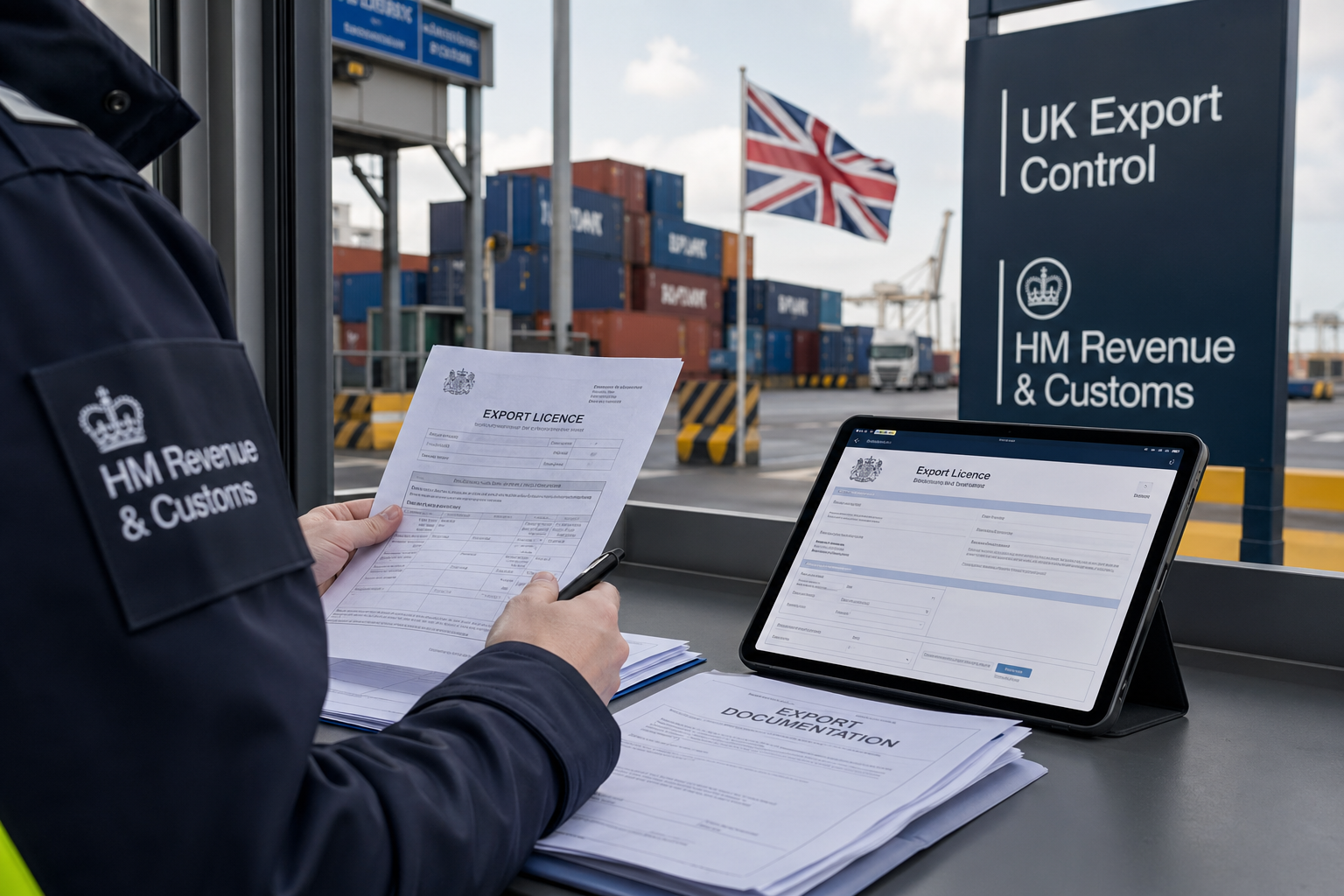
Dual-use goods sit at the intersection of commerce and national security. These items — which can serve both civilian and military purposes — are subject to strict export controls in the UK. Getting it wrong carries serious consequences: fines, criminal prosecution, and imprisonment of up to 10 years.
This guide explains what dual-use goods are, how to determine if your products are controlled, the licence types available, and what changed in 2025. Whether you’re exporting electronics, chemicals, or aerospace components, understanding these requirements is essential for compliant international trade. For a broader overview of export procedures, see our guide to exporting from the UK.
What Are Dual-Use Goods?
Dual-use items are goods, software, and technology that can be used for both civilian and military applications. A high-performance computer might power a research laboratory or guide a missile system. Certain chemicals could manufacture pharmaceuticals or chemical weapons. This dual potential is why exports are controlled.
The UK control list is organised into 10 categories (numbered 0–9), each subdivided into five groups (A–E):
| Category | Description |
|---|---|
| 0 | Nuclear materials, facilities, and equipment |
| 1 | Materials, chemicals, micro-organisms, and toxins |
| 2 | Materials processing (electronics manufacturing, etc.) |
| 3 | Electronics |
| 4 | Computers |
| 5 | Telecommunications and information security |
| 6 | Sensors and lasers |
| 7 | Navigation and avionics |
| 8 | Marine |
| 9 | Aerospace and propulsion |
Each category’s subdivisions are:
- A: Systems, equipment, and components
- B: Test, inspection, and production equipment
- C: Materials
- D: Software
- E: Technology (technical data, know-how)
Examples of controlled dual-use items:
- Encryption software (Category 5)
- High-performance computing systems (Category 4)
- Certain drones and unmanned aerial vehicles (Category 9)
- Precision machine tools for semiconductor manufacturing (Category 2)
- Specific chemicals usable in chemical weapons production (Category 1)
For Great Britain, controls are set out in the Assimilated Council Regulation (EC) 428/2009. Northern Ireland follows Regulation (EU) 2021/821 under the Windsor Framework — a critical distinction for NI-based exporters.
How to Check If Your Goods Are Controlled
Before exporting, you must determine whether your items fall under export control. Three official tools help:
1. UK Strategic Export Control Lists
The UK Strategic Export Control Lists provide the definitive reference. These lists detail every controlled item by category and code. If your product matches a listed entry, it requires a licence unless an OGEL applies.
2. OGEL Checker Tool
The OGEL Checker helps determine whether your export qualifies for an Open General Export Licence. OGELs allow exports without individual licence applications if you meet pre-published conditions. The checker asks about your item, destination, and end-use to confirm eligibility.
3. Control List Classification Service
If you’re uncertain whether your goods are controlled, use the SPIRE classification service. Submit technical specifications to the Export Control Joint Unit (ECJU), who will issue a classification decision. This is particularly valuable for new or complex products.
Important: Even if your goods aren’t on the control list, catch-all controls may apply. If you know or suspect items will be used for military purposes, weapons of mass destruction (WMD), or cyber-surveillance, a licence is still required.
UK Export Licence Types Explained
Three licence types cover most dual-use export scenarios:
Standard Individual Export Licence (SIEL)
A SIEL is the most common licence type. It authorises:
- Specific quantity of goods
- Specific goods (by model, specification)
- Named consignee and end-user
When to use: One-off exports, new trading relationships, or when OGEL/OIEL conditions aren’t met.
Processing time: Typically 20 working days, though complex cases take longer.
Validity: Usually two years from issue.
Open Individual Export Licence (OIEL)
An OIEL is tailored to your business needs, allowing:
- Multiple shipments over time
- Specified goods (can cover product ranges)
- Specified destinations (can list multiple countries)
When to use: Regular exports of similar goods to known customers. More flexible than SIEL but requires individual application.
Processing time: Around 60 working days for initial application.
Validity: Up to five years, with annual reviews.
Open General Export Licence (OGEL)
OGELs are pre-published licences available to all exporters who meet stated conditions. Key OGELs include:
- Dual-use OGEL: Exports from GB to EU member states
- Military OGEL: Certain military goods to specified destinations
- Trade OGEL: Brokering and technical assistance activities
When to use: When your export meets all OGEL conditions (destination, item, end-use). No application needed — just register and comply.
Critical: You must register with ECJU before using an OGEL and keep records of all exports. If conditions aren’t met, the OGEL doesn’t apply and you need a SIEL or OIEL.
The Application Process
All licence applications go through SPIRE, the UK’s online export licensing system managed by the Export Control Joint Unit (ECJU), part of the Department for Business and Trade. Once you have your licence, you’ll need to make customs declarations — see our CDS guide for details on completing export declarations.
Step-by-Step Process
- Create a SPIRE account — Company registration required
- Determine licence type — SIEL, OIEL, or OGEL registration
- Prepare documentation:
- Technical specifications of goods
- End-user details and contact information
- End-user undertaking (for SIELs to certain destinations)
- Contract or proforma invoice
- Submit application — Complete all SPIRE fields accurately
- ECJU review — Inter-departmental consultation may occur (MoD, FCO, etc.)
- Decision — Licence granted, refused, or revoked
End-User Undertakings
For many SIEL applications, especially to higher-risk destinations, ECJU requires an end-user undertaking (EUU). This is a formal commitment from the importer stating:
- What the goods will be used for
- That they won’t be re-exported without UK approval
- That they won’t be used for WMD programmes
EUUs must be on company letterhead, signed by a senior officer, and match the application details exactly.
Processing Times
- OGEL registration: Immediate upon completion
- SIEL: 20 working days (standard), though 60+ days for complex cases
- OIEL: 60 working days initial, 30 days for variations
Plan accordingly — rushing isn’t an option. Exporting without a required licence is a criminal offence regardless of whether you’ve applied.
Catch-All Controls and End-Use Restrictions
Even if your goods aren’t on the control list, you may still need a licence under catch-all controls.
Military End-Use Controls (Article 12A)
Under the Export Control Order 2008 (as amended), a licence is required if:
- You know or have been informed by the UK government that goods may be intended for military use in an arms embargo destination
- The goods could be used as parts or components of military items exported without authorisation
This applies to any goods, not just listed dual-use items.
WMD End-Use Controls
Separate controls cover items that could be used for chemical, biological, or nuclear weapons programmes. A licence is required if you know or suspect goods will be used for WMD purposes, regardless of whether items are controlled.
Cyber-Surveillance Controls
Since 2021, specific controls cover cyber-surveillance technology — items used for digital surveillance of individuals. These require licences even for non-listed items if there’s risk of internal repression or human rights violations.
Due diligence is critical. Exporters are expected to screen customers, verify end-use, and report suspicious inquiries to ECJU. Ignorance is not a defence.
2025–2026 Regulatory Changes
The UK updated its dual-use control list effective 16 December 2025 through the Export Control (Amendment) (No. 2) Regulations 2025 (SI 2025/1197). Key changes:
500 Series Entries
Previous national controls on sensitive emerging technologies (PL9013, PL9014, PL9015) were deleted and replaced with new “500 series” entries in the Retained Dual-Use Regulation. These cover:
- Advanced computing integrated circuits — High-performance chips for AI and data centres
- Semiconductor manufacturing equipment — Tools for producing advanced nodes
- Special materials — Compounds for electronics and aerospace applications
- Quantum technology — Quantum computing and sensing equipment
- Additive manufacturing — Certain 3D printing systems and software
- Peptide synthesisers — Equipment with potential dual-use applications
EU Alignment
The changes align UK controls with EU Dual-Use Regulation updates (Delegated Regulation (EU) 2025/2003) from November 2025. This maintains regulatory coherence post-Brexit, reducing compliance burden for exporters serving both markets.
What Exporters Must Do
- Review product classifications — Items previously under PL9013/9014/9015 may now fall under 500 series entries
- Update internal compliance procedures — Ensure screening covers new controlled categories
- Check OGEL eligibility — Some previously OGEL-eligible exports may now require individual licences
Northern Ireland and the Windsor Framework
Northern Ireland follows EU dual-use rules under the Windsor Framework. This creates distinct requirements:
| Scenario | Licence Required? |
|---|---|
| Export from GB to EU | Yes — use Dual-use OGEL or SIEL |
| Export from GB to non-EU | Yes — standard UK rules apply |
| Export from NI to EU | No — free movement within EU single market |
| Export from NI to non-EU | Yes — EU dual-use rules apply |
| Export from EU to NI | No — free movement within EU single market |
Practical implications:
- NI-based exporters shipping to EU customers face no licensing requirements for dual-use goods
- GB-based exporters shipping to NI are making intra-UK movements but must comply with EU rules for onward export
- Companies operating in both GB and NI need separate compliance procedures
The ECJU guidance provides detailed scenarios. When in doubt, seek classification advice.
Penalties for Non-Compliance
Exporting controlled items without the correct licence is a criminal offence under the Export Control Act 2002. Penalties include:
- Unlimited fines — Based on severity and harm
- Imprisonment — Up to 10 years for serious offences
- Confiscation of goods — Items seized at border
- Debarment — Loss of export privileges
- Reputational damage — Public prosecution records
Recent enforcement cases demonstrate HMRC and ECJU take violations seriously. In 2024, a UK technology firm was prosecuted for exporting encryption software without a licence to a sanctioned end-user — resulting in a £2.3 million fine and director disqualification. Note that export controls work alongside import controls — certain goods also require import licences. Read our import licensing guide for requirements on controlled imports.
Compliance isn’t optional. It’s a legal requirement with personal liability for directors and compliance officers.
Key Takeaways
- Dual-use goods span 10 categories (0–9) covering nuclear materials, electronics, chemicals, aerospace, and more
- Three licence types exist: SIEL (specific exports), OIEL (multiple shipments), OGEL (pre-published conditions)
- Always check the UK Strategic Export Control Lists and use the OGEL Checker before exporting
- Catch-all controls apply even to non-listed items if you know or suspect military/WMD end-use
- 2025 changes introduced 500 series entries for emerging technologies (quantum, advanced computing, semiconductors)
- Northern Ireland follows EU rules under the Windsor Framework — different from GB
- Penalties include unlimited fines and up to 10 years imprisonment — compliance is essential
FAQ
Q: How do I know if my product is dual-use controlled?
A: Check the UK Strategic Export Control Lists first. If uncertain, use the OGEL Checker Tool or apply for a classification through SPIRE. When in doubt, assume controlled until confirmed otherwise.
Q: Can I export to the EU without a licence?
A: From Great Britain, yes — if you register for and comply with the Dual-use OGEL conditions. From Northern Ireland to the EU, no licence is needed due to free movement within the EU single market.
Q: What’s the difference between SIEL and OIEL?
A: A SIEL covers specific goods, quantity, and consignee for one-off exports. An OIEL is tailored to your business, allowing multiple shipments of specified goods to specified destinations over up to five years.
Q: How long does a licence application take?
A: SIELs typically take 20 working days, OIELs around 60 working days initially. Complex cases involving inter-departmental consultation can take longer. Plan ahead — exporting without a required licence is a criminal offence.
Q: Do catch-all controls apply to non-listed items?
A: Yes. If you know or suspect goods will be used for military purposes, WMD programmes, or cyber-surveillance in violation of human rights, a licence is required regardless of whether items appear on the control list.
Q: What changed in December 2025?
A: The Export Control (Amendment) (No. 2) Regulations 2025 replaced PL9013/9014/9015 national controls with new 500 series entries covering advanced computing, semiconductor equipment, quantum technology, and additive manufacturing systems.
Sources:
- GOV.UK: Export controls: dual-use items, software and technology — gov.uk/guidance/export-controls-dual-use-items-software-and-technology-goods-for-tortune-and-radioactive-sources
- The Dual-Use Items (Export Control) Regulations 2000 — legislation.gov.uk/uksi/2000/2620
- Export Control (Amendment) (No. 2) Regulations 2025 (SI 2025/1197) — legislation.gov.uk
- UK Strategic Export Control Lists — gov.uk/government/publications/uk-strategic-export-control-lists
- ECJU SPIRE guidance — spire.trade.gov.uk