Key Takeaways
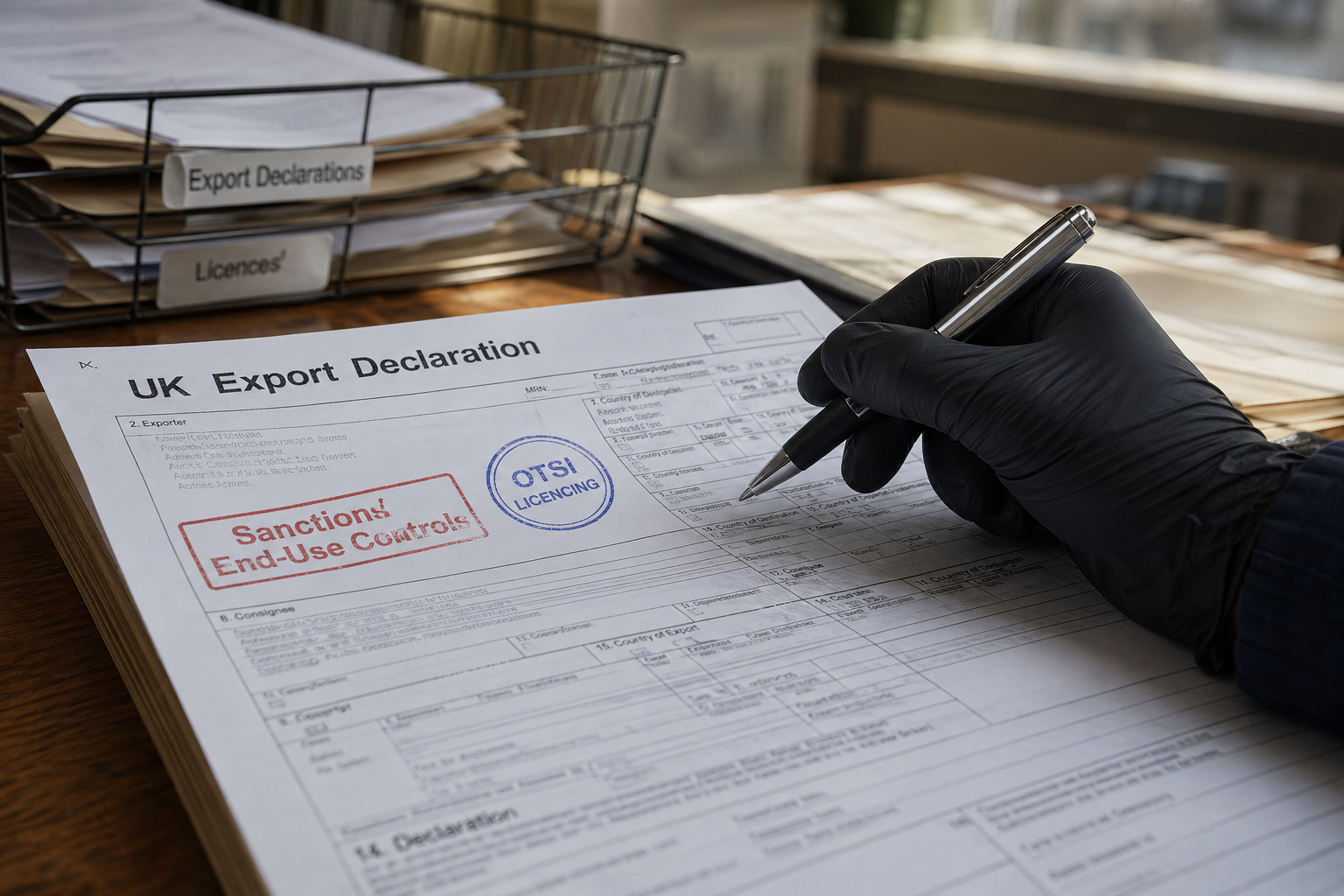
- From 27 April 2026, the Office of Trade Sanctions Implementation (OTSI) formally expanded its licensing remit for Sanctions End-Use Controls (SEUC)
- Exporters must obtain a licence before exporting if informed in writing by DBT/OTSI/HMRC that their goods pose a sanctions diversion risk
- SEUC applies to goods not otherwise subject to strategic export controls — covering items outside military/dual-use lists
- Criminal offence to export without a licence once informed; penalties include seizure, public naming, monetary fines, and prosecution
- Due diligence remains critical — exporters should review DBT’s “Countering Russian Sanctions Evasion” guidance even if not yet informed
- In parallel, the UK removed Syria sanctions on luxury goods, gold, precious metals, and diamonds from 22 April 2026. See our Syria sanctions removal guide for details
What Changed on 27 April 2026
The UK government has expanded Sanctions End-Use Controls (SEUC), giving the Office of Trade Sanctions Implementation (OTSI) formal authority to require export licences for shipments at risk of diversion to sanctioned destinations.
From 27 April 2026, if the Department for Business and Trade (DBT) or HMRC identifies your export as posing a sanctions circumvention risk, you will receive a written “informing notice”. From that point, it becomes a criminal offence to proceed with the export without first obtaining a licence from OTSI.
This is not a blanket licensing requirement. Exporters who have not been informed can continue trading as normal. But once informed, you must stop and apply — or face enforcement action. For context on related export compliance, SEUC operates alongside existing strategic controls.
What Are Sanctions End-Use Controls?
Sanctions End-Use Controls are a targeted anti-circumvention measure designed to prevent sanctioned goods and related technologies from reaching sanctioned jurisdictions or end users via third countries.
Prior to SEUC, HMRC and DBT could advise exporters of diversion risks, but it was at the exporter’s discretion whether to proceed. SEUC changes this: once informed, exporters must obtain a licence before exporting.
The measure complements existing “making available” prohibitions under the Sanctions and Anti-Money Laundering Act 2018 (SAMLA), which make it an offence to supply restricted goods to sanctioned destinations by direct or indirect means. SEUC allows the government to intervene before the goods leave the UK. For operators managing sanctions compliance, SEUC adds a pre-export licensing layer.
When Does SEUC Apply?
Sanctions Regimes Covered
SEUC applies to all UK trade sanctions regimes where restrictions extend beyond arms embargoes. Currently, this covers 11 regimes:
- Republic of Belarus
- Democratic People’s Republic of Korea (DPRK)
- Iran
- Iran (Nuclear)
- Libya
- Myanmar
- Russia and non-government-controlled territories of Ukraine
- Somalia
- Syria
- Venezuela
- Zimbabwe
Goods Covered
SEUC applies to goods and related technologies that are:
- Sanctioned under one of the regimes above
- NOT otherwise subject to strategic export controls (i.e., not on the UK’s military or dual-use control lists, not subject to WMD or Military End-Use Controls)
This means SEUC catches items that would not normally require an export licence — but become licensable once the exporter is informed of a specific diversion risk.
The “Informing” Trigger
The requirement to obtain a licence only applies after the exporter receives a written informing notice from:
- The Department for Business and Trade (DBT), or
- HMRC’s national clearance hub, or
- The Office of Trade Sanctions Implementation (OTSI)
The notice will:
- Identify the shipment or transaction in scope
- State that an export licence is required before the goods can be exported
From that point, you must not proceed with the export unless a licence is granted. If you choose not to apply for a licence and still seek to export, you will be in breach of UK sanctions law.
What Exporters Must Do When Informed
If you receive an informing notice:
- Stop the export immediately — do not ship the goods
- Review the notice carefully — it will identify the specific shipment and goods covered
- Apply for a licence via OTSI — use the GOV.UK application process for trade sanctions licences
- Provide detailed due diligence — include end-user information, transaction history, and any evidence that reduces diversion risk
- Wait for the outcome — goods cannot be exported until the licence decision is made
If the goods have already been intercepted at the border, HMRC may:
- Detain the goods while a licensing decision is made, or
- Allow the goods to be returned to the exporter, pending the outcome
OTSI is currently not accepting advance applications for SEUC licences. You must wait to be informed before applying.
How to Apply for a Licence
Licence applications are submitted to OTSI via GOV.UK. Applications are assessed on a case-by-case basis by DBT, working with other departments as needed.
Assessment Criteria
DBT will consider:
- The nature of the good or technology and its potential uses
- The diversion risks associated with the customer, route, or end-user
- The exporter’s compliance history and due diligence processes
- Any additional intelligence available to HM Government
Possible Outcomes
- Licence granted — export may proceed, subject to any licence conditions
- Licence refused — goods may not be exported to the end-user or route identified
The complexity of the case and availability of information will affect decision timelines. Exporters are encouraged to submit detailed, complete, and accurate applications as early as possible after receiving an informing notice.
Penalties for Non-Compliance
Failure to comply with the licensing requirement is a breach of trade sanctions and may result in enforcement action. Possible consequences include:
| Penalty | Enforced By |
|---|---|
| Detention or seizure of goods at the border | HMRC |
| Revocation or refusal of existing and future export licences | OTSI/DBT |
| Public naming under OTSI’s civil enforcement powers | OTSI |
| Publication of a breach report | OTSI |
| Monetary penalty (strict liability basis possible) | OTSI |
| Criminal investigation and prosecution | HMRC/OTSI |
HMRC is responsible for enforcement of trade sanctions at the UK border, including detention of goods and criminal investigation of breaches. OTSI leads on civil enforcement of sanctioned services and trade in sanctioned goods outside the UK where a UK person is involved. OTSI can refer cases to HMRC for criminal investigation.
In some circumstances, monetary penalties may be imposed on a strict liability basis — meaning a penalty can be imposed even where the person did not know or have reasonable cause to suspect they were in breach.
Due Diligence Best Practices
SEUC does not change your existing record-keeping or due diligence expectations. However, the stakes are now higher: being informed of a diversion risk can halt your export and trigger a licensing process.
To reduce the risk of being caught out:
- Screen customers and end users — check against consolidated sanctions lists (OFSI, EU, US)
- Review transaction patterns — be alert to unusual routing requests, vague end-user information, or customers in high-risk jurisdictions
- Check the Russia Common High Priority List — an internationally agreed list of Western items critical to Russian weapons systems
- Document your due diligence — keep records of customer checks, end-user declarations, and transaction rationale
- Review DBT’s guidance — “Countering Russian Sanctions Evasion: Guidance for Businesses” provides practical due diligence advice applicable to other sanctions regimes
If you suspect your goods may be at risk of diversion, consider not carrying out the transaction. You are strongly encouraged to undertake further due diligence before proceeding and may wish to seek legal advice.
Case Studies: How SEUC Works in Practice
Case 1: Licence Refused After Being Informed
A UK company exporting industrial cooling systems to a Central Asian distributor was informed by DBT that the goods were likely to be re-exported to a sanctioned Russian entity. The goods were stopped at port by HMRC and referred to DBT for assessment.
The company received a letter requiring them to apply for a licence under SEUC. The goods were held pending a decision. The application was refused due to diversion concerns. The company updated its due diligence procedures and stopped trading with that distributor.
Case 2: Licence Granted After Being Informed
A UK trader applied for a licence to export precision electronics to a Middle Eastern country after being stopped at customs and informed. During the licence review, the exporter provided clear information on the end use of the products that indicated a reduced risk of diversion. The exporter was issued with a licence, and the export continued its onward journey.
Case 3: Breach — Forwarder Ignores Informing Notice
A freight forwarder received an informing letter about a consignment of bearings due for export to a company in the Caucasus region, raising diversion concerns. The letter made clear that an export licence was required before proceeding.
The forwarder overlooked the letter and exported the shipment. The company was investigated for breach of SEUC and risks enforcement action, including potential monetary penalties and public naming.
Related: Syria Sanctions Relief (22 April 2026)
In a separate but related development, the UK government has removed trade restrictions on luxury goods, gold, precious metals, and diamonds from Syria.
The Syria (Sanctions) (EU Exit) (Amendment) Regulations 2026 came into force on 22 April 2026, amending the Syria (Sanctions) (EU Exit) Regulations 2019 to remove the definitions of “gold, precious metals or diamonds” and “luxury goods” in their entirety.
It is no longer prohibited to:
- Export, supply, deliver, or make available gold, precious metals, or diamonds to the Governing Authority of Syria, or to import or acquire such items from the Governing Authority of Syria
- Export, supply, or make available luxury goods to Syria or a person connected with Syria
Restrictions preventing the provision of ancillary services (brokering, financing, funding, and technical assistance) in respect of such transactions have also been removed.
Items previously caught under these definitions included:
- Pure-bred horses
- Luxury food items meeting value thresholds (e.g., truffles, caviar, wine)
- Cigars, perfumes, and cosmetics above value thresholds
- Pearls and precious stones
- Luxury vehicles and fashion items
- Artwork and antiques
- Gold, precious metals, and diamonds (HS codes 7102, 7106, 7108, 7109, 7110, 7111, 7112)
This change reflects the evolving political situation in Syria following the removal of the Assad government in 2025. However, sanctions on military goods, chemical weapons, and individuals linked to the former regime remain in place.
Frequently Asked Questions
Do I need to apply for a SEUC licence before exporting to a non-sanctioned country?
No. SEUC only applies if you have been formally “informed” in writing by DBT, OTSI, or HMRC that your specific export poses a diversion risk. Exporters who have not been informed can continue trading as normal.
What happens if I’ve already shipped goods before receiving an informing notice?
SEUC applies at the point of export. If goods have already left the UK, SEUC does not apply retroactively. However, existing “making available” prohibitions under SAMLA still apply — it remains an offence to knowingly supply sanctioned goods to sanctioned destinations by indirect means.
Can I apply for a SEUC licence in advance, before being informed?
No. OTSI is currently not accepting advance SEUC licence applications. You must wait to be informed before applying. If you suspect your export may be at risk, consider additional due diligence or seek legal advice before proceeding.
How long does a SEUC licence application take?
Decision timelines vary based on case complexity and information availability. DBT encourages exporters to submit detailed, complete applications to minimise delays. There is no statutory decision timeframe — complex cases may take several weeks.
What if I disagree with the informing notice?
You can engage with DBT/OTSI during the licensing process to provide additional information that may reduce the assessed diversion risk. However, you cannot export the goods until a licence is granted. If a licence is refused, you may seek legal advice on challenging the decision.
Does SEUC apply to freight forwarders as well as exporters?
Yes. The informing notice may be sent to the exporter, the freight forwarder, or both. If you are a forwarder and receive an informing notice, you must not proceed with the shipment until a licence is granted. Forwarders should ensure they have processes to identify and act on such notices.
Are there any goods exempt from SEUC?
SEUC does not apply to goods already subject to strategic export controls (military, dual-use, WMD, or Military End-Use Controls). These goods already require export licences under separate legislation. SEUC catches goods that would not normally require a licence but are identified as posing a sanctions diversion risk.
Related Guidance
For broader export control requirements, see our guide to dual-use goods export controls. For import licensing requirements, read our import licensing guide. For understanding trade sanctions frameworks, consult our UK trade remedies explainer.
Sources: GOV.UK — Sanctions End-Use Controls guidance (published 22 April 2026, updated 23 April 2026); Baker McKenzie — UK introduces Sanctions End-Use Controls (27 April 2026); Global Sanctions — UK issues sanctions end use controls guidance (23 April 2026); Syria (Sanctions) (EU Exit) (Amendment) Regulations 2026.