Key Takeaways
- LCL (Less than Container Load) allows multiple shippers to share a single container, paying only for the space used
- The LCL/FCL break-even point for UK imports from Asia is typically 12-15 CBM — below this, LCL is more economical
- LCL shipments take 5-10 days longer than FCL due to consolidation and deconsolidation time at origin and destination CFS facilities
- Each consignment in an LCL shipment requires its own customs declaration through CDS, even though goods travel in a shared container
- A single uncleared consignment can delay the entire container’s release at UK destination — this is the key operational risk of LCL. Understanding customs clearance procedures is essential for managing this risk
- Costs include ocean freight per CBM, origin and destination CFS charges (groupage charges), documentation fees, and customs clearance
What Is LCL Consolidation?
LCL — Less than Container Load — is a shipping method where cargo from multiple shippers is consolidated into a single container. Each shipper pays only for the cubic metres (CBM) or weight-tonnes they actually use, rather than chartering an entire container. This makes LCL the practical choice for UK importers moving smaller volumes that don’t justify a full 20-foot or 40-foot container.
The alternative is FCL (Full Container Load), where one shipper occupies the entire container. For most UK import routes from Asia, the economic break-even between LCL and FCL sits at approximately 12-15 CBM. Below this threshold, LCL is cheaper per unit. Above it, a 20-foot container (with roughly 28-33 CBM capacity) becomes more cost-effective despite unused space.
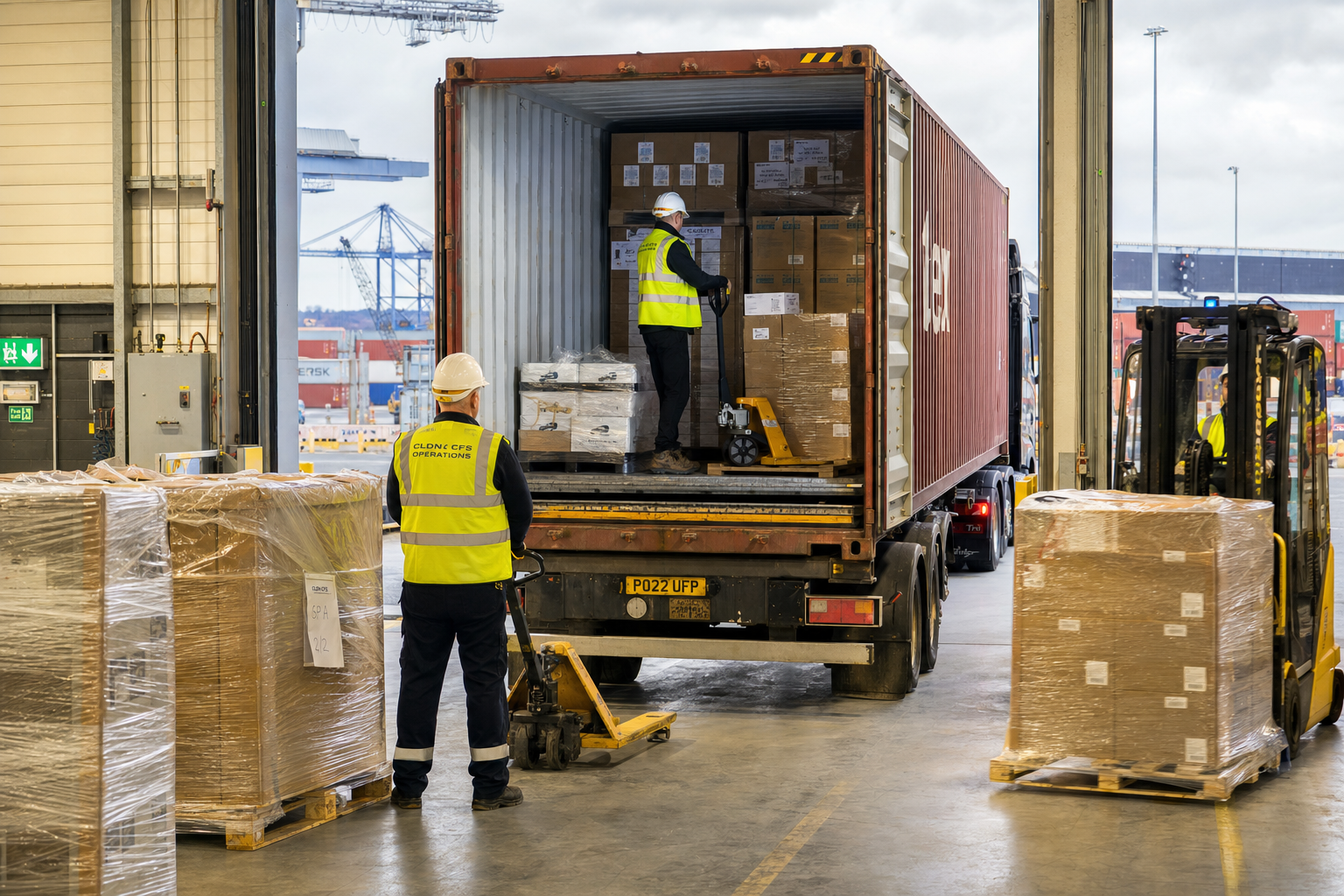
LCL operates through a network of Container Freight Stations (CFS) at both origin and destination. At origin, a freight forwarder or consolidator collects cargo from multiple shippers, loads it into a shared container, and gates it into the port. At destination, the container is deconsolidated at a CFS facility, and individual consignments are delivered to their respective importers.
For UK importers, major deconsolidation hubs include Felixstowe (the UK’s largest container port), Southampton, London Gateway, and Liverpool. These ports handle the physical separation of consolidated containers and onward distribution to individual consignees.
How LCL Consolidation Works: The Physical Flow
The LCL journey begins at the origin CFS, not at the factory gate. Shippers deliver their cargo to the consolidator’s facility, where it is weighed, measured, and documented. The consolidator then plans the container load, arranging cargo by destination port and compatibility (dangerous goods cannot be consolidated with general cargo, for example).
Once the container is fully loaded, it is gated into the origin port and shipped to the UK. The vessel doesn’t wait for individual consignments — it departs on its scheduled sailing once the container is complete. This is where the first time penalty emerges: your cargo may sit at the CFS for several days waiting for the container to fill.
At the UK destination port, the container is discharged and moved to a CFS facility for deconsolidation. Here, the container is stripped, and each consignment is separated, documented, and prepared for customs clearance. Only after all individual customs entries are cleared can the cargo be released for delivery.
The final leg involves onward transportation from the CFS to the importer’s premises. This may be by road (most common for domestic UK delivery) or by rail for certain inland destinations. The freight forwarder typically coordinates this final delivery as part of the door-to-door service.
FCL vs LCL: When Each Makes Sense
The decision between FCL and LCL isn’t just about volume — it’s about total cost, transit time, risk tolerance, and operational complexity. LCL offers lower absolute costs for smaller shipments but carries higher per-unit freight rates and longer transit times.
Cost comparison: LCL freight is calculated per revenue tonne — the greater of actual weight (in metric tonnes) or volume (in CBM). A shipment measuring 3 CBM but weighing only 1 tonne would be charged on the 3 CBM basis. The total cost includes ocean freight (per CBM/tonne), origin CFS handling charges, destination CFS groupage charges, documentation fees, customs clearance fees, and delivery charges.
Transit time implications: LCL shipments typically take 5-10 days longer than FCL on the same route. This isn’t slower sailing — it’s the consolidation and deconsolidation time at both ends. The container must wait at the origin CFS until fully loaded before it can be gated into the port. At destination, it must be stripped and individual consignments processed before release.
Risk profile: With FCL, your cargo travels alone. With LCL, your goods share space with other shippers’ cargo. This introduces two risks: first, incompatible cargo could potentially cause damage (though professional consolidators segregate carefully); second, and more critically, a single uncleared consignment can delay the entire container’s release at UK destination.
Operational complexity: LCL requires more documentation coordination. Each shipper receives their own House Bill of Lading from the forwarder, while the shipping line issues a single Master Bill of Lading covering the entire container. Customs declarations must be filed individually for each consignment, even though the physical shipment is shared.
For UK importers shipping under 10 CBM regularly, LCL is usually the right choice. For those approaching 15 CBM, it’s worth requesting quotes for both LCL and FCL — sometimes the per-unit savings of FCL justify the extra container cost even with unused space.
The Documentation Stack: Master BL vs House BL
LCL shipments involve a two-tier bill of lading structure that importers must understand to avoid clearance delays. The shipping line issues a Master Bill of Lading (MBL) to the freight forwarder or consolidator, covering the entire container from origin port to destination port.
The forwarder then issues individual House Bills of Lading (HBL) to each shipper whose cargo is consolidated into the container. The HBL is the document the UK importer uses for customs clearance and cargo release. It references the MBL but contains shipment-specific details: shipper, consignee, notify party, description of goods, weight, and measurements.
This HBL-MBL structure is critical for LCL operations. The UK importer never sees the MBL — it stays between the shipping line and the forwarder. What matters for clearance is the HBL, which must accurately reflect the commercial invoice and packing list for the individual consignment.
Beyond bills of lading, LCL shipments require the standard import documentation stack: commercial invoice (showing value for customs), packing list (showing weight and dimensions for CFS handling), customs declaration (submitted through CDS), and any commodity-specific certificates (phytosanitary for plant products, health certificates for food, etc.).
The freight forwarder typically handles customs clearance as an intermediary, but the legal responsibility for accurate declarations rests with the UK importer. Under CDS (Customs Declaration Service), each LCL consignment requires its own entry, even though multiple consignments arrive in the same physical container.
UK Customs Considerations for LCL Shipments
UK customs procedures for LCL shipments follow the same rules as FCL, but with added complexity due to the multi-consignor nature of consolidated cargo. Every importer must file their own customs declaration through CDS, regardless of whether their goods share a container with other shippers.
The “one hold blocks all” risk is the most significant operational concern for LCL imports. At UK destination, all individual customs entries for goods in a consolidated container must be cleared before the container can be released for deconsolidation. If one consignment is held for inspection, documentation queries, or duty disputes, the entire container waits. This can cascade into demurrage charges and delivery delays for all importers sharing that container.
UK importers can use duty deferment accounts for LCL shipments, but deferment operates per individual import entry, not at the container level. This means each consignment’s duty and VAT are accounted for separately, even though they physically arrive together. Simplified procedures (such as CFSP — Customs Freight Simplified Procedures) can apply to LCL but must be arranged in advance with HMRC.
For goods valued under £135, different rules apply. Since January 2021, the £135 de minimis threshold means goods below this value have VAT charged at point of sale rather than at import. However, this doesn’t exempt LCL consignments from customs declarations — it only changes how VAT is collected. Importers must still file entries and declare the correct commodity codes.
Commodity code determination is particularly important for LCL. Each consignment needs its own correct HS code for the customs declaration. Misclassification can lead to underpaid or overpaid duty, and potentially to penalties. See our commodity code classification guide for practical tips. The commodity code determines the duty rate, any anti-dumping duties, and whether import licenses are required.
Costing and Pricing: What You Actually Pay
LCL pricing follows the revenue tonne principle: carriers charge per metric tonne or per CBM, whichever yields higher revenue. A shipment of lightweight but voluminous goods (like furniture or textiles) will be charged on volume. Dense goods (like metal parts or machinery) will be charged on weight.
The cost breakdown for a typical UK LCL import from Asia includes:
- Ocean freight: Quoted per CBM or per tonne, depending on the revenue tonne calculation. Rates fluctuate with market conditions, fuel prices, and seasonal demand.
- Origin CFS charges: Handling fees at the origin consolidation facility, covering receiving, weighing, measuring, and loading into the container.
- Destination CFS charges: Often called “groupage charges” in UK practice, these cover deconsolidation, sorting, and preparation for customs clearance at the UK port.
- Documentation fees: Charges for bill of lading issuance, customs declaration preparation, and other administrative work.
- Customs clearance fees: If the forwarder handles clearance on your behalf, this is typically a fixed fee per entry.
- Duty and VAT: Payable to HMRC based on the commodity code and declared value. Duty rates vary by product; VAT is currently 20% for most goods.
- Onward delivery: Road freight from the CFS to your premises, quoted separately or bundled into a door-to-door rate.
Hidden costs to watch for include demurrage (if the container sits at the port beyond the free time due to customs delays), detention (if your cargo isn’t collected from the CFS promptly), and storage charges at the CFS facility. These can accumulate quickly if customs clearance is delayed.
For budgeting purposes, UK importers should request all-in quotes that specify each cost component. A low ocean freight rate can be offset by high destination charges, so the total landed cost matters more than the line-haul rate alone.
Transit Times and Planning: Realistic Expectations
LCL transit times require more buffer than FCL. A typical Shanghai to Felixstowe FCL shipment might take 30-35 days port-to-port. The same route via LCL could take 35-45 days when consolidation and deconsolidation time is included.
The additional time breaks down as follows:
- Origin consolidation: 3-7 days for cargo to arrive at the CFS, be processed, and wait for the container to fill
- Port waiting: 1-3 days for the loaded container to be gated into the port and loaded onto the vessel
- Ocean transit: Same as FCL — typically 28-32 days from major Chinese ports to UK
- Destination deconsolidation: 2-5 days for the container to be discharged, moved to CFS, and stripped
- Customs clearance: 1-3 days for standard entries, longer if queries arise or inspections are required
For production planning and inventory management, UK importers should build in at least 10 days of buffer when using LCL versus FCL. This is particularly important for time-sensitive goods or when coordinating with just-in-time manufacturing schedules.
Peak season (typically August through November, ahead of the Christmas retail period) can extend consolidation times further, as CFS facilities become congested and container space is at a premium. During these periods, LCL transit times can stretch by an additional week or more.
Key Takeaways
- LCL consolidation enables UK importers to ship smaller volumes economically by sharing container space with other shippers
- The break-even point between LCL and FCL is approximately 12-15 CBM for most UK import routes from Asia
- LCL adds 5-10 days to transit times due to consolidation at origin and deconsolidation at destination CFS facilities
- Each consignment requires its own customs declaration through CDS, and a single hold can delay the entire container
- Total LCL costs include ocean freight per CBM/tonne, origin and destination CFS charges, documentation fees, customs clearance, duty, VAT, and onward delivery
- Proper planning requires building in buffer time for consolidation delays, especially during peak season (August-November)
Frequently Asked Questions
What is the minimum volume for LCL shipments? Most freight forwarders accept LCL shipments from 1 CBM upwards. Below 1 CBM, air freight or courier services may be more economical despite higher per-unit costs. Some forwarders have minimum charge thresholds equivalent to 2-3 CBM even for smaller shipments.
Can dangerous goods be shipped via LCL? Yes, but with restrictions. Dangerous goods must be consolidated only with compatible cargo and require special documentation (dangerous goods declaration, MSDS, proper packaging and labelling). Not all consolidators handle dangerous goods, and additional fees apply. Some hazard classes cannot be consolidated at all.
How does insurance work for LCL shipments? Marine cargo insurance for LCL works the same as FCL — it’s based on the value of your individual consignment, not the container. Institute Cargo Clauses (A), (B), or (C) can all apply. The key difference is that LCL cargo has more handling points (origin CFS, destination CFS), so comprehensive cover (Clause A) is often recommended despite the higher premium.
What happens if another shipper’s cargo in my container is held by customs? This is the primary operational risk of LCL. If one consignment is held for inspection, documentation queries, or duty disputes, the entire container cannot be deconsolidated until that consignment is released. All other importers sharing the container experience delays. There’s no recourse against other shippers — the risk is inherent to consolidation.
Can I track my LCL shipment? Yes, but tracking works differently than FCL. You track your individual consignment using the House Bill of Lading number, not the container number. Most forwarders provide online tracking showing key milestones: received at CFS, loaded into container, vessel departure, vessel arrival, deconsolidation, customs clearance, and out for delivery.
Do I need an EORI number for LCL imports? Yes. Any UK business importing goods via LCL must have a valid GB EORI number. The EORI is required for the customs declaration and must be included on all import documentation. Without an EORI number, your cargo cannot clear customs and will be held at the CFS.