Key Takeaways
- Ro-Ro handles 96.2 million tonnes annually at UK ports, representing 29% of all short-sea tonnage traffic
- France accounts for 36% of UK short-sea unitised traffic, with Dover handling 79% of French unitised flows
- Post-Brexit, hauliers must use GVMS for customs declarations and obtain Permission to Progress before port arrival
- Vehicle security fines reach £10,000 per clandestine entrant, plus £6,000 for inadequate security even if no entrants found
- Key operators include P&O Ferries, Stena Line, Brittany Ferries, DFDS, and Irish Ferries across multiple route networks
- Short-sea unitised traffic grew 4% in 2023 to 13.5 million units, driven entirely by Ro-Ro growth
Understanding Ro-Ro Ferry Freight
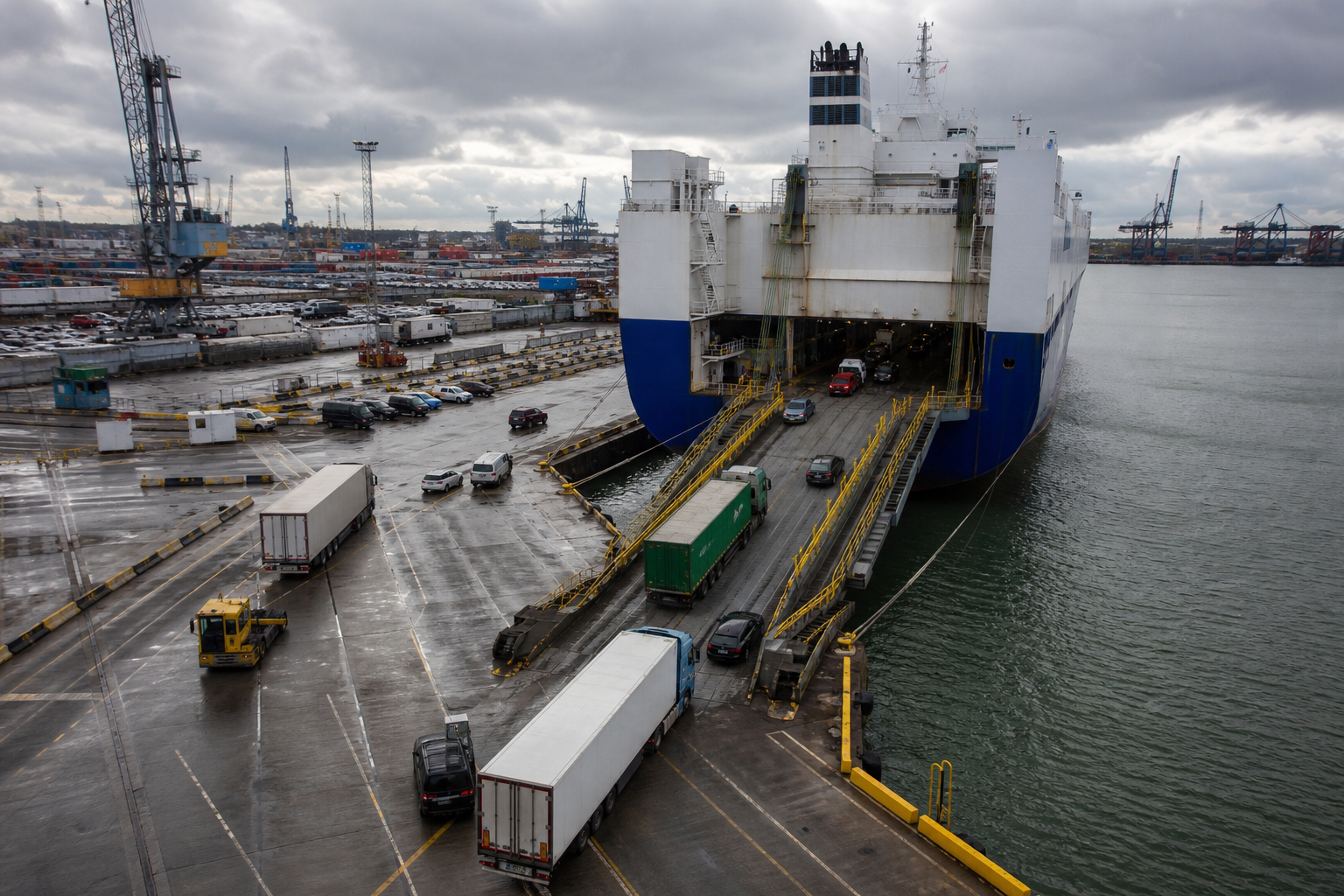
Roll-on/roll-off (Ro-Ro) ferry freight is the backbone of UK-EU trade, moving vehicles, trailers, and wheeled cargo across the Channel and North Sea without the need for cranes or containerisation. Unlike lift-on/lift-off (Lo-Lo) container vessels, Ro-Ro vessels allow cargo to drive on and off via ramps, making them ideal for accompanied freight (where drivers travel with their loads) and unaccompanied trailer movements.
For UK importers and hauliers, Ro-Ro represents the most flexible option for time-sensitive cargo. A trailer loaded in Yorkshire can be in Rotterdam within 12 hours, or in Calais within 90 minutes from Dover. This speed comes at a premium compared to deep-sea container shipping, but for just-in-time manufacturing, perishable goods, and high-value cargo, Ro-Ro remains irreplaceable. Understanding customs clearance is essential — Ro-Ro doesn’t bypass border formalities.
The UK’s Ro-Ro network spans three main corridors: the Short Sea (Channel crossings to France, Belgium, Netherlands), the Irish Sea (domestic routes to Northern Ireland and Republic of Ireland), and the North Sea (longer routes to Scandinavia and beyond). Each corridor has distinct operational characteristics, border procedures, and operator networks that freight managers must understand.
The UK Ro-Ro Landscape by the Numbers
According to the Department for Transport’s Port Freight Annual Statistics 2023, UK major ports handled 96.2 million tonnes of Ro-Ro traffic in 2023. This represents a 3% decline from 2022 and an 8% decline from 2019 pre-pandemic levels, reflecting both Brexit-related friction and shifts in trade patterns.
Ro-Ro accounts for 29% of all short-sea tonnage traffic, making it the second-largest cargo group on short-sea routes after liquid bulk (37%). The dominance of short-sea trade is clear: short-sea routes represent 67% of all international UK tonnage, with the EU alone accounting for 53%.
Unitised traffic — which includes Ro-Ro units, containers, and swap bodies — saw a 4% increase in 2023 to 13.5 million units on short-sea routes. Crucially, this growth was driven entirely by Ro-Ro traffic. Passenger vehicles on short-sea routes increased 15%, while import/export motor vehicles surged 23%. By contrast, short-sea container units declined 13%, suggesting a modal shift from deep-sea containerisation to short-sea Ro-Ro for vehicle trade.
France dominates UK Ro-Ro trade, accounting for 36% of all short-sea unitised traffic. More significantly, France handles 66% of all passenger vehicle short-sea traffic. Of French unitised traffic, 79% passes through Dover, with 11% through Portsmouth. France saw the largest absolute increase in short-sea units in 2023: +549,000 units, representing 13% growth year-on-year.
The Netherlands ranks second, accounting for 21% of all short-sea unitised traffic. Import/export vehicle movements from the Netherlands increased 46% in 2023, reflecting strengthened automotive supply chains through Rotterdam.
Not all routes grew. UK-Irish Republic traffic declined 12% in 2023, partly due to P&O Ferries’ closure of the Liverpool-Dublin route in December 2023. Liverpool’s Ro-Ro unaccompanied road goods vehicles fell 23% following the closure. Domestic Ro-Ro traffic remained stable at 29.6 million tonnes, with accompanied road goods vehicles up 5% and unaccompanied down 2%.
Key UK Ro-Ro Ports and Routes
Dover–Calais (The Short Sea Corridor)
Dover is the UK’s busiest Ro-Ro port, handling the majority of Channel traffic. The Dover–Calais route operates as a high-frequency shuttle, with crossings every 90 minutes during peak periods. P&O Ferries and DFDS both operate on this route, offering freight lanes with dedicated check-in facilities.
For hauliers, Dover requires careful planning. The port operates a pre-booking system, and drivers must arrive within a specified check-in window (typically 2 hours before departure). Late arrivals risk being rolled onto the next available sailing, which can disrupt just-in-time delivery schedules. The Port of Dover’s 2023 figures show it handles approximately 2.3 million freight vehicles annually.
Holyhead–Dublin (The Irish Sea Link)
Holyhead is the primary gateway for UK-Ireland trade, with Irish Ferries and Stena Line operating multiple daily sailings. The crossing takes approximately 3 hours 15 minutes on the fast craft, or 4 hours on conventional ferries. Belfast, by contrast, handles 12.1 million tonnes of domestic traffic — the most of any UK port for domestic routes — serving as the hub for Northern Ireland supply chains.
The Cairnryan–Larne route, operated by P&O Ferries and Stena Line, offers a shorter crossing (2 hours) and has seen increased traffic as an alternative to the longer Holyhead route. Cairnryan saw notable Ro-Ro increases in 2023, benefiting from its proximity to Glasgow and central Scotland distribution centres.
Hull–Rotterdam (The North Sea Route)
P&O Ferries operates the Hull–Rotterdam route, with overnight sailings taking approximately 11-12 hours. This route is popular for unaccompanied trailer movements, allowing hauliers to position trailers in the Netherlands without tying up driver hours. The route handles significant automotive and manufacturing cargo, serving the Midlands and Yorkshire industrial base.
Portsmouth–Le Havre/Caen/Santander/Bilbao
Brittany Ferries operates from Portsmouth to multiple French and Spanish ports. The Portsmouth–Caen route (overnight, 6 hours) is popular for western France distribution. The longer routes to Santander and Bilbao (24-32 hours) provide an alternative to road haulage through France for Iberian Peninsula traffic, particularly for temperature-controlled and high-value cargo.
Liverpool–Dublin (Closed December 2023)
P&O Ferries closed this route in December 2023 as part of network optimisation. Traffic previously using this route has shifted to Holyhead and Cairnryan, contributing to congestion peaks at those ports during high-volume periods.
Accompanied vs Unaccompanied Freight
The choice between accompanied and unaccompanied freight is one of the most significant operational decisions for hauliers using Ro-Ro services.
Accompanied freight means the driver travels with the vehicle on the ferry. This option offers maximum flexibility: drivers can respond to delays, manage cargo conditions (particularly for temperature-controlled loads), and maintain control over security. However, it consumes driver hours against EU Working Time Directive limits. A Dover–Calais crossing with check-in, sailing, and disembarkation can easily consume 4-5 hours of a driver’s available time.
Unaccompanied freight (trailer-only movements) separates the trailer from the driver. The haulier drops the trailer at the port’s freight terminal, and it travels on the next available sailing with capacity. The driver returns to base or picks up another load. Unaccompanied movements are ideal for:
- Regular scheduled movements where timing flexibility exists
- Trailer pooling arrangements between UK and EU depots
- Situations where driver hours are constrained
- Overnight North Sea routes where driver accommodation would add cost
The trade-off is reduced control. Unaccompanied trailers cannot be redirected mid-crossing, and any issues at the destination port require local contractor intervention. Security risks are also higher — unaccompanied trailers are targets for clandestine entrants during the port dwell period.
According to DfT statistics, accompanied road goods vehicles increased 5% in 2023 on domestic routes, while unaccompanied declined 2%. This suggests hauliers are prioritising driver control over cost savings in the current operating environment.
Post-Brexit Border Procedures for Ro-Ro Hauliers
The post-Brexit border regime fundamentally changed Ro-Ro operations. The key requirement is the Goods Vehicle Movement Service (GVMS), HMRC’s digital system for managing pre-lodged customs declarations.
The GVMS Process
Before arriving at the port, hauliers must:
- Submit customs declarations through CDS (Customs Declaration Service) or use a customs intermediary
- Receive a Goods Movement Reference (GMR) from GVMS linking all declarations for the trailer
- Present the GMR at check-in — the barcode is scanned, and the system verifies all declarations are in order
Without a valid GMR, vehicles cannot board ferries. Port systems are integrated with GVMS, and check-in barriers will not open for non-compliant vehicles. See our CDS guide for declaration procedures.
Inland Border Facilities (IBFs)
For transit movements or where full customs clearance cannot be completed before port arrival, hauliers use Inland Border Facilities. The three primary IBFs for Ro-Ro traffic are:
- Sevington (Ashford): The main IBF for Dover-bound traffic, located 3 miles from the port. Functions as an Office of Departure for exports and Office of Destination for imports.
- Holyhead IBF: Serves the Irish Sea routes, co-located with the port.
- Warrington IBF: Handles North West England traffic, particularly for Hull and Liverpool routes.
At an IBF, drivers present their documentation for inspection. Once cleared, they receive Permission to Progress (P2P) through the CHIEF or CDS system. Only with P2P can the vehicle proceed to the port for boarding.
Transit and the TIR Convention
For goods moving under the Common Transit Convention (which includes EU member states, UK, Norway, Switzerland, and others), hauliers must ensure transit declarations are properly lodged. The transit procedure allows goods to move under customs control without paying duty at each border. However, the transit must be discharged at the destination Office of Destination — failure to do so results in duty demands and potential penalties. See our import duty guide for how duty applies to Ro-Ro shipments.
Operational Considerations
Vehicle Security and Clandestine Entrants
Vehicle security is not optional — it is a legal requirement with severe financial consequences. Under the Immigration and Asylum Act 1999, carriers face:
- £10,000 penalty per clandestine entrant found in the vehicle
- £6,000 penalty for inadequate security even if no entrants are found
- Potential criminal liability for facilitation of illegal entry
These penalties apply to all arrivals into the UK or into UK control zones (including French ports where UK Border Force operates juxtaposed controls).
The gov.uk guidance for hauliers specifies minimum security standards:
- All doors, compartments, and fuel tanks must be locked and sealed
- Curtain-sided vehicles must have secure locking mechanisms on all straps and buckles
- Cargo areas must be inspected before loading and after any unscheduled stops
- Drivers must maintain a security checklist as evidence of due diligence
For Ro-Ro operations, the risk period extends beyond the road journey. Trailers parked at port terminals overnight are targets. Hauliers using unaccompanied services should specify enhanced security requirements to the ferry operator and consider additional physical seals. Our freight forwarder selection guide covers how to choose a partner with strong security protocols.
Driver Hours and Tachograph Rules
Ro-Ro crossings count as “other work” under EU Working Time Directive rules when the driver remains with the vehicle. Ferry time cannot be recorded as rest unless the driver has access to a couchette or sleeping cabin and is free to leave the vehicle.
For accompanied freight on short-sea routes (Dover–Calais, Holyhead–Dublin), the crossing duration is typically too short to qualify as rest. Drivers must ensure they have sufficient remaining hours for the onward journey. On North Sea routes (Hull–Rotterdam, overnight sailings), operators often provide cabin accommodation, allowing the crossing to count as rest — but this must be explicitly booked and confirmed.
Ferry Booking Systems
All major Ro-Ro operators use online booking platforms with freight-specific interfaces. Key features to understand:
- Check-in windows: Most operators require arrival 60-120 minutes before departure. Late arrivals are not guaranteed sailing.
- Amendment policies: Freight bookings can typically be amended up to 2 hours before departure, subject to capacity.
- Hazardous goods (ADR): Must be declared at booking. Not all sailings accept ADR cargo, and additional documentation is required.
- Temperature-controlled cargo: Reefer points must be booked in advance. Operators charge premium rates for powered slots.
P&O Ferries, Stena Line, and DFDS all offer freight account systems with volume discounts, online manifest management, and integrated GMR upload for GVMS compliance. Brittany Ferries Freight provides similar services for western routes.
Key Takeaways
- Ro-Ro handles 96.2 million tonnes annually at UK ports, representing 29% of all short-sea tonnage — it remains the dominant mode for time-sensitive UK-EU freight
- France accounts for 36% of UK short-sea unitised traffic, with Dover handling 79% of French flows — route selection significantly impacts transit time and reliability
- GVMS is mandatory: no GMR, no boarding. Pre-lodge all declarations and obtain Permission to Progress before port arrival
- Vehicle security penalties reach £10,000 per clandestine entrant plus £6,000 for inadequate security — document all security checks
- Accompanied freight consumes driver hours but maintains control; unaccompanied saves hours but reduces flexibility — choose based on cargo value and schedule criticality
- North Sea overnight routes (Hull–Rotterdam) can count as driver rest if cabin accommodation is booked — plan for Working Time Directive compliance
Frequently Asked Questions
What is the difference between accompanied and unaccompanied Ro-Ro freight? Accompanied freight means the driver travels with the vehicle on the ferry, maintaining control over the cargo but consuming driver hours. Unaccompanied freight (trailer-only) separates the trailer from the driver, allowing more efficient use of driver time but reducing control and increasing security risks. Unaccompanied is typically 15-25% cheaper per movement.
Do I need a GMR for every Ro-Ro crossing? Yes. The Goods Movement Reference (GMR) from GVMS is mandatory for all freight vehicles using Ro-Ro routes between Great Britain and the EU. The GMR links all customs declarations for the trailer and must be presented at check-in. Without a valid GMR, port systems will not allow boarding.
How far in advance must I book Ro-Ro freight? Most operators accept bookings up to 12 months ahead, but minimum booking windows vary. P&O Ferries and DFDS typically require at least 2 hours before departure for freight bookings, though this is subject to capacity. For guaranteed sailing, book at least 24 hours ahead. Hazardous goods and temperature-controlled cargo require advance booking — often 48-72 hours.
What happens if my Ro-Ro sailing is cancelled due to weather? Operators will rebook freight on the next available sailing with capacity. However, there is no automatic compensation for delay unless specified in the contract. For time-critical cargo, consider booking on multiple operators or using accompanied freight to maintain driver control over alternative routing. Force majeure clauses typically exclude weather-related cancellations from liability.
Can I use Ro-Ro for hazardous goods (ADR cargo)? Yes, but ADR cargo must be declared at booking and is subject to capacity limits per sailing. Not all vessels are certified for all ADR classes. Additional documentation includes the ADR transport document, emergency instructions, and driver ADR training certificate. Expect premium pricing and limited sailing options — book at least 48 hours ahead.
What are the vehicle security requirements for Ro-Ro freight? All doors, compartments, and fuel tanks must be locked and sealed. Curtain-sided vehicles require secure locking on all straps and buckles. Drivers must inspect cargo areas before loading and after any unscheduled stops, maintaining a security checklist as evidence. Penalties are £10,000 per clandestine entrant found, plus £6,000 for inadequate security even if no entrants are present.