EU customers buying CBAM goods from UK suppliers now need more than a product invoice and a commodity code. From 1 January 2026 the EU Carbon Border Adjustment Mechanism moved from reporting-only transition into its definitive regime, so importers must report embedded emissions and buy or surrender CBAM certificates for covered goods, according to the European Commission.
That changes the conversation for UK exporters. Your EU customer may ask for installation-level emissions data, production-route evidence, verification records and proof of any carbon price already paid under the UK Emissions Trading Scheme. If you cannot provide actual-emissions evidence, the importer may have to use default values that carry a financial penalty.
This guide explains what EU customers are likely to request, how to prepare the evidence pack, and where UK exporters should draw a line between helpful supplier support and taking on the importer’s legal responsibility.
Key Takeaways
- CBAM covers imports into the EU of iron and steel, aluminium, cement, fertilisers, hydrogen and electricity.
- The transitional phase ran from 1 October 2023 to 31 December 2025; from 1 January 2026 the definitive regime adds certificate costs.
- EU importers are responsible for declarations, but UK exporters often hold the emissions and production evidence needed to support them.
- Actual-emissions data matters because default values can include markups intended to push importers towards supplier-specific evidence.
- The EU’s small-import exemption is based on the EU importer’s annual CBAM goods volume, not simply your own shipment size.
- UK ETS evidence may reduce the CBAM charge where it proves a carbon price was already paid for the embedded emissions.
What changed in 2026
CBAM is no longer just a quarterly reporting exercise for EU importers. The European Commission says the definitive regime applies from 1 January 2026, with importers required to account for embedded emissions and purchase CBAM certificates linked to the EU ETS allowance price.
During the transitional phase, which business.gov.uk describes as running from 1 October 2023 to 31 December 2025, importers had to submit emissions reports but did not pay a financial adjustment. That period gave EU buyers time to identify suppliers, learn the reporting templates and test whether they could obtain actual emissions rather than relying on default values.
The practical effect is simple: your EU customer now has money at stake. A buyer that once accepted a broad spreadsheet may now ask for plant-level figures, methodological notes and documentary evidence because weak data can turn into a higher certificate bill. Procurement teams may also start treating CBAM readiness as a supplier-risk question, especially for steel, aluminium and fertiliser inputs.
The covered sectors are deliberately narrow but commercially significant. The European Commission and business.gov.uk list iron and steel, aluminium, cement, fertilisers, hydrogen and electricity as the main in-scope categories. Many UK exporters outside those sectors will still be affected indirectly if they sell components, assemblies or semi-finished goods that include covered materials imported into the EU under the relevant Combined Nomenclature codes.
Why actual emissions now matter
Actual-emissions evidence can directly affect the EU customer’s CBAM cost. If the importer cannot use supplier-specific figures, it may need to apply default values, and those values are designed to be conservative rather than generous.
Research notes for this article cite industry analysis and ICAP commentary describing a default-value markup schedule of 10% in 2026, 20% in 2027 and 30% from 2028 onwards, with fertilisers treated differently at a 1% markup. That schedule should be checked against the final implementing rules during QA, but the direction is clear: EU policy is pushing importers towards actual production data.
Default values can also be a poor commercial fit for efficient UK producers. CarbonSettle analysis cited in the research notes found default values commonly 30-80% above typical actual production emissions, with some routes producing certificate costs two to four times higher than a verified-actuals declaration. Even where those estimates vary by material and route, they show why buyers will press suppliers for evidence before accepting a default-based declaration.
For UK exporters, this creates both a risk and an opportunity. A supplier that can produce a credible emissions pack may be easier for EU buyers to keep on an approved vendor list. A supplier that cannot explain its production route, energy mix or UK ETS position may find the customer prices a CBAM risk premium into negotiations.
What EU customers will ask for
Most EU customers will not ask UK exporters to file the CBAM declaration. They will ask for the facts that only the exporter, manufacturer or upstream installation can supply.
Expect requests for product identification first. The importer will need the CN or commodity code, product description, net mass and country of origin, because the CBAM assessment starts with whether the goods fall inside the regulation. If classification is already contested, fix that before arguing over emissions methodology; the same shipment cannot be managed properly if the parties disagree on whether it is in scope.
The second request is usually embedded-emissions data. The customer may ask for direct emissions from the production process, relevant indirect emissions where required, the production route, installation name, reporting period and calculation method. For steel and aluminium, buyers may also ask for batch or heat-level traceability if their own reporting system links CBAM data to purchase orders.
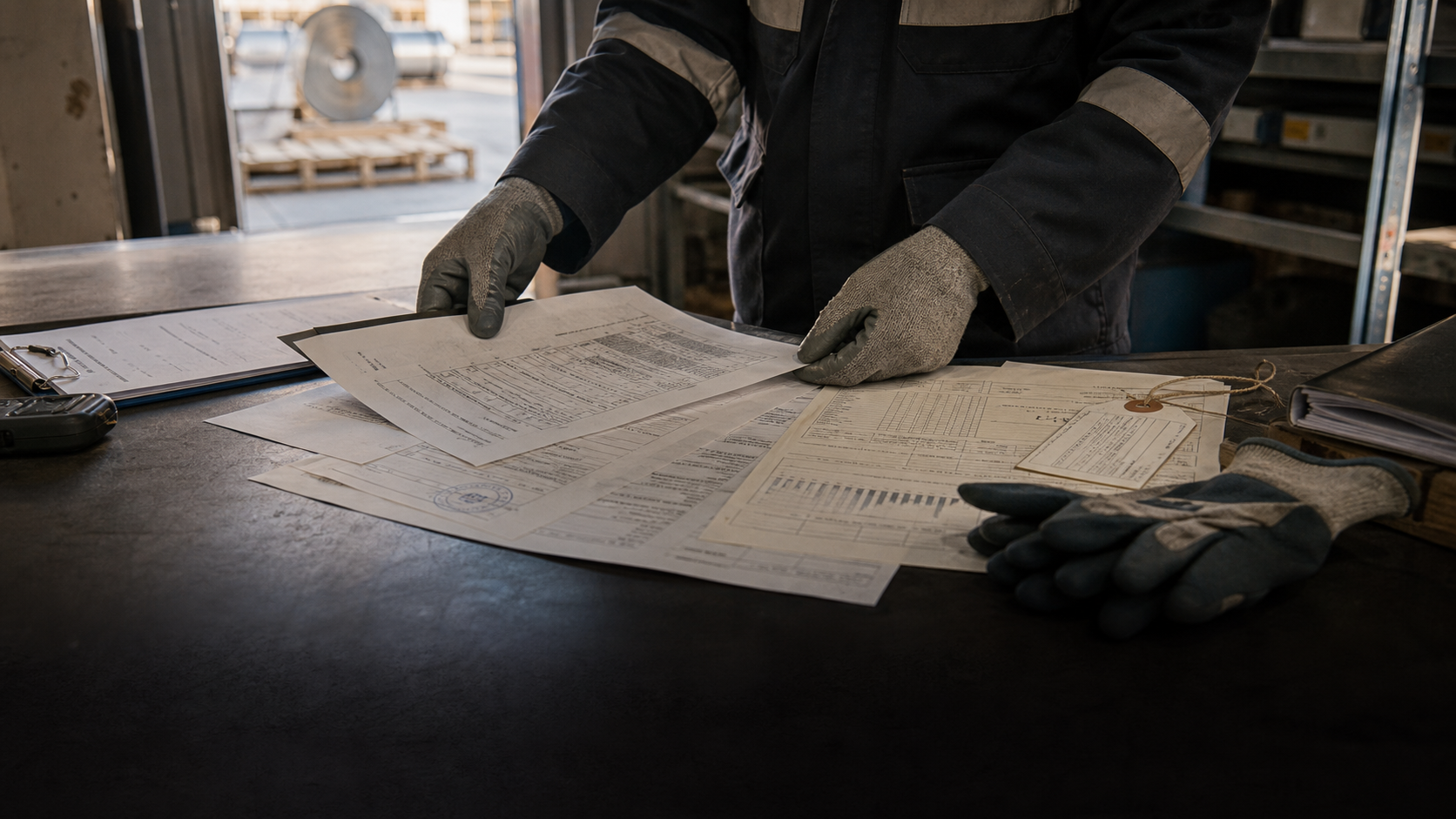
The third request is evidence, not just numbers. That can include meter records, energy invoices, production logs, mass-balance workings, emissions monitoring reports, verifier statements and internal approvals. Treat this like a customs audit pack: the figure matters, but the trail behind the figure matters more.
The fourth request is carbon-price evidence. Business.gov.uk says UK exporters may be asked to provide evidence of emissions data and any carbon price already paid under the UK ETS. That matters because CBAM is intended to equalise carbon costs, not charge twice for the same embedded emissions where an eligible carbon price has already been paid.
Building the evidence pack
Start with a product-to-installation map. List each EU-bound product, its commodity code, the producing site, the production route and the responsible data owner. If the product is traded rather than manufactured by you, identify the upstream supplier that can provide installation-level data and check whether your contract allows you to pass it to EU customers.
Then define the calculation method. The evidence pack should explain which emissions sources are included, which reporting period is used, how production volumes are matched to emissions, and how any allocation across product families is handled. A short method note is better than a spreadsheet with no context, because the EU customer needs to understand whether the figure is usable.
Keep the source evidence close to the calculation. Store energy invoices, meter readings, production records, UK ETS evidence and verifier correspondence in the same controlled folder or document set. If you use a document code or version number, put it on the emissions statement sent to the customer so both parties can trace the exact evidence relied on.
Build in review before release. CBAM data touches operations, finance, sustainability and trade compliance, so a single person rarely sees the whole picture. A workable approval chain is: production validates volumes, sustainability validates emissions factors, finance validates carbon-price evidence, and trade compliance checks product scope and customer wording.
Do not over-promise. If a figure is estimated, provisional or based on supplier data that has not been verified, say so. EU importers may still use transitional-style evidence during a bedding-in period, but vague certainty is worse than a clear limitation because it leaves the customer exposed when a verifier asks how the value was derived.
Verification and customer assurance
The definitive CBAM regime introduces a stronger assurance environment. The European Commission notes that the definitive system includes an accreditation framework for verifiers checking embedded emissions, which means your customer’s request may be shaped by what its verifier will accept.
Verification does not mean every UK exporter must immediately hire an EU-accredited verifier for every shipment. It does mean unsupported figures will become harder to defend. If you are a manufacturer of in-scope goods, speak to your EU customers about what assurance level they expect before the first annual declaration cycle becomes urgent.
For repeated supply, a standing annual or semi-annual emissions statement may work better than shipment-by-shipment improvisation. The statement should identify the installation, product family, reporting period, emissions value, methodology version and evidence retained. It should also explain when the customer must ask for an update, such as a major fuel switch, production-route change or acquisition of material from a new upstream producer.
Deadlines and the 50-tonne exemption
The most important deadline is the first definitive declaration for 2026 imports. The research notes flag conflicting public summaries: business.gov.uk has referred to a first declaration due by May 2027, while an iPoint summary of Commission material points to 30 September 2027. Treat that date as a QA item and confirm it against the current Commission guidance before relying on it in customer communications.
Even if the first annual declaration feels distant, supplier data collection cannot wait until the filing month. EU importers will need to match purchase data, emissions values, certificate purchases and carbon-price deductions across the reporting year. UK exporters that provide evidence late may force customers to use defaults for at least part of the period.
The 50-tonne exemption is also easy to misunderstand. Business.gov.uk says EU importers bringing in less than 50 tonnes of CBAM goods per year are exempt, with hydrogen and traded electricity excluded from that exemption. The threshold is about the EU importer’s annual imports of CBAM goods, not whether your single consignment is small.
That means a UK exporter selling only modest quantities may still receive CBAM data requests. Your buyer may import similar materials from several suppliers and exceed the threshold at importer level. Conversely, you should avoid telling customers they are exempt unless you have visibility of their total EU import position, which most exporters do not.
How to respond to customer questionnaires
Answer the scope questions first and keep them precise. Confirm the product, commodity code, country of origin, producing installation and reporting period before providing emissions values. If the customer’s product code or description is wrong, correct that first because the rest of the questionnaire may depend on it.
Use a standard response pack rather than rewriting answers for every buyer. A pack can include a covering note, emissions statement, method note, carbon-price evidence summary, data limitations and contact details. You can then adapt it to the customer’s portal without losing control of the core wording.
Separate facts from legal responsibility. The EU importer remains responsible for its CBAM declaration and certificate surrender, while the UK exporter supplies information. Your response should avoid language that says you certify the buyer’s compliance unless your business has explicitly agreed that role and understands the liability.
Where you cannot provide actual-emissions data, say what you can provide and when. For example, you may be able to give default-value support, production-route data or a timetable for verified actuals. Silence often pushes the EU customer towards conservative assumptions, while a credible improvement plan may preserve the relationship.
Keep copies of everything sent. Store the exact version of each statement, the customer it was sent to, the date, the products covered and the evidence behind it. If a buyer queries a declaration two years later, your team needs to know what value was supplied and why it was reasonable at the time. If you need a refresher on the core export file, read our guide to how to export from the UK and then add a separate CBAM evidence layer for covered goods.
CBAM also sits beside normal customs controls. Commodity classification, origin, valuation and Incoterms still matter because they identify the product, commercial flow and contracting party, but emissions evidence needs its own controls. Under DDP, the UK seller may be much closer to the EU import obligation than under FCA or FOB; our DDP vs DAP guide explains why delivery terms should be checked before promising compliance support. Classification still anchors the scope decision, and our commodity code classification tips explain why a code decision needs an audit trail.
Frequently Asked Questions
Do UK exporters have to file CBAM declarations?
Usually no. The EU importer is responsible for the CBAM declaration and certificate surrender when goods are imported into the EU. UK exporters are affected because they may hold the actual-emissions evidence, production-route data and UK ETS information the importer needs. Check contracts carefully where the UK seller acts as importer of record or sells on DDP terms.
What is the difference between actual and default emissions?
Actual emissions are supplier- or installation-specific values calculated from production and emissions data. Default emissions are fallback values used where actual data is unavailable or not acceptable. Default values may include markups, which can make them more expensive for EU importers than a credible actual-emissions declaration.
Does the 50-tonne exemption mean small UK exporters can ignore CBAM?
No. The exemption is assessed by reference to the EU importer’s annual CBAM goods volume, and business.gov.uk says hydrogen and traded electricity are excluded from it. A small UK supplier may still sell to an EU customer whose total imports exceed the threshold. You can tell the customer your shipment volume, but do not assume you know its total exemption position.
When is the first definitive CBAM declaration due?
Public summaries have differed on the first deadline for 2026 imports. The research notes for this article flag 30 September 2027 in a Commission-linked factsheet summary and May 2027 in business.gov.uk material. Treat the current Commission guidance as the source to confirm before sending deadline advice to customers.
Can UK ETS payments reduce the CBAM charge?
They may be relevant where the exporter can evidence a carbon price already paid for the embedded emissions. Business.gov.uk says UK exporters may be asked for evidence of emissions data and carbon price paid under the UK ETS. The EU importer will need that evidence in a form it can use to support any deduction or adjustment under the CBAM rules.
What should a basic supplier evidence pack include?
A basic pack should include the product and commodity code, producing installation, reporting period, embedded-emissions value, calculation method, source records, carbon-price evidence if relevant, data limitations and a named contact. For repeated supply, issue a version-controlled statement and keep the supporting documents in an audit file.