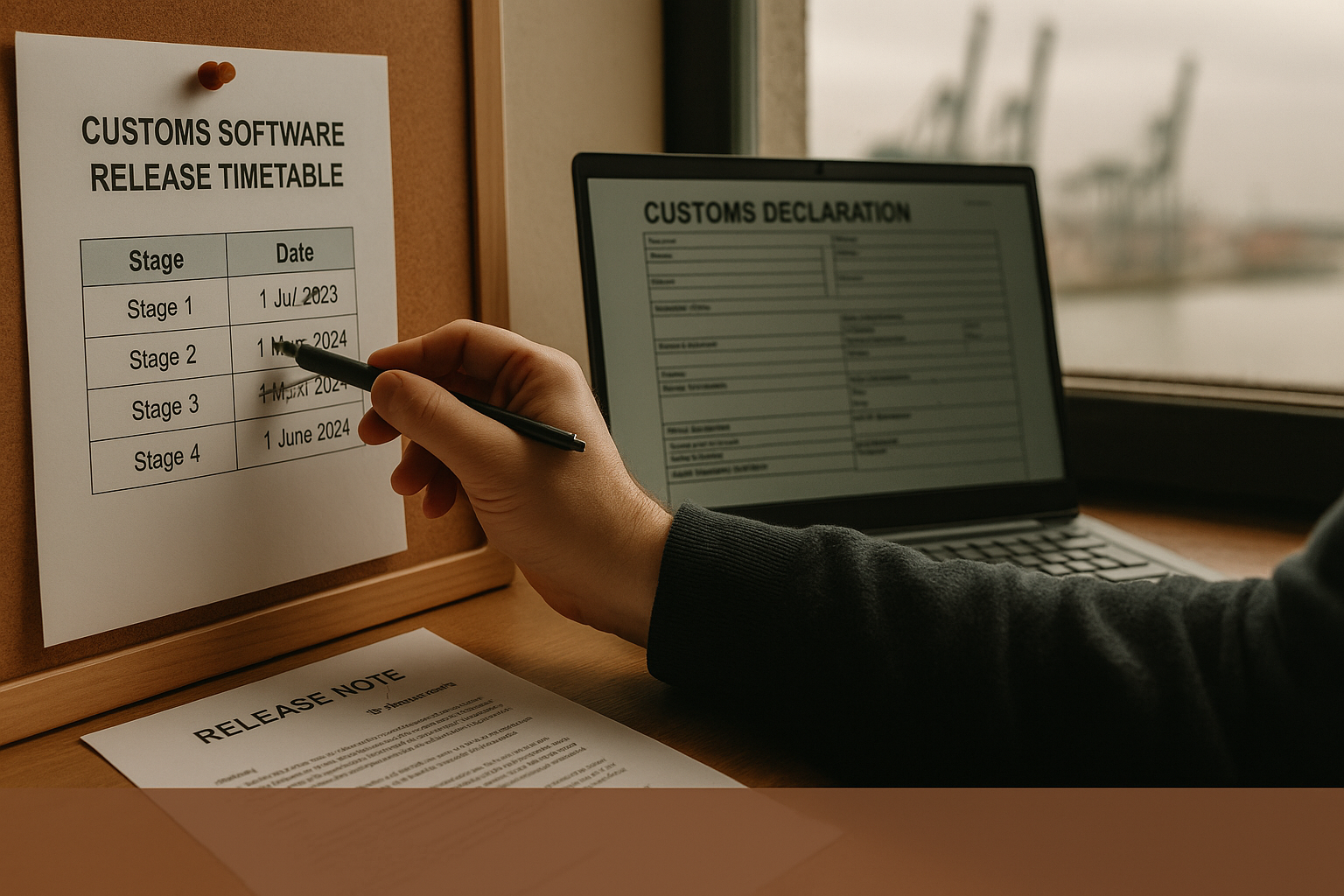
CDS release 5.3.0 went live on 26 September 2026, and it is the sort of release that punishes traders who treat HMRC software updates as background noise. The Customs Declaration Service was offline from 19:00 on Saturday 26 September until 08:30 on Sunday 27 September while the change landed, according to notices reported by BIFA and Defra’s Plant Health Information Portal. Behind that maintenance window sit code-list deletions, tightened validation of authorisations, and a timetable of further changes that runs through 2027. Get the details wrong and your declarations are rejected at the frontier, not softened with a warning.
If you lodge declarations yourself, or you brief a forwarder who does, this article gives you the immediate changes to action, the forward timetable worth diarising, and a practical checklist for the next fortnight. The data is drawn from HMRC’s release notes as tracked by BIFA, AEB and Strong & Herd, all of whom publish detailed summaries of each CDS release.
Key Takeaways
- CDS 5.3.0 went live on 26 September 2026 after downtime from 19:00 Saturday to 08:30 Sunday; any affected pre-lodged declaration must be amended before goods arrive or it will be rejected.
- Bulgaria’s move to the euro means currency code BGN is no longer accepted on frontier declarations — use EUR, except where the tax point predates 26 September 2026.
- 5.3.0 starts systematic validation of SDP (C512/SDE) and EIDR (C514/EIR) authorisations, with Inward Processing, Outward Processing, Temporary Admission and Customs Warehousing to follow in later releases.
- NI low-value imports face two staged changes: additional procedure code C07 stops being valid on H1 declarations in the week commencing 28 September 2026, and Product Identifier document codes become mandatory for distance sales from 1 November 2026.
- Out-of-quota steel imports from 1 October 2026 attract 50% duty, and document code 9Y16 stops covering contracts signed before 14 March 2026 for goods imported after 30 September 2026.
- Several headline items — including GB EORI restrictions in Northern Ireland — are deferred to 2027, so check HMRC’s timetable rather than reacting to every rumour.
What actually changed on 26 September 2026
The release date and downtime matter more than usual this cycle, because the 5.3.0 changes apply to declarations in flight. According to Strong & Herd’s release summary, any pre-lodged declaration affected by the 5.3.0 changes must be amended before the goods arrive. Pre-lodgement is common practice for ro-ro, deep-sea and airfreight flows, which means thousands of declarations sat in the queue with data that 5.3.0 no longer accepts.
The operational rule is simple: if goods are arriving after 26 September 2026 and the declaration references a deleted code, an outdated currency or a now-invalid goods location, amend before arrival. HMRC rejects the declaration; CDS does not quietly upgrade it for you. Traders using a software vendor should also confirm the vendor pushed updated code lists before the release, because rejected declarations caused by stale vendor data are the most avoidable failure mode in releases like this.
The downtime window itself — 19:00 on Saturday 26 September to 08:30 on Sunday 27 September, per the Defra Plant Health Portal notice — is worth copying into your standing operational calendar. HMRC has settled into a pattern of Saturday-night maintenance for CDS releases, and any business lodging weekend pre-notifications or ferry-driven declarations needs to plan around it. Our CDS service availability incident playbook covers how to cope when the system is unreachable.
Immediate declaration changes you must action
Currency codes: BGN out, EUR in, VES corrected
Bulgaria’s adoption of the euro has a direct CDS consequence. From 26 September 2026, currency code BGN is no longer accepted on frontier declarations — use EUR instead. There is one carve-out: per Strong & Herd, BGN remains valid on supplementary declarations where the tax point predates 26 September 2026, so historical claims and corrections referencing the old lev still work.
Separately, HMRC corrected the Venezuelan currency code. The Venezuelan Bolívar is VES, but CDS previously listed VED, and declarations using VED are rejected on frontier submissions from 26 September 2026. If you trade with Venezuela at all — and most UK importers of Venezuelan-origin goods are niche traders in specific commodities — this is a one-time standing-data fix. Update the currency mapping in your declaration software, your freight forwarder templates and any spreadsheet-driven lodgement process.
Deleted Additional Information codes
Additional Information codes 30100 and 30200 have been deleted from the CDS code list. Any declaration using either code in DE 2/2 after the release will be rejected. These codes were used in a range of contexts, and the risk is that old templates — particularly standing declaration templates used for repeat shipments — carry them silently. Audit your templates now rather than waiting for a rejection.
Goods location code changes
CDS has withdrawn the goods location code GBAUESXBHXDST and replaced it with GBAUESXLONDST, and has withdrawn a further 11 goods location codes, with HMRC’s Appendix 16 updated accordingly. Goods location codes look like plumbing, but a withdrawal can strand an entire route: if your port community system or carrier suggests the old code and your software has not refreshed Appendix 16, declarations start failing without any obvious commercial cause.
Temporary Admission period corrected
One change is genuinely helpful. CDS had wrongly limited additional procedure code D19 (Temporary Admission) to six months; release 5.3.0 corrects it to the proper 24-month relief period, according to Strong & Herd. If you use Temporary Admission for equipment, exhibits or vehicles, re-check any workaround you built around the six-month error — many traders were splitting or re-lodging periods unnecessarily.
Gross mass validation tightened
Gross mass (DE 6/5) must now be declared either once at header level or on every item line. Per Strong & Herd, declaring it on only one item of a multi-item declaration causes rejection. This catches mixed consignments where mass was only recorded against the heaviest line. If your packing-list-to-declaration mapping assigns gross mass inconsistently, fix the mapping in software before the next multi-item lodgement.
Authorisation validation is the big one
What 5.3.0 starts validating
The structural change in 5.3.0 is enhanced authorisation validation. From this release, CDS validates two authorisations systematically, according to AEB’s summary of HMRC guidance: SDP (document code C512, authorisation type SDE, used for Special Procedures Declaration) and EIDR (document code C514, authorisation type EIR, for End Use/Import Duty Relief). An invalid or mismatched authorisation — an authorisation number that does not exist, a document code that does not match the authorisation type, or an authorisation held by the wrong party — causes rejection.
This changes declarations from a data-entry exercise into a cross-check against HMRC’s authorisation database. Many traders discovered during previous validation rollouts that their authorisations were recorded with mismatches that had never been tested. The only preparation is to reconcile each SDP and EIDR authorisation number against the document codes used on live declarations and confirm the legal entity holding the authorisation is the entity named in the declaration.
The roadmap behind it
AEB notes HMRC will extend this validation to Inward Processing, Outward Processing, Temporary Admission and Customs Warehousing over later releases. If your business uses any of those regimes, read 5.3.0 as the start of a campaign rather than an isolated change. The traders hit hardest by each wave are those who find out from rejection messages at the border. Reconciling authorisations across all special procedure codes now — checking holder, number format and matching document codes — is cheaper than firefighting a rejected IP declaration for a time-sensitive load.
For background on how these regimes fit together across a declaration, see our guide to the Customs Declaration Service and our piece on CDS DE 1/11 additional procedure codes for imports.
What is coming after 5.3.0: the forward timetable
October–December 2026
Three dated changes follow hard on 5.3.0. First, steel: document code 9Y16 — the contractual waiver for steel contracts signed before 14 March 2026 — ceases to be valid for goods imported after 30 September 2026, and per AEB’s timetable, out-of-quota steel imports from 1 October 2026 are liable to 50% duty. Importers with old contracts should confirm their duty exposure before confirming orders; our coverage of EU steel quotas and UK importers explains the quota mechanics in detail.
Second, Melt and Pour steel reporting for Northern Ireland imports applies from 1 October 2026, per provisional guidance issued 9 September 2026. Declarations need at least two document codes: one ‘Y’ code marking the country of melt and pour, and one ‘C’ code carrying the proof evidence. If you import steel into NI, align with your supplier on mill certificates now.
Third, vaping: Vaping Products Duty came into force on 1 October 2026, with CDS completion guidance published alongside 5.3.0. Our vaping products duty logistics guide covers the practical handling.
Also in that window, for NI-bound flows: additional procedure code C07 must not be used on an H1 declaration for movements into Northern Ireland from the week commencing 28 September 2026 (it stays valid for GB imports), and from 1 November 2026, Product Identifier document codes become mandatory for distance sales of low-value imports into NI. The European Deforestation Regulation then applies in Northern Ireland from 30 December 2026 per the AEB timetable — a due-diligence data problem as much as a customs one.
2027 and beyond
The rest of the timetable is worth diarising but not panicking about. Items 20–28 in the 5.3.0 release table — the GB EORI restrictions in Northern Ireland — are not live in this release and will be introduced at some point in 2027, according to AEB. Also queued: an Automated Export System release in early 2027 with further data-format changes not expected until 2028; sanctions on goods from Israeli-occupied territories expected no earlier than March 2027; withdrawal of the arrived-export declaration facility at some GVMS locations expected September 2027; and UK CBAM reporting applying to 2027 imports, though AEB does not expect it to change declaration completion.
The pattern is consistent: HMRC is publishing a rolling timetable so traders can plan, and the trade bodies tracking it (BIFA, AEB, Strong & Herd) make it easy to follow. The failure mode is not ignorance of the timetable — it is discovering a code deletion through a rejected declaration because nobody mapped the timetable onto your own declaration traffic.
Traders’ action checklist for the next fortnight
Work through this list in order; the first three items are where rejections bite hardest.
- Reconcile SDP and EIDR authorisations. Check each C512/SDE and C514/EIR document code on your live declaration templates against the authorisation number and holder. Confirm the authorising entity matches the declaring entity.
- Purge deleted codes from templates. Remove AI codes 30100 and 30200, currency code BGN (frontier declarations) and VED, and any withdrawn goods location codes including GBAUESXBHXDST. Refresh Appendix 16 data in your software.
- Review pre-lodged declarations. Identify pre-lodged declarations arriving after 26 September that carry any affected data, and amend before the goods arrive — HMRC rejects affected declarations otherwise.
- Fix gross mass mapping. Ensure DE 6/5 is present at header level or on every item, consistently, for multi-item declarations.
- Diarise the staged dates. 30 September (steel 9Y16 expires), 1 October (steel duty, Melt and Pour NI, Vaping Products Duty), 1 November (NI low-value Product Identifier codes), 30 December (EUDR in NI), and the 2027 items.
- Re-test corrected D19 usage. If you previously worked around the six-month Temporary Admission error, simplify back to the intended 24-month relief period.
If you are also correcting errors on already-accepted declarations, our guide to customs declaration corrections covers the amendment routes, and the EORI number guide covers the standing data underpinning those authorisations.
Frequently Asked Questions
What happens if I do not amend an affected pre-lodged declaration?
HMRC rejects it. Per Strong & Herd’s release guidance, any pre-lodged declaration affected by the 5.3.0 changes must be amended before the goods arrive. A rejected declaration at arrival means the goods either sit at the frontier or you re-lodge under pressure, with storage and demurrage risk depending on the port. Check arrivals scheduled for the days immediately after a release date against the release notes.
Does 5.3.0 affect GB and NI flows differently?
Yes. Several changes are NI-specific: additional procedure code C07 is barred on H1 declarations into Northern Ireland from the week commencing 28 September 2026 (but remains valid for GB imports), Melt and Pour reporting applies to NI steel imports from 1 October 2026, and Product Identifier document codes become mandatory for NI low-value distance sales from 1 November 2026. GB-only flows are unaffected by those items but still hit by the currency, code-list and authorisation changes.
Are the GB EORI restrictions in Northern Ireland live now?
No. The GB EORI restrictions for Northern Ireland, listed as items 20–28 in the release 5.3.0 table, are deferred to 2027, according to AEB’s summary of HMRC’s timetable. Treat the release table as a forward plan, not a list of live changes, and check the dates column rather than reacting to headlines.
What duty applies to out-of-quota steel from 1 October 2026?
50%, per AEB’s reproduction of HMRC’s timetable. Document code 9Y16, which waived duties on contracts signed before 14 March 2026, ceases to be valid for goods imported after 30 September 2026. Importers with contracts signed before that date should confirm whether their shipment arrives before or after the cut-off, because the duty exposure changes sharply across it.
How often does HMRC update CDS, and where can I track it?
HMRC releases CDS updates on a rolling cycle, typically with a Saturday-night maintenance window, and publishes a forward timetable of expected changes. BIFA, AEB and Strong & Herd all publish reliable summaries of each release and the forward items, and HMRC’s service availability page on GOV.UK lists downtime windows. Subscribing to one trade-body summary is usually enough for most traders.
What should I do if my declaration was rejected for an authorisation mismatch?
Check whether the authorisation — SDP (C512/SDE) or EIDR (C514/EIR) — exists, matches the document code, and names the same legal entity as the declaration. If the authorisation is genuinely missing or mismatched, contact the authorising party or apply for the correct authorisation, then amend and re-lodge. Persistent mismatches should be raised as a data issue, because the extended validation programme will keep testing authorisations in future releases.