Key Takeaways
- Lloyd’s Register says alternative-fuel ship orders are growing faster than the port infrastructure needed to bunker them. Its research is global, not a survey of UK port capacity.
- According to Clarksons Research figures cited by Lloyd’s Register, 1,942 alternative-fuel-capable vessels were on order in January 2026, representing 47% of global orderbook tonnage. An order is not an operating ship or a confirmed fuel supply.
- Lloyd’s Register reports LNG bunkering at 222 ports and active methanol bunkering at 25 ports. These are global figures; neither establishes what is available at a particular UK berth.
- For a UK shipment, confirm the actual vessel, rotation, bunkering location and fallback plan with the carrier before treating an alternative-fuel claim as a resilient transport option.
What the Lloyd’s Register report actually measures
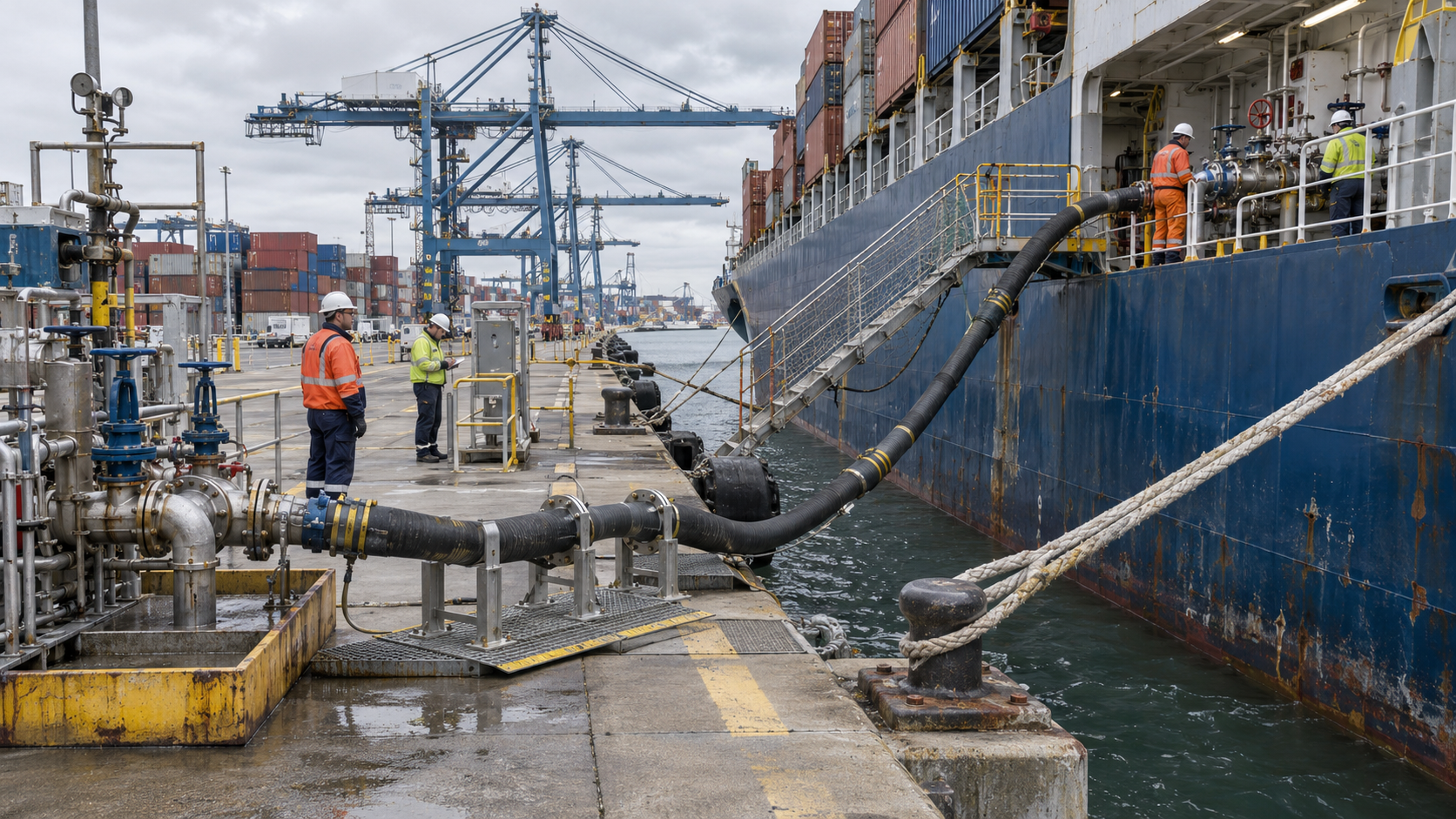
The immediate operational question is whether a ship can obtain its specified fuel on its real voyage. A port’s general interest in cleaner shipping is not equivalent to a permitted, staffed and supplied bunkering operation at the berth and time that vessel needs it. Lloyd’s Register’s Ports report, published on 26 October 2026, describes a gap between vessel investment and port readiness. It draws on evidence from more than 25 ports across Europe, Asia, the Middle East and the Americas, according to Lloyd’s Register.
That geographical scope matters to UK readers. The report is useful for identifying questions to put to carriers, terminals and port authorities; it is not a register of UK bunkering locations. The port availability figures in Lloyd’s Register’s accompanying release are global totals. Do not convert them into a claim that a named UK gateway can bunker a particular fuel, or assume that a fuel available somewhere in a port is available to every ship call.
The study considers biofuels, liquefied natural gas (LNG), methanol, ammonia, hydrogen and nuclear-powered shipping. These are not interchangeable options. Each has a different storage, handling, supply-chain and safety profile. A carrier’s statement that a newbuild is “alternative-fuel capable” also leaves open what fuel it will actually burn on your service, when that capability will be used and where it will bunker. Ask for a voyage-specific answer rather than relying on a fleet-level announcement.
For importers and exporters, the distinction is commercial as well as technical. A service that needs a fuel stop outside its scheduled rotation may add time, change transhipment arrangements or require a conventional-fuel fallback. You should assess that exposure alongside other route risks, such as the disruption and surcharge mechanisms described in our international shipping surcharges guide. Fuel readiness does not replace ordinary checks on schedule reliability, capacity and inland delivery.
The orderbook-to-bunkering mismatch
Ship orders show intended capability, not a guarantee of fuel availability. According to Clarksons Research data cited by Lloyd’s Register, 1,942 alternative-fuel-capable vessels were on order in January 2026. Those vessels represented 47% of global orderbook tonnage, not 47% of ships already in service. The denominator is the orderbook’s tonnage, so the percentage should not be presented as the share of all existing vessels or port calls.
Lloyd’s Register reports LNG bunkering at 222 ports globally and active methanol bunkering at 25. It also reports 385 methanol-capable and 45 ammonia-capable vessels on order. These figures describe different things: port availability, ordered vessel capability and, in the first figure, a particular point in time. Dividing one by another would not produce a useful capacity ratio. A port may serve several ships, and a single ship may bunker at more than one location. The practical test remains whether capacity exists for the vessel and schedule you are buying.
| Fuel or pathway | What Lloyd’s Register’s findings indicate | What you must verify for a shipment |
|---|---|---|
| Biofuel blends | Lloyd’s Register identifies them as the most immediately deployable option because they can largely use existing bunker infrastructure. | Blend specification, verified supply, vessel acceptance and whether the booked sailing actually uses it. |
| LNG | Lloyd’s Register reports bunkering availability at 222 ports worldwide. | Whether your vessel, berth and rotation can access the necessary operation, including any planned fuel stop. |
| Methanol | Lloyd’s Register reports active bunkering at 25 ports and 385 methanol-capable vessels on order. | Actual supply and bunkering arrangements at the service’s ports, not just an engine specification. |
| Ammonia | Lloyd’s Register reports 45 capable vessels on order; most ports pursuing it remain at pilot, trial or safety-framework stage. | Whether a commercial operation is authorised and available for your specific call. |
| Hydrogen and nuclear | Both appear within the report’s future-fuel scope, but neither should be treated as a routine option on a current cargo booking. | A specific, evidenced operational proposition rather than a roadmap or concept announcement. |
This table is a screening aid, not a ranking of emissions performance. Fuel production, accounting method and actual use affect any environmental claim. If a tender requires an emissions figure, agree the reporting boundary and evidence with the carrier rather than substituting “alternative-fuel capable” for measured voyage data. Record whether the figure covers a named sailing, a service average or a contractual allocation. These are materially different promises.
Lloyd’s Register’s FOBAS data add another concentration warning. Its release says drop-in biofuel deliveries were recorded at 90 ports worldwide during the preceding 12 months, but the 13 leading ports accounted for 77.5% of recorded bunker quantities. Singapore contributed more than a quarter, according to the same source. Availability at numerous ports therefore does not mean equal supply depth across routes. Where your contingency depends on a secondary port, ask whether it can supply the required volume and blend, not merely whether it has handled a delivery before.
Why readiness differs by fuel
Biofuel blends can fit more readily into existing bunkering arrangements, which is why Lloyd’s Register identifies them as the nearest-term deployable pathway. That does not make every blend acceptable to every vessel or contract. The operator still needs to confirm specification, compatibility, handling and the documentation behind any emissions claim. For a shipper, the critical distinction is between a carrier that has access to a blend somewhere in its network and one that can evidence use on the service covered by your booking.
LNG has a more established global bunkering footprint in the figures Lloyd’s Register reports. Yet a global port count cannot confirm availability at the berth, under the port’s operating rules, or within a particular vessel’s turnaround. Ask whether bunkering happens alongside cargo operations, at a separate location or during an added call. The answer affects schedule risk and may affect the cost basis in your contract. If the service switches vessel type, check whether the fuel plan changes too.
Methanol requires closer route-by-route scrutiny because Lloyd’s Register’s reported active-port count is much smaller than LNG’s, while it also reports a substantial methanol-capable orderbook. A ship may be capable of using methanol but operate on another fuel until suitable supply is available. You should therefore distinguish the vessel’s design capability from actual fuel procurement and use. Where a carrier proposes a methanol-backed service, request the intended bunkering port and the operational fallback if supply is interrupted. Build that fallback into your transit-time assumptions.
Ammonia is earlier in its commercial development. Lloyd’s Register cites the first commercial ammonia bunkering operation at Ulsan, South Korea, in April 2026, while saying most ports pursuing ammonia remain at pilot, trial or safety-framework stage. One completed operation is evidence of progress, not evidence that the same process can be repeated at every port or for your vessel. Port authorities need to consider hazards, emergency arrangements, equipment and workforce competence before routine operations. A UK buyer should not include ammonia bunkering as an assumed feature of a current service without a specific, independently checkable operational plan.
Hydrogen and nuclear-powered shipping belong in longer-horizon planning discussions covered by the report, rather than in routine assumptions for a present shipment. The right commercial question is not whether a technology is mentioned in an industry report. It is whether the carrier has a vessel, an approved operation, a supply chain and a schedule that meet your contract. Keep exploratory technologies out of service-level commitments until those elements are evidenced. This prevents a procurement document from confusing ambition with deliverable capacity.
What UK shippers should ask before booking
Start with the service, not the fuel label. Identify the vessel or vessel class, its scheduled port rotation, the intended bunkering point and the point at which a supply failure would alter the voyage. Ask the carrier whether the fuel is actually used on the booked service or merely available as an engine option. If you are offered an emissions-related product, request its accounting method and the evidence you will receive after shipment. Put those details in the service specification so that sales language and operational commitments do not drift apart.
A concise carrier questionnaire should cover the following:
- Which vessel or vessel class will carry the cargo, and what fuel is expected on this sailing?
- At which port and operational location will it bunker, and has the operation been confirmed for the relevant call?
- What happens if the fuel, berth or bunkering service is unavailable? Will the vessel use another fuel, call elsewhere or change schedule?
- Who will notify you of a fuel-related deviation, and when?
- Which documents support the carrier’s emissions claim and what voyage or allocation do they cover?
Treat unanswered questions as an uncertainty to price and plan for, not as proof that the service is unsuitable. A conventional-fuel fallback may preserve schedule reliability, but it could change the emissions outcome you expected. A diversion may preserve the fuel commitment yet alter the delivery date. Agree which outcome takes priority for your cargo before disruption occurs. For time-sensitive goods, connect this decision to the same contingency planning you use for port inspection and release bottlenecks.
Importers should also check who carries any additional freight or inland costs if a service change moves the arrival port or delivery window. Your sales contract, freight contract and insurance arrangements may allocate those costs differently. A fuel-specific surcharge should be examined on the same basis as other ocean-freight extras: what triggers it, how it is calculated and whether it can be changed mid-contract. Our guide to port energy-transition charges explains how to separate a genuine charge from a vague pass-through. Do not assume that a port’s investment programme translates automatically into a charge on your shipment.
What ports and terminals should assess
Lloyd’s Register argues for demand-led, route-specific planning. A port should establish which vessels are likely to call, what fuel quantities they need and whether that demand is sufficiently credible to support investment. An announced vessel order in the wider market is not the same as a committed call at a particular terminal. Port authorities and operators also need to determine how bunkering would interact with cargo handling, berth occupancy, adjacent activities and emergency access. These are planning questions from the report, not a statement that one uniform UK approval applies to every fuel and location.
Risk assessment and licensing need to be considered for the specific fuel and operation. Storage, transfer, exclusion arrangements and response capability will differ between pathways. The port should engage the relevant regulators and emergency services early, then test whether its workforce and contractors can carry out the proposed operation. Training should cover normal transfer, communication between ship and shore, and credible failure scenarios. A paper procedure alone does not establish operational readiness.
Partnerships matter because a port rarely controls the entire fuel chain. Suppliers, bunker operators, vessel owners, terminals, local authorities and emergency responders each own part of the process. If any one party has not committed capacity or agreed an operating window, the apparent port capability may not be available on the ship’s actual call. Ports can make commercial offers clearer by specifying which fuels, berths, vessel classes and operating conditions are supported. They should distinguish a pilot from a recurring commercial service in public material.
Use the report as a prompt, not a UK inventory
The cited Lloyd’s Register material does not provide a UK-specific count of LNG, methanol or ammonia bunkering ports. It also does not tell you whether a named UK terminal has a licence, a supplier, an available berth or a trained crew for a particular operation. Any procurement or investment decision needs those facts from the relevant carrier, port, terminal and supplier. A global trend can justify asking the question; it cannot answer it for your shipment.
Keep three separate records: vessel capability, actual fuel use and port operational availability. Date each confirmation, name its source and note the conditions attached. Recheck it when a vessel is substituted or a route changes. If you cannot confirm all three, state the uncertainty explicitly in your risk register and contract discussion. That is a more useful response to the orderbook-readiness gap than treating every alternative-fuel announcement as a guaranteed service.
Frequently Asked Questions
Does the report show that UK ports cannot support alternative-fuel ships?
No. Lloyd’s Register’s evidence is global and its cited release does not provide a UK port inventory. It identifies a mismatch between growing vessel orders and uneven bunkering readiness, but capability at a named UK port must be checked directly with the port, terminal, supplier and carrier.
Is an alternative-fuel-capable ship using alternative fuel on my shipment?
Not necessarily. Capability describes what the vessel can use; it does not prove what it will bunker on a particular voyage. Ask the carrier for the planned fuel, bunkering location, fallback and documentary basis for any emissions claim tied to your cargo.
Which fuel is easiest to deploy now?
Lloyd’s Register identifies biofuel blends as the most immediately deployable because they can largely use existing bunkering infrastructure. That is a general assessment, not a guarantee of supply or vessel compatibility on your route. Confirm blend specification, actual delivery and any relevant documentation for the booked sailing.
Should I change carriers because a port has no published fuel plan?
Not on that fact alone. First ask the carrier how the service is fuelled and where it bunkers; a voyage may obtain fuel elsewhere. Compare the answer with your delivery, cost and emissions requirements, then document the fallback if the planned fuel is unavailable.