Key Takeaways
- UK import location decisions in 2026 should start with gateway capacity, not just rent, because container volumes and port investment are shifting the practical shortlist.
- The lower Thames corridor is gaining weight for container-heavy importers serving London, the South East and the Midlands through London Gateway.
- Felixstowe remains the benchmark for deep-sea container scale, especially where A14 access and rail-fed inland distribution matter.
- East Midlands Gateway is not a seaport, but its rail freight interchange, airport access and M1 position make it a strong inland import platform.
- Site choice still depends on labour, power, planning, customs controls and customer geography; a cheaper shed in the wrong corridor can add cost every day.
Gateway Proximity Matters Again
The best logistics hotspot for a UK importer in 2026 is the place where inbound flow, onward transport and available space line up. Pure rent comparisons miss the point if containers then sit on the wrong side of a congested route, or if your warehouse team cannot turn imported stock quickly enough for customers. The operating question is no longer “where is the cheapest big box?” but “where can this import pattern move with the fewest avoidable touches?” That makes port and rail access central to the site search.
The freight backdrop supports that view. According to the Department for Transport’s 2025 port freight statistics, UK ports handled 428.3 million tonnes of freight in 2025, with total tonnage down by less than 1% from 2024. Within that total, imports increased by 2% to 237.5 million tonnes while exports decreased by 4% to 98.6 million tonnes. DfT also reported that container tonnage rose 10% in 2025, the largest absolute increase of any cargo group.
Property data points in the same direction, although it does not tell you which port to choose on its own. JLL reported UK big-box logistics take-up of 12.9 million sq ft in H1 2026, up 3.0% year on year, and 10.9 million sq ft of big-box space under offer at the end of the half. JLL also said Grade A big-box supply was 3% lower year on year at the end of Q2 2026, while prime headline logistics rents rose 1.4% in the six months to June 2026. In practical terms, importers may find space, but the best-connected space is unlikely to wait for a slow procurement cycle.
This is why a gateway-led search should sit alongside your usual warehouse specification. If you are still forming the brief, start with the basics in how to choose a 3PL and then adapt the shortlist for owned or leased operations. If container type, demurrage exposure or routing is the immediate pressure, the shipping container sizes guide and demurrage and detention guide are useful companion reads. The location decision is strongest when it joins the physical site, the carrier plan and the customs process into one operating model.
Lower Thames And London Gateway
The lower Thames corridor deserves a prominent place on any 2026 import shortlist for container-heavy supply chains serving London and the South East. London Gateway is no longer a peripheral bet; it is a scaled container gateway with visible expansion momentum. DfT attributed much of the 2025 container-tonnage increase to additional traffic at the Port of London, up 38%, after the opening of a fourth berth at London Gateway. That matters because port capacity changes the economics of nearby warehousing, drayage and stock positioning.
DP World said London Gateway surpassed 3 million TEU in 2025, up from 1.9 million TEU in 2024, a rise of more than 52%. The same company said its London Gateway and Southampton terminals handled more than 5 million TEU combined in 2025, in a UK market totalling more than 9 million TEU. Those figures do not make the Thames the right answer for every importer, but they prove the corridor has moved beyond future promise. If your containers serve London, Essex, Kent, the South East or a national network with heavy southern demand, the lower Thames now needs a serious cost-to-serve calculation.
The main operational advantage is the combination of deep-sea container access and proximity to dense consumption markets. A distribution centre close to the port can reduce container haulage mileage, improve slot discipline and lower exposure to long round trips when the quay or road network is under pressure. It can also simplify the movement of high-velocity consumer goods where stock needs to reach stores, fulfilment centres or parcel networks quickly after clearance. For importers with predictable container flows, a Thames-side or Essex location can be more than a property play; it can be a resilience choice.
The trade-off is competition for good sites and labour. A location that looks perfect on a port map can still fail if it has poor yard depth, limited power, weak public transport for warehouse staff or planning constraints on operating hours. You also need to test whether a London Gateway-oriented model still works when stock is bound for the Midlands, the North West or Scotland. In those cases, the port may be attractive, but an inland consolidation point could still produce a better national distribution outcome.
Felixstowe And The A14 Corridor
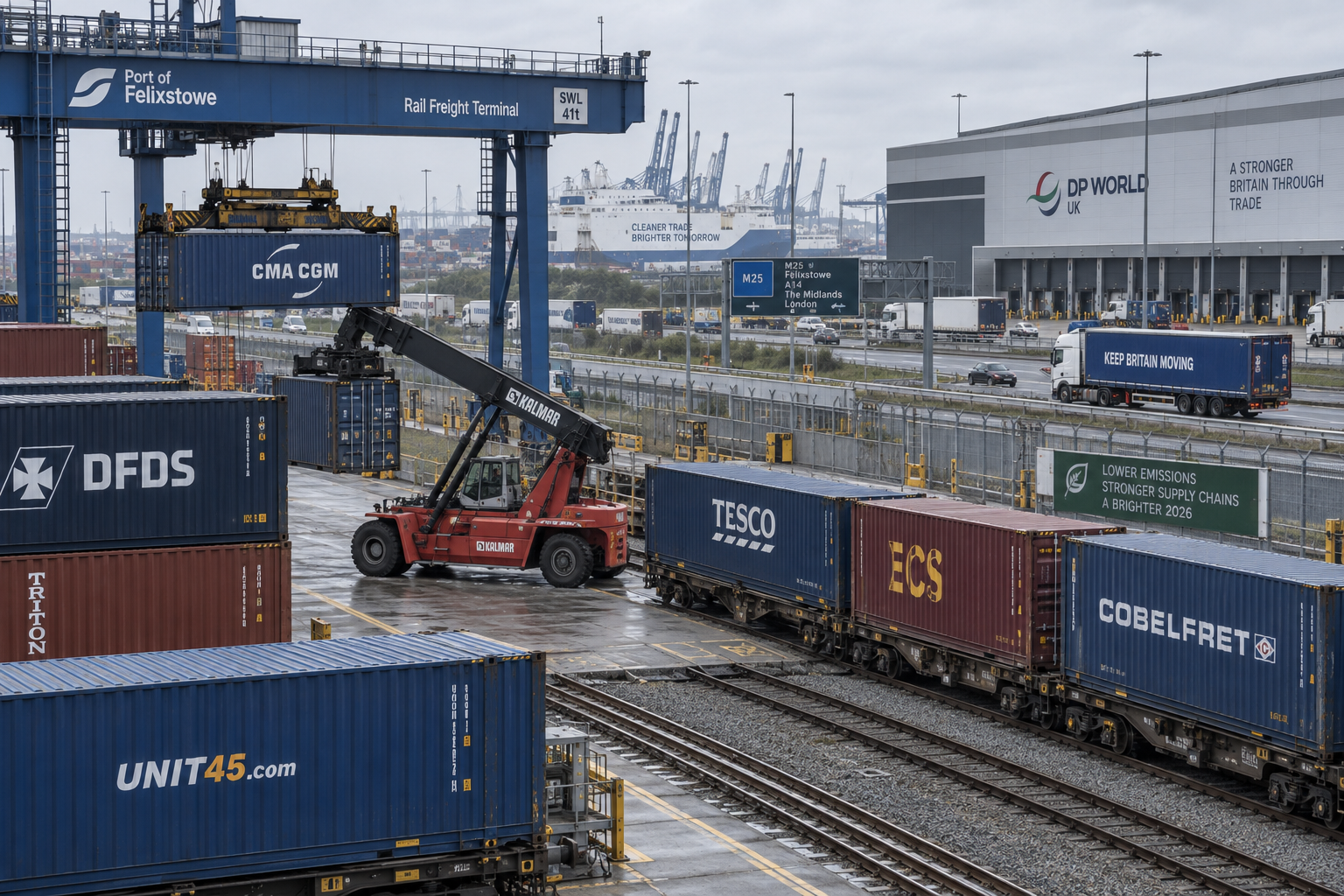
Felixstowe remains the reference point for deep-sea container scale in the UK. The Port of Felixstowe states that it handles about 4 million TEU per year, receives about 2,000 ship calls per annum, has 28 cranes across 3,773m of quayside, and runs up to 58 trains per day from three rail terminals to 15 destinations. Those figures explain why many importers continue to treat the A14 corridor, the Midlands and rail-linked inland terminals as part of one Felixstowe-fed operating system. The decision is less about fashion and more about proven volume.
For importers, the strength of Felixstowe is that it works well with both road and rail distribution models. The A14 link towards the Midlands gives access to major warehousing clusters without forcing every container into a South East congestion pattern. Rail departures can support inland moves where container volume, service frequency and receiving capability justify the planning discipline. For higher-volume importers, that can help reduce road dependency and create a more predictable rhythm between vessel arrival, clearance, inland movement and warehouse receipt.
Felixstowe is particularly strong where the cargo profile favours deep-sea reliability and where the customer base is not concentrated in London alone. Retail, manufacturing input stock, consumer goods and e-commerce importers may all find that Felixstowe plus an inland distribution node gives a better national balance than a port-adjacent warehouse. The model often works best when the importer has enough volume to plan container flows in blocks, not simply react container by container. That makes forecasting, customs data quality and carrier performance as important as the location itself.
The watchpoint is that port scale does not remove the need for warehouse discipline. A site near the A14 or in the Midlands can still underperform if the yard cannot handle peak container arrivals, if vehicle booking is weak, or if inbound teams lack visibility of clearance status. If your operating risk is customs delay rather than pure transport distance, strengthen the declaration and release process alongside the property choice; the customs clearance step-by-step guide is a better starting point than another postcode comparison.
East Midlands Gateway As An Inland Platform
East Midlands Gateway should be assessed as an inland import platform, not as a substitute seaport. Its strength is that it connects rail freight, motorway access, air cargo adjacency and national distribution geography in one logistics zone. SEGRO describes East Midlands Gateway as a 700-acre logistics development that has delivered more than 4.5 million sq ft of logistics accommodation, with about 70,000 sq ft available on Plot 13. For importers building a national stock position, that scale and transport mix can be more useful than being close to a quay.
The rail freight interchange is the main differentiator. SEGRO says the site includes a 50-acre Strategic Rail Freight Interchange capable of handling up to sixteen 775m freight trains per day, with container storage and HGV parking. That gives importers a way to receive containerised flows inland, then break bulk or cross-dock stock into a national delivery pattern. It is especially relevant where a port-proximate site would put the warehouse too far south or east for the customer base.
The location also has conventional road advantages. SEGRO positions the site next to East Midlands Airport, with direct access to M1 Junction 24; Nottingham is 13 miles away, Leicester 20 miles and Derby 14 miles. Those distances make it attractive for national distribution, returns processing, spare parts, high-service inventory and hybrid air-road operations. Knight Frank’s August 2026 market commentary also identified locations around Heathrow, London Gateway and East Midlands Airport as particularly well-positioned, while Leeds, Manchester and Birmingham continued to benefit from demand for urban delivery infrastructure.
The limitation is that an inland gateway adds a planning layer. Rail-fed container flows need enough volume and schedule discipline to be worth the coordination, and not every forwarder or carrier plan will align neatly with your chosen site. You must also check whether customs controls, bonded storage or special procedures are needed on site or nearby; customs warehousing procedures explain when suspending duty and import VAT may help.
Southampton, Solent And Other Import Corridors
Southampton and the Solent remain important for importers whose flows, carrier services or customer geography point south and west. DP World’s combined figure for London Gateway and Southampton passing more than 5 million TEU in 2025 shows that Southampton is part of a large container platform, even though the research for this article does not separate a current Southampton-only TEU figure. For cargo moving towards the South West, the M3 corridor, central southern England or selected Midlands lanes, the Solent can still be a practical choice. The right test is lane economics, not whether a corridor is attracting more headlines.
Other import corridors should not be dismissed. Heathrow remains relevant for time-sensitive air freight and high-value stock, particularly when customs release, security and onward delivery speed carry more weight than warehouse rent. Leeds, Manchester and Birmingham continue to matter where urban delivery density, labour pools and motorway access support final-mile or regional fulfilment. These markets may not be the first place to look for a port-led container operation, but they can be the correct answer for inventory that must sit close to the end customer.
The danger is treating every “hotspot” list as a ranking. A food importer using controlled-temperature storage, a consumer electronics importer, and a manufacturer receiving components will value different combinations of port access, power, labour, compliance controls and delivery reach. A stock profile with heavy returns may need a different site from one built around full-pallet outbound distribution. Your final shortlist should therefore be built around flows, not general market noise.
For temperature-sensitive cargo, the location filter must include equipment, monitoring and contingency planning, not just motorway time. The practical issues in temperature-controlled logistics show why a strong corridor can still fail if site capability is wrong. For air versus sea decisions, the air freight versus sea freight guide helps frame when speed justifies the cost.
How To Shortlist A 2026 Site
Start with inbound reality. Map the port or airport of arrival, container volume, delivery frequency, seasonal peaks, customs clearance route and detention exposure before you inspect buildings. A warehouse that saves £0.50 per sq ft is not a saving if it adds daily container mileage, missed slots or slow inventory availability. Put the landed-cost and transport model next to the property schedule; the landed-cost calculation guide is the right framework for keeping those costs visible.
Then score each candidate corridor against six practical tests. First, can inbound containers or air freight reach the site within your service window on normal and disrupted days? Second, does the site have enough yard, dock, trailer and container-handling capacity for peak weeks? Third, can the local labour market support your shift pattern without relying on heroic overtime? Fourth, is there enough power, data connectivity and automation headroom for the operation you expect in three years? Fifth, can customs, sanitary, security or special-procedure requirements be handled without improvised workarounds? Sixth, does the location reduce cost-to-serve for your actual customers, not an average customer on a spreadsheet?
Use corridor choices as hypotheses rather than conclusions. London Gateway and the lower Thames are strong for South East container intensity. Felixstowe and the A14 remain strong for deep-sea container scale, rail options and Midlands routes. East Midlands Gateway is compelling for intermodal and national distribution models, while Southampton, Heathrow, Manchester, Birmingham and Leeds each fit specific cargo or customer patterns.
The final decision should be evidenced with lane-level modelling, not a single headline metric. Ask your forwarder or 3PL for realistic dwell, slot, haulage and surcharge assumptions, then compare those assumptions with property availability and rent data. Check that any promised rail or port service is actually usable at your volume and schedule.
Frequently Asked Questions
What is the best UK logistics hotspot for importers in 2026? There is no single best hotspot for every importer. London Gateway and the lower Thames look strong for container-heavy South East flows, Felixstowe remains powerful for deep-sea container scale and A14-linked distribution, and East Midlands Gateway is strong for inland intermodal and national distribution. The correct choice depends on inbound port, customer geography, stock profile and service promise.
Should importers choose a warehouse near the port? Port proximity can reduce container haulage, improve responsiveness and lower exposure to long round trips, but it is not automatically best. If your customers are national or Midlands-heavy, an inland site with rail access may produce a better cost-to-serve result. You should compare port-adjacent and inland options using real lane volumes, detention risk and labour assumptions.
Why is London Gateway attracting more attention? London Gateway has gained scale and capacity. DfT linked a 38% rise in Port of London container tonnage in 2025 to the opening of a fourth berth at London Gateway, while DP World said London Gateway exceeded 3 million TEU in 2025. That growth makes the lower Thames a serious option for importers serving London, the South East and wider southern networks.
Is East Midlands Gateway suitable for imports? Yes, where the import model suits inland consolidation or intermodal movement. It is not a seaport, but SEGRO says it has a 50-acre Strategic Rail Freight Interchange capable of handling up to sixteen 775m freight trains per day, plus motorway and airport adjacency. It is strongest when planned as part of the inbound transport and distribution model.
What should be checked before signing a warehouse lease? Check inbound transport time, yard capacity, labour availability, power, customs requirements, rail or port service reliability, and customer delivery reach. You should also model demurrage, detention, accessorial charges and seasonal peaks before treating rent as the deciding factor. A cheaper site can cost more if it adds recurring transport and handling friction.