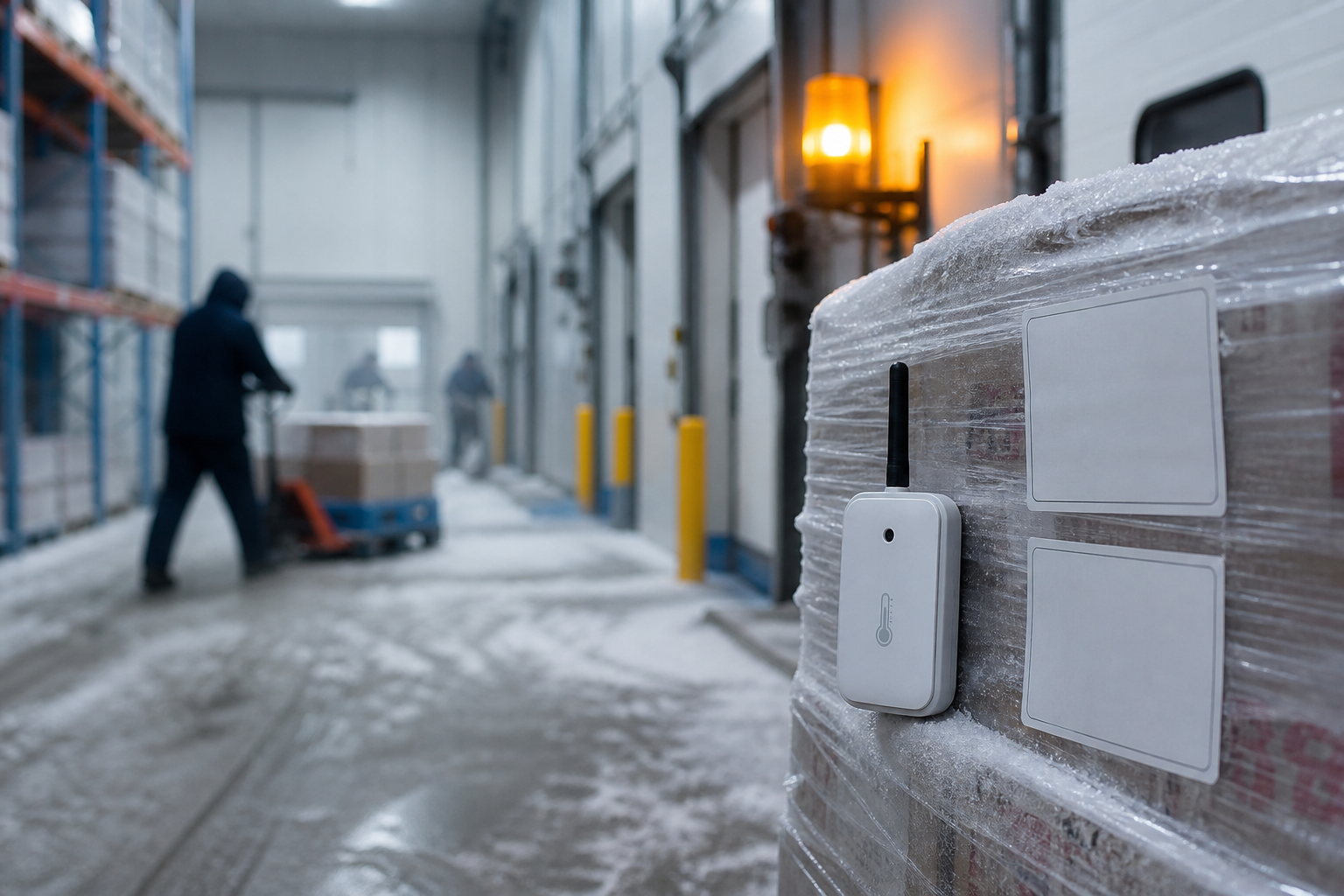
Key Takeaways
- UK chilled food generally must be kept at or below 8°C, so cold chain automation should start with reliable temperature evidence rather than warehouse robotics.
- Manual temperature logs leave long blind spots; a five-minute sensor interval creates 288 readings per day and gives managers a defensible record when something drifts.
- AS/RS, AMRs, robotic pallet movement and smarter WMS rules can reduce door openings, labour exposure and heat gain in frozen and chilled sites.
- Automation only helps if calibration, alert ownership and corrective-action records are treated as part of the operating process.
- The best 2026 business case combines compliance evidence, lower waste, better energy control and steadier service levels, not a single headline labour-saving number.
Cold Chain Automation Starts With Temperature Evidence
UK cold chain automation in 2026 is less about replacing people with robots and more about proving that chilled, frozen and temperature-sensitive goods stayed inside their safe operating range. Sensors, automated alerts, data loggers, warehouse control systems and robotic handling all matter, but the first question is simple: can you show what happened to the product when nobody was looking?
For many food, pharmaceutical and fresh-product operators, the weakest point is still the gap between manual checks. A member of staff may record a fridge or loading-bay temperature at the start and end of a shift, but a door seal failure, defrost-cycle issue or loading delay can happen in between. If the only record is a clipboard line, you may not know whether the breach lasted four minutes or four hours.
The legal baseline is clear enough to make that risky. The Food Safety (Temperature Control) Regulations 1995 require relevant chilled foods to be kept at or below 8°C, subject to the detailed exemptions and handling rules in the regulations. Frozen and wider food-hygiene controls sit within the retained UK food hygiene framework, including Regulation (EC) No 852/2004 as preserved in UK law after Brexit. That does not force every operator to buy the same technology, but it does require a system that controls risk and produces evidence.
That is why the most useful automation project often begins before the first robot is specified. Fit continuous temperature monitoring in storage rooms, vehicles, despatch lanes and high-risk transfer points. Connect those readings to named alert owners. Keep calibration records with the same discipline as maintenance logs. Then add handling automation where it reduces the number of manual touches and open-door minutes.
The Compliance Case Is Built On Records, Not Gadgets
Section 21 of the Food Safety Act 1990 gives businesses a due diligence defence where they can show that they took all reasonable precautions and exercised all due diligence. In practice, that means an Environmental Health Officer will want more than a neat policy document. They will want temperature records, corrective actions, maintenance evidence and proof that the system was followed.
Manual records can still be part of that system, especially in smaller sites, but they need honest limits. Two manual readings per day cover two moments, not the whole day. By contrast, a sensor recording every five minutes creates 288 readings in 24 hours. That does not guarantee compliance by itself, but it gives you a much clearer account of excursions, response times and recurring failure points.
The useful automation stack has four layers. First, sensors record temperature and sometimes humidity, door status, power loss or probe health. Second, a monitoring platform turns readings into alarms and exception reports. Third, operating procedures define who responds, how quickly they respond and what stock decision follows. Fourth, audit storage keeps the record available when an insurer, customer or regulator asks for it.
Calibration is the part operators are most tempted to underfund. If probes drift, batteries fail or staff cannot show when a logger was last checked, the system loses credibility. UKAS-traceable calibration is commonly used as the reference standard, with annual calibration a sensible starting point for many operations and shorter intervals for demanding frozen, pharmaceutical or high-risk food environments. Automation makes poor calibration more visible, but it does not remove the need for calibration.
Where Automation Changes Cold Store Operations
Cold stores are expensive places to run because every unnecessary movement has a thermal and labour cost. Doors open, warm air enters, evaporators work harder and staff spend more time in uncomfortable environments. Automation is attractive because it can reduce those wasteful movements while improving pick accuracy and stock visibility.
Automated Storage and Retrieval Systems are the most visible example. Crane-based or shuttle-based systems can move pallets or totes through dense racking with fewer manual forklift runs. MarkWide Research’s 2026 UK cold chain market analysis cites up to 40% footprint reduction from AS/RS compared with conventional racking in suitable applications. Treat that as a design-dependent figure, not a universal promise: product mix, pallet height, order profile and building shape decide whether the saving is real.
Autonomous Mobile Robots are another route, especially where an operator wants staged automation rather than a full high-bay rebuild. AMRs can move totes, cages or pallets between picking, consolidation and despatch areas. They are useful where labour spends too much time walking through chilled zones or where repetitive transfers between temperature areas create service risk. The best cases usually pair AMRs with clear WMS logic, so the robot moves the right stock at the right time rather than becoming a mobile bottleneck.
Robotic picking remains more selective in cold chain than in ambient e-commerce. Frozen packs, variable fresh produce, fragile chilled goods and condensation all make gripping harder. The practical 2026 approach is to automate repeatable flows first: pallet movement, case handling, sortation, stock rotation, scanning and exception alerts. Full item-level robotic picking may fit some standardised frozen categories, but many UK operators will get faster payback from better movement control and fewer manual temperature breaches.
The Business Case Has Four Parts
The first business-case pillar is avoided waste. WRAP’s July 2025 food waste work puts UK annual food waste in the region of 9.5 million to 10.2 million tonnes, depending on the scope and year measured. A single cold-chain failure will not explain that national figure, but poor temperature control is one of the avoidable causes that operators can tackle directly. Better monitoring lets you isolate affected stock, prove unaffected stock was protected and spot equipment faults before a full load is lost.
The second pillar is inspection readiness. If a customer audit or EHO visit asks for the last 12 months of temperature records, automated systems can provide time-stamped logs and exception histories quickly. That matters for food-service suppliers, importers handling chilled goods and 3PLs running customer-owned inventory. It also reduces the risk of staff recreating missing logs under pressure, which is exactly the sort of practice that weakens a due diligence defence.
The third pillar is energy control. Cold storage energy use is heavily affected by door openings, set-point discipline, defrost management and airflow. Automation can help by reducing unnecessary movements, warning when doors are held open, sequencing picks to avoid repeated chamber access and matching equipment operation to real demand. Rising energy costs make this more than a sustainability line in a board paper; it is an operating-cost issue.
The fourth pillar is service consistency. Cold chain customers usually care about failed delivery windows, stock quarantine and rejected goods more than the internal technology. Automation is worthwhile when it improves on-time despatch, stock rotation, batch traceability and exception handling. If it only produces a dashboard while the same late decisions happen on the floor, it is reporting theatre rather than operational control.
UK Infrastructure Is Moving Towards Denser Automated Sites
Large UK cold-chain operators are already investing in denser, more automated networks. Lineage’s UK presence includes 13 cold storage facilities, with services that include bonded warehousing, transport and automation-enabled cold storage. That gives national and international food businesses a route to outsource temperature-controlled storage without building every site themselves.
The direction of travel is also visible in new facility projects. Warehouse & Logistics News reported in May 2026 that Swisslog had been appointed as automation partner for Magnavale’s new frozen facility in Avonmouth, Bristol. Avonmouth is a logical cold-chain location because it sits close to port, motorway and regional distribution flows. The automation angle matters because new cold stores are being designed around high-density storage and controlled movement from the outset, not retrofitted after layout decisions are fixed.
For smaller operators, those projects are still useful signals. They show where the benchmark is moving: more data, denser storage, less manual travel and tighter integration between warehouse systems and physical movement. A regional chilled 3PL may not need a crane-fed high bay, but it may need real-time chamber monitoring, handheld scanning, automated quarantine rules and better links between its WMS and transport planning.
The outsourcing question should be asked plainly. If your volumes are unstable, your capital budget is limited or you lack engineering capability, using a specialist cold-chain 3PL may be better than building automation internally. If your product profile is stable and temperature risk is core to the brand, owning the monitoring and warehouse design may make more sense. The same decision logic applies when comparing in-house operations with third-party logistics for ambient goods, but cold-chain compliance raises the cost of getting it wrong.
Implementation Roadmap For 2026
Start with a temperature-risk map. List every point where product changes environment: goods-in, marshalling, storage chambers, picking, packing, despatch lanes, vehicle loading and delivery handover. Mark the legal or customer-required range for each product group. Then identify where you currently rely on manual checks, assumptions or post-event investigation.
Next, fix monitoring before movement automation. Install sensors in representative locations, not just beside the easiest power socket. Include door contacts or power-loss alerts where they explain temperature events. Decide the alarm thresholds, escalation windows and stock-hold rules before the first incident, because writing them during a breach invites inconsistent decisions.
Then connect temperature events to operating actions. A high-temperature alert should create a task, not just an email. Someone must check the chamber, inspect the door, move product if necessary, record the decision and close the event. If the process sits outside the WMS, make sure the record still follows the stock batch or pallet ID.
After that, automate the movements that create the most risk or waste. This may be AMRs between zones, conveyors through chilled despatch, automated pallet putaway, voice-directed picking or AS/RS in a frozen chamber. Keep the scope close to the measured problem. If most breaches happen during loading, a full picking robot will not solve the root cause.
What To Check Before Buying
Cold-chain automation procurement should test the operating model, not just the brochure. Ask vendors how the system handles sensor failure, calibration expiry, network outage, probe replacement and retrospective audit export. Ask whether records can be locked, time-stamped and retrieved by chamber, product group, pallet, vehicle or customer account.
Integration matters because cold-chain records are only useful when they sit near the commercial and physical flow. Your WMS, transport management system and monitoring platform should share enough identifiers to reconstruct what happened to a load. For importers and exporters, this sits alongside customs clearance, import VAT and customer service records when a shipment is queried.
Run a pilot with defined pass criteria. Good measures include alert response time, number of unresolved excursions, door-open duration, rejected-stock value, energy use per pallet position, pick accuracy and audit retrieval time. Avoid pilots that only prove the dashboard exists. The question is whether the system changes the behaviour of the operation.
Finally, involve maintenance and quality teams early. Engineering teams know which evaporators, doors and compressors fail most often. Quality teams know what auditors ask for and where records are weak. Operations teams know where staff bypass procedures because the current flow is unrealistic. Automation works when those three perspectives are reflected in the design.
Common Mistakes To Avoid
Do not start with a warehouse robot when the temperature record is still weak. A robot can move stock efficiently through a process that still fails audit. If you cannot prove that a chilled chamber stayed within range overnight, the board-level automation story has missed the first compliance requirement.
Do not treat alerts as success. More alarms can mean better visibility, but it can also mean poor threshold design or unclear ownership. Alert fatigue is especially dangerous in cold chain because staff may start ignoring warnings that usually have no consequence. Every recurring alarm should either trigger a design fix or be recalibrated to reflect real risk.
Do not assume a vendor’s cloud record automatically meets your evidential needs. Check export formats, retention periods, user permissions and change logs. If staff can edit records without traceability, the system may be weaker than a signed paper log. If records cannot be retrieved quickly by date and location, inspection readiness suffers.
Do not forget people. Cold-chain automation often changes shift roles, loading discipline, hygiene controls and maintenance routines. Staff need to know what the system is measuring, why the threshold matters and what decision they are authorised to make. A good standard operating procedure turns an alert into a controlled response; a poor one turns it into background noise.
Frequently Asked Questions
What temperature must chilled food be kept at in the UK? Relevant chilled food is generally required to be kept at or below 8°C under the Food Safety (Temperature Control) Regulations 1995. Some exemptions and process-specific rules apply, so operators should map the requirement to each product group and customer specification.
Does UK law require automated temperature monitoring? UK food law does not require every cold-chain operator to use the same automated monitoring technology. It does require proper temperature control, evidence and corrective action where risk exists. Automation is often the most reliable way to produce complete records, but it must be backed by procedures and calibration.
Is AS/RS suitable for frozen warehouses? AS/RS can work very well in frozen warehouses where the product profile, pallet format and throughput are stable enough to justify the design. It can reduce manual travel, improve density and limit unnecessary door movement. It is less suitable where product dimensions, order profiles or site layouts change constantly.
How often should cold-chain sensors be calibrated? Annual UKAS-traceable calibration is a common starting point, with shorter intervals for high-risk, pharmaceutical, frozen or customer-audited environments. The right interval depends on risk assessment, equipment type and audit requirements. Calibration dates should be visible in the monitoring system, not hidden in a separate spreadsheet.
Should a small food business automate its cold chain in 2026? A small business should usually start with continuous monitoring, alerting and clear corrective-action records before considering warehouse robotics. That can be affordable and gives immediate compliance value. Larger movement automation only makes sense once volumes, layout and service failures justify the investment.