Introduction
The UK grocery fulfilment landscape has undergone a dramatic transformation since 2020. What began as a pandemic-driven rush to automate has settled into a more nuanced reality: there is no single winning model. Instead, three distinct approaches now coexist, each with different economics, technology stacks, and strategic rationales. For a broader view of how fulfilment fits into the wider outsourced model, see our guide to 3PL and warehousing in the UK.
Centralised Customer Fulfilment Centres (CFCs) — the Ocado model — rely on massive, highly automated warehouses serving wide geographic areas. Urban Fulfilment Centres (UFCs) and micro-fulfilment centres (MFCs) embed automation inside or alongside existing stores, enabling faster local delivery. Store-pick models abandon automation entirely, relying on human pickers in customer-facing stores.
Meanwhile, the standalone dark store model — pioneered by rapid delivery startups promising 15-minute delivery — has largely collapsed in the UK. Getir, Gorillas, Zapp, and Jiffy all exited the market between 2024 and 2025, unable to make the unit economics work at scale.
This article examines the three surviving fulfilment models, the technology powering them, and what the rapid delivery collapse teaches us about the real economics of online grocery in the UK.
The Ocado Model: Centralised Automation at Scale
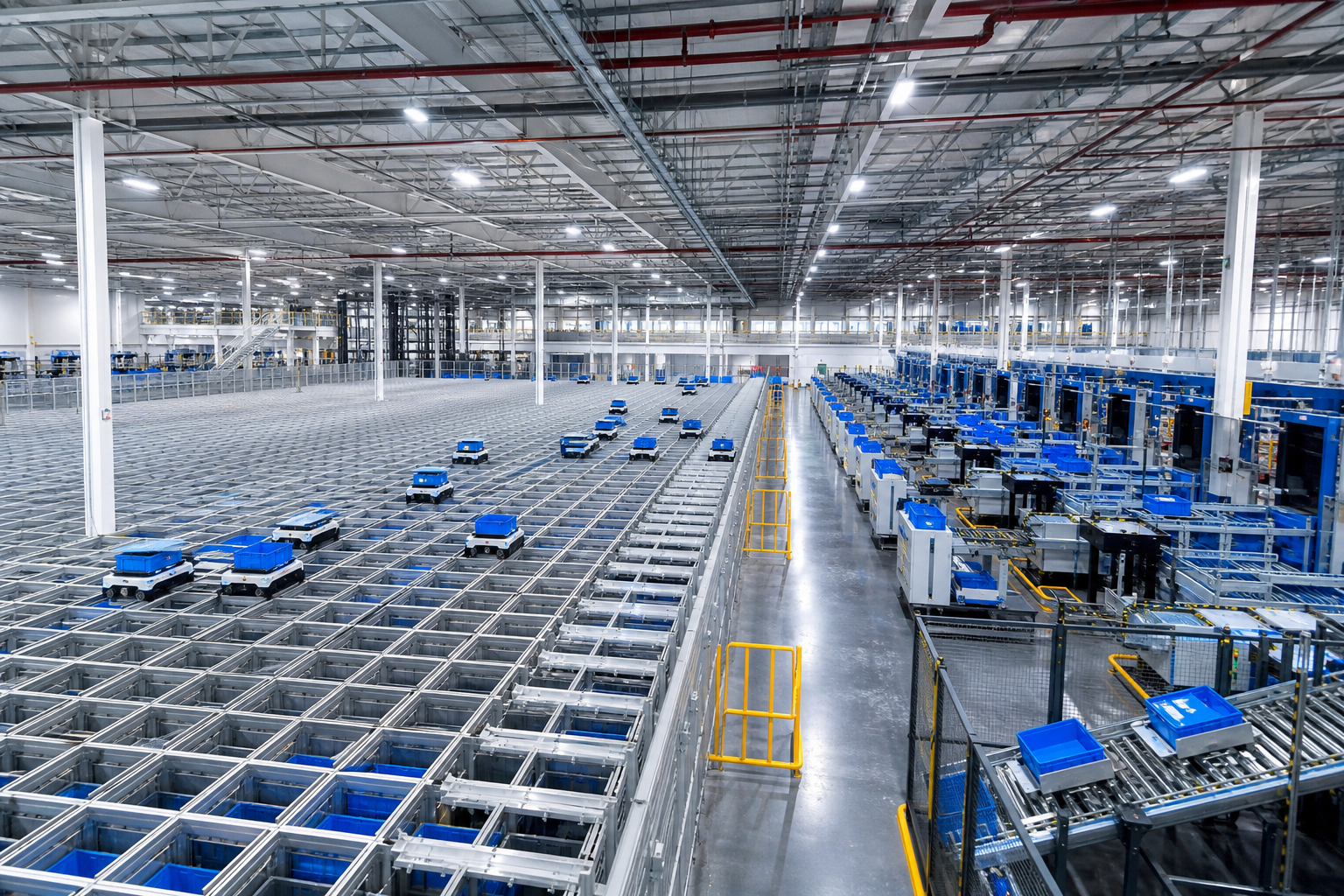
Ocado Group operates seven highly-automated CFCs across the UK as of 2026. These are not warehouses in the traditional sense — they are technology platforms. Each centre uses the Ocado Smart Platform (OSP), a grid-based storage and retrieval system where thousands of autonomous bots move across a three-dimensional lattice, retrieving shopping baskets and bringing them to picking stations. For context on the return on investment behind these systems, see our article on warehouse automation ROI in the UK.
The latest iteration, Ocado Re:Imagined, introduced in 2025, includes:
- 600s bots: The world’s lightest and most efficient grocery fulfilment bots, reducing energy consumption and increasing speed
- On-Grid Robotic Pick: Automated picking technology that reduces manual labour by up to 50%
- Automated freezer: Temperature-controlled automation for frozen goods, historically a manual operation
Ocado claims its technology can pick a 50-item basket in under five minutes, with up to 100% order accuracy, 0.7% purge rates (items substituted or unavailable), and 91% van fill rates. The company also reports that its CFCs have a carbon footprint three times smaller than supermarket click-and-collect operations up to the point of dispatch.
However, the centralised model has limits. In January 2024, Ocado Retail announced it would pause new UK site openings for two to three years. The latest CFC, opened in Luton in September 2025, replaced the original Hatfield facility (opened 2002) rather than expanding the network. This pause reflects both the capital intensity of CFC construction and the recognition that centralised fulfilment alone cannot serve all density profiles profitably.
Key insight: Centralised automation excels at accuracy and scale but requires enormous upfront investment and works best in high-density catchment areas.
Tesco’s UFC Network: Automation Inside the Store
While Ocado doubled down on centralisation, Tesco pursued a different strategy. Starting in 2020, the retailer began converting excess space in its largest stores into Urban Fulfilment Centres — automated micro-fulfilment facilities embedded within the store footprint.
As of late 2025, Tesco operates six UFCs:
- West Bromwich (first, 2020)
- Bradford
- Horwich Extra (Bolton)
- Bar Hill (Cambridge)
- Two additional sites opened in November 2025
Each UFC uses Dematic Multishuttle technology — a goods-to-person automation system where trays of products are brought to human pickers at ergonomic workstations. The five-stage process runs as follows:
- Receive: Products arrive from the main warehouse
- Decant: Items are transferred into the automated system
- Automated storage: Multishuttle carriers store items in dense vertical racks
- Pick: Items are brought to pickers who assemble orders
- Marshal: Completed orders are sorted onto delivery vans
Each UFC serves approximately 22 to 30 dotcom delivery vans, enabling same-day and next-day delivery across urban catchments. The model allows Tesco to leverage existing store infrastructure while adding automation where it matters most — the picking process.
However, Tesco’s ambitions have been scaled back. The original 2020 plan targeted 25 UFCs; the actual network remains at six. In September 2024, The Grocer reported that Tesco was “scaling back ambitions” for online picking hubs despite continuing to open new sites. The reality is that UFC economics work only in specific conditions: high online density, available store space, and sufficient order volume to justify the automation investment.
Tesco is also trialling Attabotics cube-storage robotics — a three-dimensional storage system where robots move both horizontally and vertically through an extremely dense cube. Notably, the trial continues despite Attabotics entering administration in 2025, suggesting Tesco sees value in the technology regardless of the supplier’s fate.
Key insight: Embedded automation balances capital cost and delivery speed but requires specific store formats and local density to justify investment.
The Store-Pick Counter-Revolution
Perhaps the most surprising development in UK grocery fulfilment is the resurgence of manual store-pick. In November 2025, The Grocer reported that Morrisons was phasing out its Ocado CFC deliveries from Erith and expanding its store-pick model instead. This represents a significant shift away from centralised automated fulfilment toward distributed, manual picking.
The economics are counterintuitive but compelling. A 2021 analysis by Atrato Capital estimated that:
- Manual store picking: Approximately £3 per basket
- Automated CFC picking: Approximately £7 per basket (£5 direct CFC cost + £2 last-mile delivery)
While automation reduces picking costs, it adds complexity, capital expenditure, and often longer delivery distances. Store-pick leverages existing retail infrastructure, places inventory closer to customers, and avoids the massive upfront investment required for automation.
Sainsbury’s and Asda have similarly relied primarily on store-pick models, supplemented by limited automation in high-density areas. The model is not without challenges — pickers compete with shoppers for space, product availability can be inconsistent, and order accuracy typically lags behind automated systems. But for many retailers, the total cost per delivered order remains lower than the CFC alternative. The wider shift in online order patterns is covered in our look at UK e-commerce logistics trends in 2026.
Key insight: Distributed manual picking can beat centralised automation on total delivered cost, despite higher per-basket picking costs.
The Rapid Delivery Dark Store Collapse
Between 2020 and 2023, venture-backed startups raised billions to build networks of dark stores — small, warehouse-like facilities dedicated exclusively to rapid delivery, typically promising 10 to 15-minute delivery windows. Getir alone raised over $5 billion. Gorillas, Zapp, Jiffy, and JOKR followed similar playbooks.
By May 2024, the model had collapsed in the UK:
- Getir exited the UK market in April 2024
- Gorillas was acquired by Getir and subsequently wound down
- Zapp ceased operations in 2023
- Jiffy and JOKR exited or were acquired
A ScienceDirect study published in April 2025 analysed the socio-spatial distribution of dark retail units in England and concluded that the standalone dark store model proved unprofitable at scale. The issues were fundamental:
- Unit economics: £5 to £7 delivery costs could not be recovered through typical basket values
- Real estate costs: Urban locations required for 15-minute delivery commanded premium rents
- Operational complexity: Managing hundreds of small facilities proved more difficult than anticipated
- Customer retention: Rapid delivery was a novelty, not a habit — customers returned to scheduled delivery once the urgency faded
The global dark store fulfilment market is still projected to grow — Future Market Insights valued it at USD 5.7 billion in 2026, forecasting USD 28.6 billion by 2036. But the UK experience demonstrates that growth will come from retailer-embedded models (UFCs, MFCs) rather than standalone dark stores.
Key insight: Standalone dark stores failed because delivery speed alone cannot overcome poor unit economics. Embedded models within existing retail networks have better prospects.
Technology Landscape: Who Supplies What
The fulfilment technology market has consolidated around several key players, each with distinct approaches:
| Provider | Technology | Model | UK Deployments |
|---|---|---|---|
| Ocado | OSP, 600s bots, On-Grid Robotic Pick | Centralised CFC + store-based automation | 7 CFCs, expanding store-based |
| Dematic | Multishuttle, goods-to-person | UFC/MFC embedded in stores | Tesco (6 UFCs) |
| AutoStore | Cube storage + autonomous robots | Dense storage, goods-to-person | Multiple UK retailers |
| Takeoff Technologies | MFC automation | Micro-fulfilment centres | Limited UK presence |
| Fabric | Modular MFC technology | Micro-fulfilment centres | Pilot deployments |
| Exotec | Goods-to-person robotics | MFC and CFC applications | Growing UK presence |
| Attabotics | 3D cube storage robotics | Dense storage, minimal footprint | Tesco trial |
Interact Analysis predicted in 2021 that the UK would have 80 MFCs by 2023. Actual deployment has been significantly slower, reflecting the economic and operational challenges outlined above. The technology exists; the economics dictate selective deployment.
Key Takeaways
- Three models coexist: Centralised CFCs (Ocado), embedded UFCs/MFCs (Tesco), and manual store-pick (Morrisons, Sainsbury’s) — each suits different density profiles and capital positions
- Ocado paused UK expansion: Seven CFCs remain operational, but capital intensity limits further growth
- Tesco scaled back UFC ambitions: Six sites operational versus an original target of 25
- Store-pick is resurging: Morrisons is shifting from CFC to store-pick, citing better total economics
- Rapid delivery dark stores collapsed: Getir, Gorillas, Zapp, and others exited the UK market between 2024 and 2025
- Technology is mature, economics are selective: Automation works where density and volume justify investment
- Last-mile remains the challenge: FMCG/grocery represents approximately 30% of the UK last-mile delivery market, valued at USD 7.65 billion in 2025
FAQ
What is the difference between a CFC, UFC, and dark store?
A CFC (Customer Fulfilment Centre) is a large, centralised automated warehouse serving a wide geographic area. A UFC (Urban Fulfilment Centre) or MFC (Micro-Fulfilment Centre) is a smaller automated facility embedded within or alongside an existing store. A dark store is a small facility dedicated exclusively to delivery, with no customer-facing retail operation — typically associated with rapid delivery startups.
Why did rapid delivery dark stores fail in the UK?
The standalone dark store model could not achieve profitable unit economics at scale. Delivery costs (£5-£7 per order) exceeded what customers would pay, urban real estate was expensive, and customer retention proved poor once the novelty of 15-minute delivery faded.
How many Ocado CFCs are operating in the UK?
Seven CFCs are operational as of 2026. The latest, Luton, opened in September 2025 and replaced the original Hatfield facility. Ocado has paused new UK site openings for two to three years.
Why is Morrisons moving from Ocado CFC to store-pick?
Morrisons determined that the total delivered cost of store-pick is lower than CFC fulfilment, despite higher per-basket picking costs. Store-pick leverages existing retail infrastructure and places inventory closer to customers, reducing last-mile expenses.
What technology does Tesco use in its UFCs?
Tesco uses Dematic Multishuttle technology — a goods-to-person automation system where trays of products are brought to human pickers at ergonomic workstations. The company is also trialling Attabotics cube-storage robotics.
Will micro-fulfilment expand in the UK?
Selective expansion is likely. Interact Analysis predicted 80 MFCs by 2023; actual deployment has been slower. Growth will occur where local density and order volumes justify the automation investment, primarily in urban areas with high online grocery penetration.