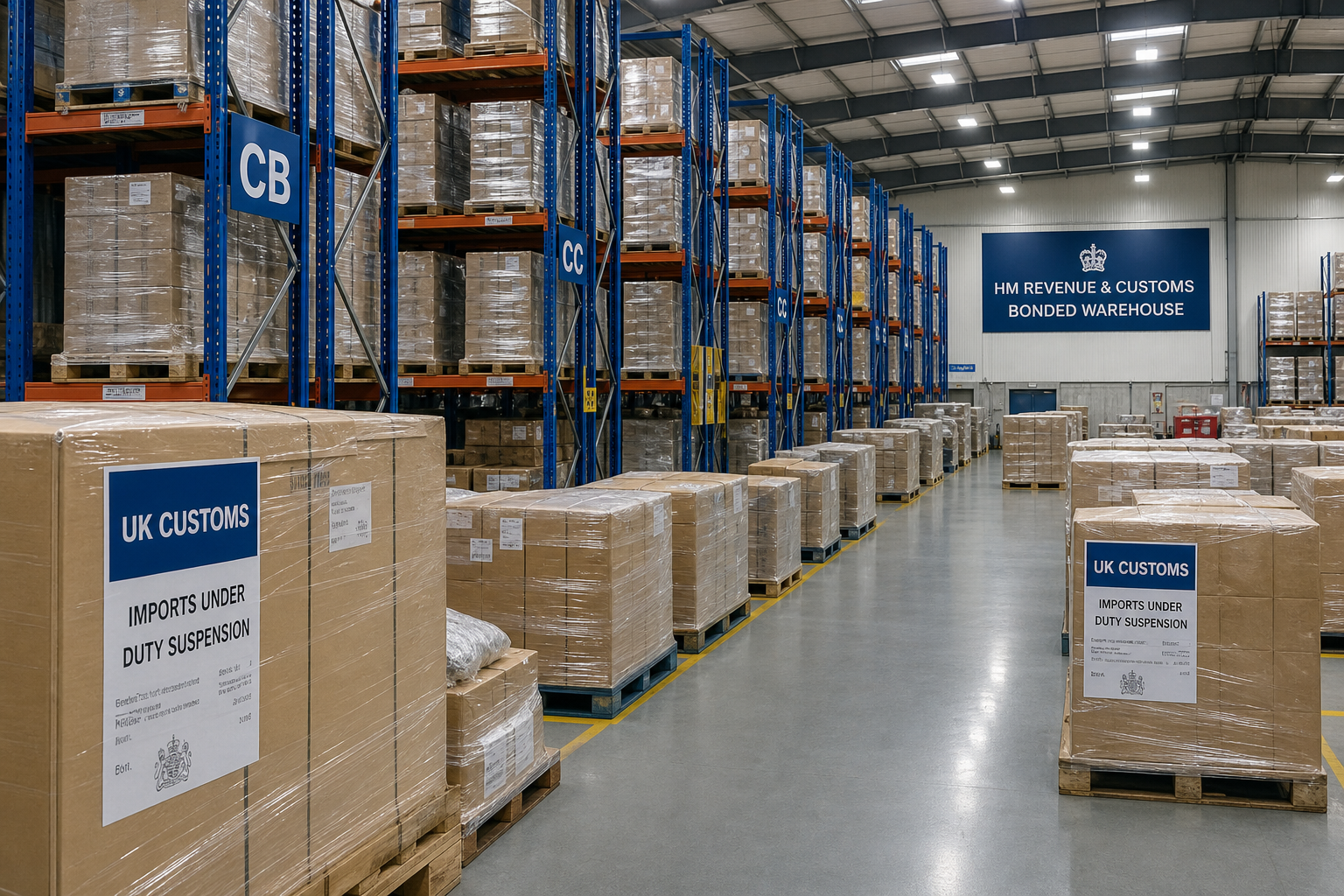
If you’re importing goods into the UK but aren’t ready to sell them immediately, customs warehousing offers a powerful cash-flow advantage: you can store goods indefinitely without paying customs duty or import VAT until they’re released to free circulation. For businesses managing seasonal inventory, awaiting re-export opportunities, or simply needing flexibility in their supply chain, this procedure can tie up significantly less working capital than paying duty on arrival.
This guide covers everything you need to know about customs warehousing in the UK — from eligibility and application requirements to the permitted handling operations you can carry out while goods are in suspension.
What Is Customs Warehousing?
Customs warehousing is a special procedure that allows you to store non-UK goods in a designated warehouse without paying customs duty or import VAT. The duty suspension continues until the goods are either:
- Released to free circulation (duty and VAT become payable)
- Re-exported outside the UK (no duty or VAT payable)
- Transferred to another customs procedure (such as inward processing)
The core benefit is straightforward: if you’re holding stock for future sale or awaiting re-export, you defer duty payments until the goods actually enter the UK market. For high-value shipments or businesses with thin margins, this can make a substantial difference to cash flow.
Goods can remain in a customs warehouse for an unlimited period after authorisation, unless HMRC orders removal on health, safety, or environmental grounds. There’s no pressure to clear goods within a specific timeframe.
Types of Customs Warehouse
HMRC recognises two types of customs warehouse, and the distinction matters for your application:
Public customs warehouse — Used by businesses that store goods belonging to other traders (depositors). The warehousekeeper holds the authorisation, and depositors place their goods under the procedure. If you operate a third-party logistics facility and want to offer duty-suspended storage as a service, this is the model you need.
Private customs warehouse — Used by businesses that store only their own goods. The authorisation holder and the depositor are the same person. This is the typical setup for importers who want to defer duty on their own inventory while it sits in their warehouse awaiting sale.
Both types operate under the same fundamental rules, but public warehouses face additional scrutiny around record-keeping and depositor management.
Who Can Operate a Customs Warehouse?
To be authorised as a warehousekeeper, you must meet several criteria:
- UK establishment — You must be established in the UK
- EORI number — A valid Economic Operators Registration and Identification number is mandatory
- Financial solvency — HMRC will assess your financial position to ensure you can meet potential duty liabilities
- Customs compliance record — A history of serious or repeated customs infringements can disqualify you
- Business need — You must demonstrate an economic need for the warehouse
- Declaration capability — You must be able to make customs declarations yourself or employ an agent who can
- Inventory records — You need systems to track goods entering, moving within, and leaving the warehouse
- Health and safety standards — Your premises must meet applicable H&S requirements
- Guarantee — You must provide a guarantee covering potential duty and VAT liabilities, unless you hold AEO status or meet AEO conditions
The guarantee requirement is often the most significant hurdle. However, if you hold Authorised Economic Operator (AEO) certification, you’re exempt from providing a separate guarantee for customs warehousing. This is one of the tangible benefits of AEO status beyond simplified procedures and reduced physical checks.
The Application Process
HMRC recommends applying at least two months before you intend to start using the warehouse. The application requires:
- Site plans showing the warehouse layout and boundaries
- Screenshots or descriptions of your warehouse management system (WMS)
- Written procedures for receiving, storing, and dispatching goods
- A list of commodity codes you expect to handle
- Health and safety policy documentation
- For public warehouses: letters of intent from prospective depositors
HMRC will conduct a site visit as part of the assessment. They need to verify that your premises are suitable and that your record-keeping systems can track goods accurately throughout their time in the warehouse.
If you need authorisation covering both Northern Ireland and EU warehousing, you can apply for a single authorisation by emailing HMRC’s UUM team. This requires an XI-prefix EORI number.
Using a Customs Warehouse — The Depositor’s Guide
If you’re placing goods into someone else’s customs warehouse (as a depositor), you have specific responsibilities:
- UK establishment — You must be established in the UK to be a depositor
- Correct declaration — Goods must be declared into the customs warehousing procedure using a full import declaration, simplified declaration, or Entry in the Declarant’s Records (EIDR) — see our step-by-step customs clearance guide for the full declaration process
- Five-day rule — Goods must reach the warehouse within five working days of customs clearance
- Declaration details — You must provide the warehousekeeper with all import declaration details so they can update their records
- Goods compatibility — Check that the warehouse is approved to store your type of goods
- Removal declaration — When goods leave the warehouse, you’re responsible for declaring them correctly for their next procedure
The warehousekeeper relies on you to provide accurate information. If declaration details are missing or incorrect, it creates compliance risks for both parties.
Permitted Handling: Usual Forms of Handling (UFH)
One common question is what you can do to goods while they’re in a customs warehouse. HMRC permits “usual forms of handling” — operations that preserve goods, improve their presentation, or prepare them for distribution without fundamentally changing their nature.
UFH falls into three categories:
Preserving goods in storage — Ventilation, drying, dust removal, simple repairs of packing or transport damage, applying protective coatings, stocktaking, temperature control, pasteurisation, and treatment to eliminate parasites.
Improving presentation — Stemming or pitting fruit, desalination of hides, dilution or concentration of liquids, mixing same-kind goods to achieve consistent quality, simple dividing or cutting, and denaturing.
Preparing for distribution — Sorting, filtering, sifting, testing and regulating, packing and unpacking, labelling, ironing textiles, and putting machinery into working order.
The critical constraint: UFH cannot change the 8-digit commodity code unless specifically permitted. If your planned processing would change the classification, you need to transfer the goods to the inward processing procedure instead. Goods can remain physically in the warehouse while under inward processing, then re-enter customs warehousing once processing is complete.
Removing Goods from the Warehouse
When goods leave the customs warehouse, they must go somewhere. Your options:
Release to free circulation — Customs duty and import VAT become payable, calculated using the quantity, value, and tariff classification at the time of removal. Tariff preferences, quotas, and duty reliefs remain available when releasing to free circulation.
Re-export — Goods leave the UK customs territory. No duty or VAT is payable.
Transfer to another procedure — Goods can move to inward processing, temporary admission, or another special procedure.
Movement between warehouses — Moving goods between warehouses under the same authorisation requires only record-keeping (no customs declaration). Moving between different authorisation holders requires the receiving depositor to complete a declaration.
Removal as finished product — Individual parts can be classified as a finished product on removal if they’re presented together in quantities that make specific numbers of finished products, the parts are sufficiently advanced to have the essential features of the finished product, and non-UK parts form the essential character before UK parts are added.
Temporary removal for viewing — Goods can be temporarily removed for viewing or testing by prospective purchasers, but they must stay near the authorised warehouse area, purchasers must be accompanied by warehouse staff, and HMRC permission is required. You cannot remove goods to private premises, public venues, or for auction and sales activities.
Duty, VAT and Valuation Rules
Understanding when and how duty is calculated is essential:
Valuation timing — If goods were sold for export to the UK before entering the warehouse, the value is based on that sale. If no sale for export occurred, a sale can take place while goods are in the warehouse — use the duty rates and exchange rates applicable at the time of removal.
Duty calculation on removal — Customs duty and import VAT are calculated using the quantity, value, and tariff classification at the time the goods are removed from the warehouse, not when they entered.
VAT on warehouse sales — Sales of goods while they’re in a customs warehouse are not subject to supply VAT unless they are retail sales (which are restricted — see below).
Duty Management System (DMS) — If you use DMS to support your commercial stock records, it must be updated as soon as information becomes available and no later than midnight of the following warehouse operation day — including weekends and public holidays if they are operating days.
Retail Sales Restrictions
Ordinary walk-in retail is not permitted in customs warehouses. Retail sales are allowed only for:
- Travellers leaving the UK
- Members of international organisations
- NATO forces
- Diplomatic or consular personnel
- Remote or online customers (pick-and-dispatch model)
If you’re operating a public warehouse and a depositor wants to sell directly to consumers from the warehouse floor, this is generally not permitted unless the buyer falls into one of these categories.
Co-storage and Goods of Different Statuses
You can store goods with different customs statuses in the same warehouse, provided you can identify the status of each item at all times. However, goods of different statuses cannot be used to complete a single order unless you’re authorised for identical or equivalent goods.
This matters if you’re mixing duty-suspended goods with goods that are already in free circulation. Your inventory system must keep them clearly distinguished.
AEO and Customs Warehousing
If you hold AEO certification, customs warehousing becomes simpler and cheaper:
- Guarantee waiver — AEO holders are exempt from the guarantee requirement for customs warehousing. For GB AEO holders, this means a guarantee waiver up to the level of your deferment account. For NI AEO holders, it means a reduction or waiver of comprehensive guarantees.
- Faster authorisation — AEO status demonstrates compliance capability, which can streamline the application assessment.
- Mutual recognition — AEO status is recognised in many trading partners’ customs systems, which can simplify related procedures.
If you’re considering customs warehousing and don’t yet have AEO status, it may be worth pursuing both applications in parallel.
Key Takeaways
- Customs warehousing allows indefinite duty and VAT suspension until goods are released to free circulation or re-exported
- Two types exist: public (store others’ goods) and private (store your own goods)
- Warehousekeepers must be UK-established, hold EORI, demonstrate financial solvency, and provide a guarantee unless AEO-certified
- Application should be submitted at least two months before intended use
- Usual Forms of Handling (UFH) are permitted but cannot change the 8-digit commodity code unless specifically authorised
- Retail sales from customs warehouses are restricted to specific buyer categories
- Duty and VAT are calculated at the time of removal, using rates and values applicable then
- AEO status waives the guarantee requirement and streamlines authorisation
FAQ
How long can goods remain in a customs warehouse?
There’s no time limit. Goods can be stored indefinitely after authorisation, unless HMRC orders removal on health, safety, or environmental grounds.
Do I need to pay duty if I re-export goods from a customs warehouse?
No. If goods are re-exported outside the UK customs territory, no customs duty or import VAT is payable.
Can I process goods in a customs warehouse?
Only “usual forms of handling” (UFH) are permitted. If your processing would change the 8-digit commodity code, you need to transfer goods to the inward processing procedure instead.
What happens if I sell goods while they’re in the warehouse?
Sales of goods in a customs warehouse are not subject to supply VAT unless they are retail sales. However, retail sales are restricted to specific buyer categories — ordinary walk-in retail is not permitted.
Do I need a guarantee to operate a customs warehouse?
Yes, unless you hold AEO status or meet AEO conditions. AEO-certified warehousekeepers are exempt from the guarantee requirement.
Can I move goods between different warehouses?
Moving goods between warehouses under the same authorisation requires only record-keeping. Moving between different authorisation holders requires the receiving depositor to complete a customs declaration.
What if my goods arrive damaged?
Simple repairs of packing or transport damage are permitted under UFH. More extensive repairs may require transfer to inward processing.
How quickly must goods reach the warehouse after clearance?
Goods must reach the customs warehouse within five working days of customs clearance.