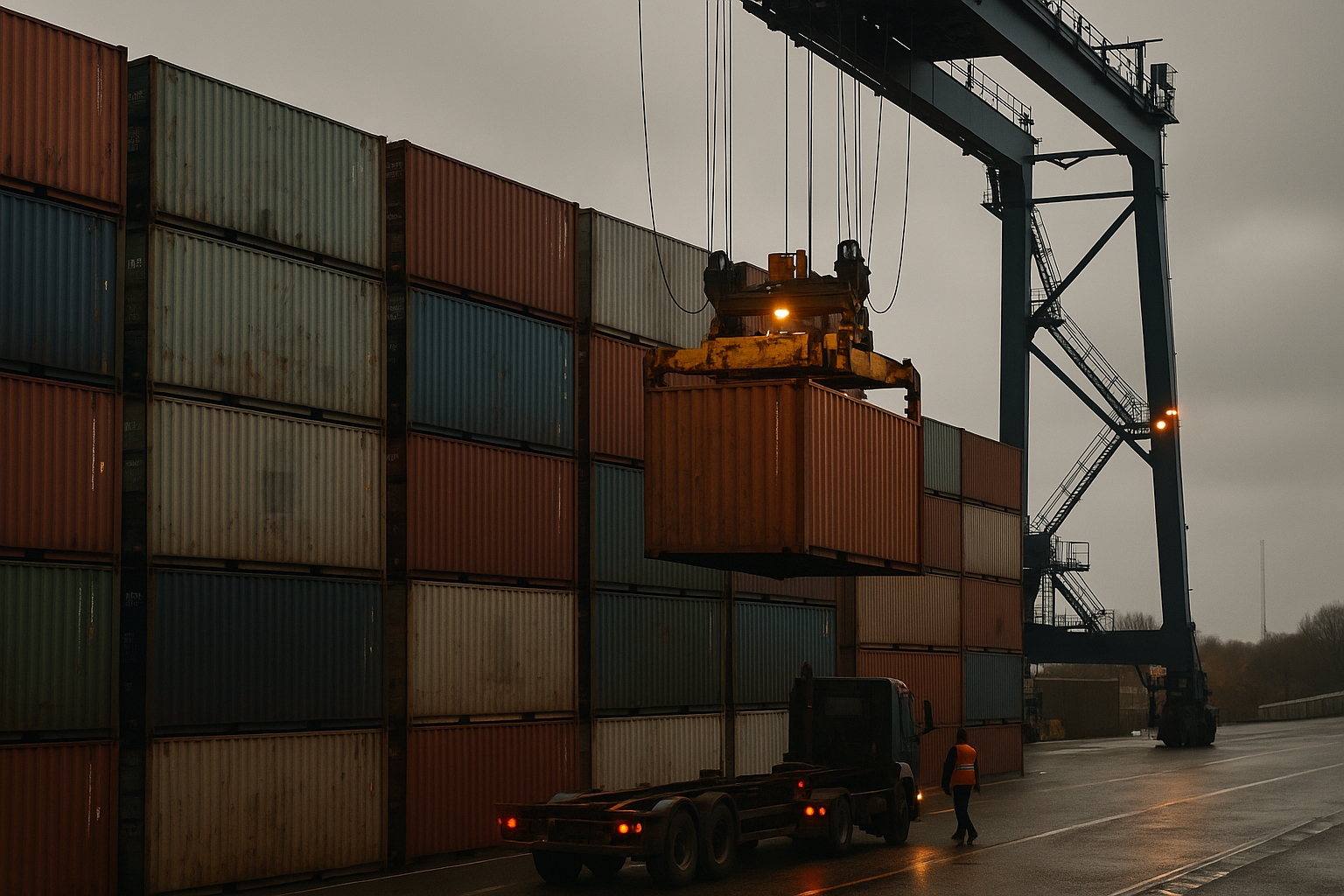
Q4 import planning is won or lost in the booking and documentation window, not at the quayside. The Department for Transport’s port freight statistics for 2025 show why: total UK port freight was essentially flat at 428.3 million tonnes, but imports rose 2% to 237.5 million tonnes while container tonnage jumped 10% — a 6.2 million-tonne increase, the largest of any cargo group. The volume is shifting towards exactly the traffic that peaks in October and November. If you are still deciding what to ship this week, this briefing gives you the working-back logic, the documentation traps and the inland bottlenecks that decide whether your Christmas stock sells or sits on a quay.
Key Takeaways
- UK container traffic grew 34% by units in Q3 2025 against Q3 2024, per Department for Transport quarterly statistics — the peak quarter is absorbing more volume than ever.
- Forwarder guidance is consistent: stock needed in early December should be landed by late October, which makes mid-October the last sensible booking window for many flows.
- CDS is now the UK’s only customs platform, so a declaration error at peak has no fallback system — check HMRC’s published downtime windows before you commit lodgement times.
- Congestion costs arrive as demurrage and detention after delayed container availability notifications; budget for them rather than pretending they will not happen.
- The inland leg — haulage slots, warehouse labour and container returns — is part of peak; a free container at a congested port is not a delivered sale.
Why Q4 2026 Is Tighter Than It Looks
The headline tonnage number hides what is happening to containerised flow. According to the DfT’s Port freight annual statistics 2025, total UK port freight fell by less than 1% to 428.3 million tonnes in 2025, yet imports grew 2% to 237.5 million tonnes while exports dropped 4% to 98.6 million tonnes. The direction of imbalance matters for peak season: more inbound volume is arriving on essentially the same port and inland infrastructure.
Container traffic is where the squeeze concentrates. Container tonnage rose 10% in 2025 — up 6.2 million tonnes, the largest absolute increase of any cargo group — with the Port of London up 38% after London Gateway’s fourth berth opened, per the same DfT release. More berths help, but only if rail sidings, road haulage and empty-container handling keep pace.
The quarterly data shows how lumpy the peak is. In Q3 2025, total UK container traffic grew 34% by units against Q3 2024, with London up 93% — a 230,200-unit increase — according to the DfT’s July-to-September 2025 quarterly statistics. Q3 is peak quarter for Christmas flows; a 34% year-on-year jump in units tells you that shipper behaviour, not port capacity alone, is driving congestion. Everyone wants the same October and November sailings, and the market clears by queueing rather than by price alone.
For context on how sailings behave outside peak, see our piece on blank sailings and equipment shortages in UK import planning — carriers withdraw capacity to support rates, and the same mechanism that thins schedules in slow months concentrates demand in peak ones.
The Congestion Reality at UK Gateways
Congestion at Felixstowe, Southampton, London Gateway and Tilbury is not a single phenomenon. It shows up in four distinct places, and each has a different cost attached.
First, vessel waiting times. Ships queue for berths when arrivals bunch up after weather or upstream delays. The Port of Felixstowe handles roughly half of Britain’s containerised trade, per the port’s own overview, so disruption there propagates across the whole of the UK’s container flow faster than at any other gateway. Second, berth productivity varies: a terminal working at reduced crane density turns a 24-hour port call into a 36-hour one, and that shortfall ripples into the next vessel’s slot.
Third, and most costly for importers, is delayed container availability notification. Per Insignia Shipping’s May 2026 analysis of UK port congestion, Q4 problems present themselves as late “available to collect” messages to importers and forwarders, meaning containers sit on terminal past their free time. That is when demurrage (the terminal charge) and detention (the shipping line’s charge on the box itself) start clocking, and inland hauliers miss their booked slots. Our guide to avoiding demurrage and detention charges covers the dispute mechanics; the planning point is simpler: assume a two- to three-day lag between vessel discharge and container availability in peak, and build that into free-time calculations.
Fourth, customs queues compound port queues. Where containers are held for examination or documentation is missing, the box occupies terminal space and your free clock runs regardless. If your flow regularly snarls at the border, our briefing on customs release bottlenecks and port inspections explains what triggers holds and how pre-lodgement discipline reduces them.
None of this means Q4 trade stops. It means the cost of slack planning rises sharply between October and December, and the DfT’s 2025 numbers show the volume base is higher than last year.
Booking Windows: Working Back from Christmas
The reverse-planning logic is simple and worth writing on the wall. According to guidance from forwarder Uneek Group published in September 2026, if a customer wants stock in early December, aim to land it in late October. That gives you roughly four weeks of buffer for port delay, customs hold, inland haulage and warehouse put-away — about the minimum survivable margin at peak.
Working further back: late-October landing means a mid-October sailing from Far East ports, which means booking with your carrier or NVOCC in early October at the latest. If you are reading this in mid-October, your realistic remaining options are narrowed but not zero. LCL consolidation still has space later than FCL because forwarders top up boxes weekly — our explainer on how LCL consolidation works covers the trade-offs in transit reliability for peak flows. For FCL, ask specifically about: confirmed loading on a named vessel rather than “space available”; equipment origin (a box positioned at an inland depot is faster to stuff than one awaited at the port); and whether the quoted rate carries a peak-season surcharge.
Rates have already moved. Drewry’s World Container Index was assessed at about US$4,526 per 40-foot container in late August 2026, with the Shanghai–Rotterdam reading near US$3,997 in mid-September — figures reported by Uneek Group’s peak-season guide, and worth treating as indicative rather than live quotes. The direction matters more than the level: ascending freight costs plus peak surcharges mean every week of delay adds cost as well as risk.
Two practical rules from operators who plan this well. One: split urgent and deferrable SKUs across two shipments — a smaller fast flow you can book late, and the bulk booked early. Two: agree inland transport in the same breath as the ocean booking. A landed container without a haulage slot is inventory, not sales.
Documentation Is the Cheapest Delay You Can Avoid
At peak, the cheapest delay is the one you never create, and documentation errors are the most avoidable delay of all. CDS is now the UK’s sole customs declaration platform — CHIEF was retired — so per HMRC there is no second system to fall back on when your declaration fails or needs correction at a critical moment. A rejected entry sits while everything behind it queues.
Start with the basics that fail most often: EORI numbers validated against the trader details file, and licence checks where controlled goods are involved, and commodity codes that match the invoice description. If a code is questionable, resolve it before shipment, not after arrival — our walkthrough of correcting customs declaration errors explains the amendment routes once an entry is lodged, and the landed-cost consequences of getting classification wrong are covered in our landed cost calculation guide.
Second, respect CDS planned downtime. HMRC publishes rolling maintenance windows on its CDS service availability page — one recent example ran from 7pm Saturday 26 September 2026 to 8:30am Sunday 27 September 2026. Schedule bulk lodgements and any time-critical entries around published windows, and brief your broker or in-house team so nobody fires a critical amendment into a planned outage on a Friday evening.
Third, align documents to a single version of truth. Peak-season errors cluster around: invoice values that differ from the booking; packing lists that do not match container seals; and consignee details that do not match the entry. A one-hour document check at origin saves days of terminal storage. Build it into your origin checklist as a named step with a named owner.
The Inland Leg Is Part of Peak
The port is only half the story. Every container you land in November needs a vehicle slot, a yard slot and labour to de-van it — and everyone else’s containers need the same three things in the same weeks.
Pre-book haulage for the arrival week, with two days of contingency either side. Book warehouse labour and de-vanning capacity now, particularly if you share a 3PL whose other clients have the same idea. Confirm container return logistics: a delayed pick-up turns into detention charges, and a full empty-yard at peak means returns need appointments. Where your flow runs through Felixstowe or the wider Suffolk corridor, check haulier availability early — regional drayage capacity tightens first because it is the least elastic part of the chain.
The DfT’s 2025 statistics showed London’s container volume up 93% by units in Q3 2025 against the prior year. Volume like that does not just test terminals; it tests every road, rail link and empty-container park downstream of them. Your plan should assume the inland leg, not the ocean leg, is the constraint that actually bites for late bookings.
What to Do This Week
Work through this list in order — it is sequenced so each step is only useful if the previous one is done.
- Inventory check: list every SKU you intend to sell from mid-November onwards, and mark which are already shipped, in transit, booked, or unbooked.
- Book the unbooked bulk: anything FCL and unbooked goes to your carrier today for the next available confirmed sailing, not “space available”.
- Split the long tail: SKUs that can wait go into one LCL consolidation with a mid-November arrival target.
- Verify paperwork: for each shipment, confirm EORI validity, commodity codes, licence needs and that invoice, packing list and entry data match one another.
- Check CDS downtime: read HMRC’s published windows and make sure no time-critical lodgement is scheduled into one.
- Reserve inland capacity: haulage slots for arrival weeks, warehouse de-vanning time, and empty-container return appointments.
- Budget the contingency: assume two to three days between discharge and container availability at peak, and cost the demurrage and detention exposure if the plan slips.
If you are late on any step, the honest answer is usually a split booking rather than hoping a single late FCL beats the queue.
Frequently Asked Questions
How early should Christmas stock be landed in the UK? Aim to land stock needed for early December by late October, per forwarder guidance from Uneek Group’s 2026 peak-season guide. That buffer of roughly four weeks absorbs port delay, customs processing, inland haulage and warehouse put-away. Stock needed for Black Friday (which falls in late November) should land one to two weeks earlier still, because the same November weeks are the most congested.
What causes most peak-season delays at UK ports? Delays concentrate in four places: vessel waiting times at congested berths, variable berth productivity, delayed container availability notifications, and customs holds. Per Insignia Shipping’s analysis, the demurrage and detention costs that follow availability delays are where importers feel it financially. Planning free-time windows realistically and pre-booked haulage mitigates most of the downstream impact.
Is CDS reliable enough to depend on at peak? CDS is now the UK’s sole customs platform and HMRC publishes planned maintenance windows in advance — for example, one window in late September 2026 ran from Saturday evening into Sunday morning. Reliability day-to-day is workable, but the operational rule is to schedule time-critical lodgements around published downtime and keep declaration data right first time, because corrections have nowhere else to go.
Should I use FCL or LCL for peak season? FCL gives you control of departure timing but requires earlier commitment and equipment availability. LCL consolidations run weekly and accept cargo later, which makes them the realistic option for late bookings, at the cost of slightly longer and less predictable transit. A common peak pattern is FCL for the bulk volume booked early, and LCL for the long tail booked late.
How do I limit demurrage and detention exposure? Negotiate free time up front where volumes justify it, monitor vessel ETA and container discharge events so you know when the clock starts, and have haulage booked with contingency so pick-up happens inside the free window. If a delay is the terminal’s or carrier’s fault, document it — evidence-based disputes recover money that passive acceptance forfeits.
What is the single highest-value action left in mid-October? Book whatever FCL remains unbooked today, demanding confirmed loading on a named vessel. Rate levels — Drewry’s World Container Index was around US$4,526 per 40-foot container in late August 2026, as reported in trade coverage — are rising into peak, and waiting costs both money and schedule certainty.