Key Takeaways
- Amazon’s upstream distribution service and growing Chinese-branded vehicle imports create different, sometimes competing, demands for UK logistics land.
- Amazon is the intended occupier, not a confirmed operating tenant, of the planned Biggleswade robotics facility described by Knight Frank.
- Southampton is the principal vehicle-import gateway identified by Knight Frank; vehicle compounds need more than warehouse floor area.
- Test power, access, planning consent and operating flexibility before treating headline availability as usable capacity.
Two demand shifts, two site specifications
Amazon’s move further upstream and rising vehicle imports are changing the questions UK operators should ask about property. One needs automated, inventory-rich distribution space with dependable power and fast onward transport. The other needs secure open storage, processing capacity and reliable access between ports and dealers. A vacant shed near a motorway may satisfy neither brief.
Knight Frank’s September 2026 industrial and logistics update reports that Amazon Warehousing and Distribution launched in the UK and four other European markets on 20 August 2026. Sellers can hold stock in Amazon-operated upstream distribution centres before it moves into fulfilment. That is distinct from a conventional seller sending stock directly into fulfilment centres. For a third-party logistics provider, the important question is which inventory functions Amazon will own and which services remain commercially attractive outside its network.
The same Knight Frank update attributes roughly 15% of UK new-car registrations in the first half of 2026 to Chinese-owned brands, nearly 175,000 vehicles and a rise of 121% year on year. Those are registration figures, not a direct count of vehicles handled at each port. They nevertheless indicate why importers, vehicle processors and transport providers are reviewing compound capacity. Growing registrations do not automatically translate into a shortage at every gateway: ship schedules, dealer release patterns and inventory dwell time determine the operational pressure.
The common constraint is suitable land rather than simply aggregate square footage. A high-bay building with insufficient electrical capacity is a poor automation candidate. A warehouse site without hardstanding, vehicle circulation and appropriate permissions is not a ready-made car compound. Operators should model the work to be done on a site before comparing rent or distance on a map. The approach in our network modelling guide is useful when several locations appear superficially equivalent.
What Amazon’s expansion changes for warehouse operators
Amazon’s upstream distribution offer changes inventory routing, not just the address on a lease. Sellers may use its distribution centres to replenish fulfilment capacity as demand changes. A 3PL working with those sellers should therefore establish whether it is supplying import reception, customs support, overflow storage, returns, non-Amazon channels or value-added work. Without that distinction, a proposed facility could be built around volumes that subsequently move into Amazon’s own network.
Knight Frank identifies Amazon as the intended occupier in planning documents for a planned 1.41 million sq ft robotics-sortable fulfilment facility at Symmetry Park, Biggleswade. The description is about a planned project and intended occupier; it does not establish that the building is complete, operating or contractually guaranteed. Biggleswade’s appeal is its reach into the South East and the wider national road network, but occupier-specific design still matters more than a postcode alone.
Automation creates a sequence of technical checks. Ask the landlord and distribution network operator for the available electrical connection capacity, the energisation programme, resilience options and the cost allocation for upgrades. Then establish clear height, floor loading, column grid, yard depth and the potential to alter the building. A robotics scheme may require a different fit-out and commissioning timetable from a manual warehouse; a missed power date can delay the entire operation even when the shell is ready.
Labour and transport must be examined alongside automation. Mechanical handling can change the mix of roles rather than remove the need for supervisors, technicians and peak-period staff. A site that works for inbound trunking may still perform badly when vans and HGVs compete for limited yard space. Before committing, run representative hourly flows through gate, dock and parking assumptions. Our warehouse labour planning briefing sets out why staffing availability belongs in the same site decision as rent.
Contract terms deserve equal scrutiny. An operator serving several customers needs to know whether automation can be repurposed, removed or shared when volume changes. Negotiate rights for equipment installation and maintenance access, clarify reinstatement obligations and identify who carries the risk of delayed utilities. If a customer agreement is shorter than the property commitment, model the cost of an empty or partially used building. The issue is especially acute where a bespoke layout narrows the pool of replacement occupiers.
Why vehicle imports create a different land problem
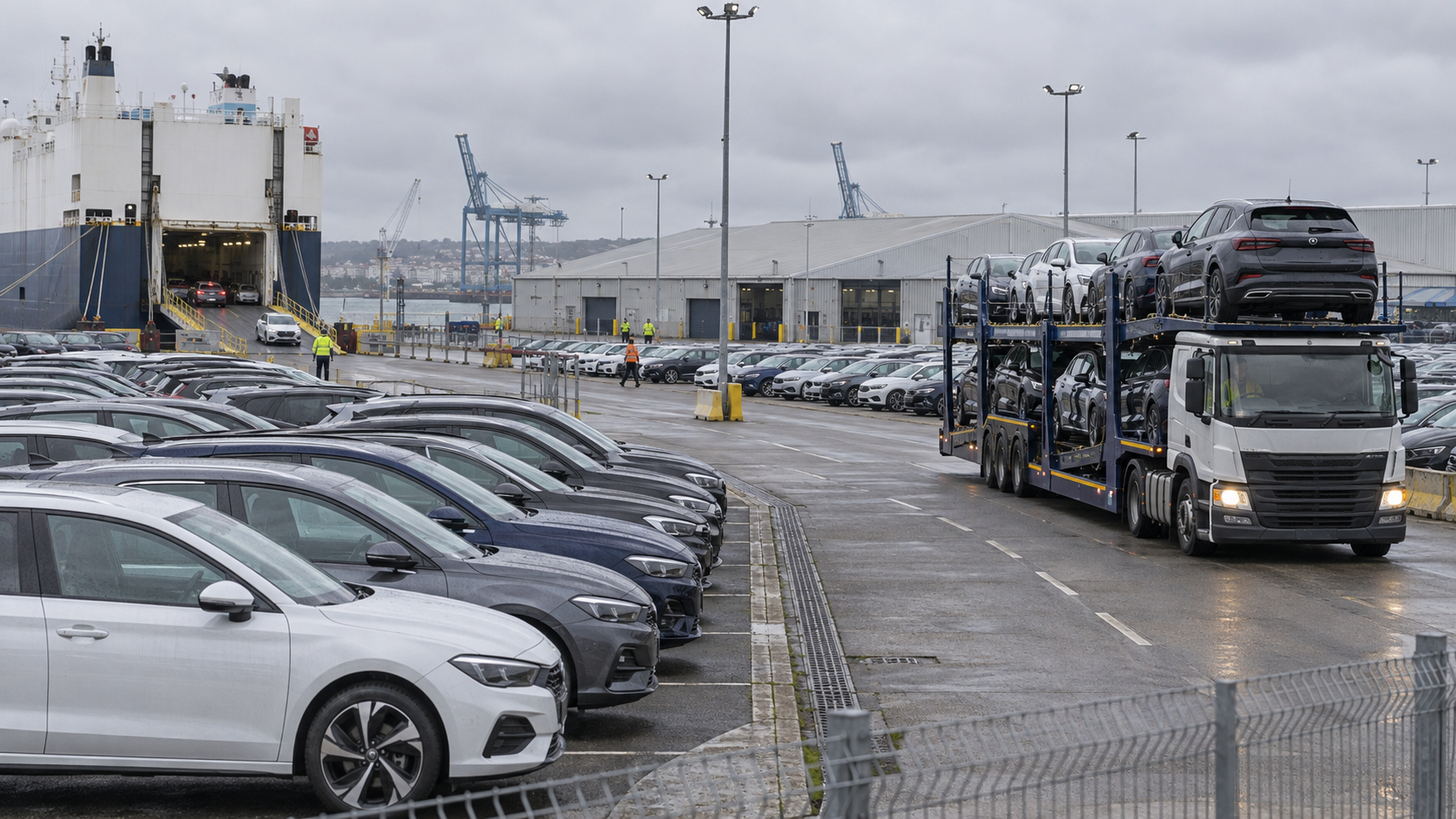
Vehicle imports need a chain of spaces, not simply a berth and a depot. Cars can require unloading, inspection, damage recording, charging or refuelling, valeting, accessory fitting, pre-delivery inspection and onward dispatch. Each step consumes time and manoeuvring space. Compounds also need security, lighting, drainage, controlled access and safe segregation between moving transporters and parked vehicles.
Knight Frank identifies Southampton as the primary UK port for high-volume Chinese vehicle imports and names Portbury, Liverpool, Teesport and Immingham as secondary beneficiaries. This is its market assessment, not a claim that every importer must use Southampton. Operators should compare the available shipping service, landside capacity and destination mix before assuming that the closest port is the lowest-cost route. A longer road leg may be offset by more reliable vessel access or faster vehicle processing.
Vehicle storage is sensitive to dwell time. A compound that appears ample at average throughput can become congested when a large vessel discharge coincides with delayed dealer allocation or transporter shortages. Calculate peak parked inventory from arrival patterns and realistic release times, then leave room for inspection holds and exceptions. The space estimate should cover circulation aisles, inspection bays and damaged-vehicle segregation, not just the footprint of tightly parked cars.
Electrical provision is increasingly a vehicle-site issue too. An electric vehicle processing centre may need charging capacity, safe charging procedures and a plan for vehicles that arrive at low state of charge. The charging requirement differs from the continuous industrial load of a robotics warehouse, but both can be constrained by grid connection timing. Ask for the maximum import capacity, available upgrade route and responsibilities for cabling before signing a site agreement. Physical room for chargers does not prove that the electrical connection can support them.
Planning and environmental constraints can rule out an apparently attractive parcel. Confirm the permitted use, operating hours, lighting conditions, surface-water arrangements and any restrictions on transport movements. Check whether neighbouring residential uses make night unloading impractical. For a leased compound, specify who pays for hardstanding, fencing and remediation, and what remains at lease expiry. Our UK port guide provides a broader comparison of gateway functions; the property decision still needs site-level diligence.
A practical map of the hotspots
The Midlands remain the main national big-box search area, but demand is not evenly distributed. JLL’s October 2026 big-box market update says the Midlands accounted for 70% of Grade A big-box take-up in the first nine months of 2026. It reports 19.8 million sq ft of take-up for units above 100,000 sq ft over that period. These are transaction measures, not a guarantee that a suitable unit remains available today.
For vehicle flows, the relevant map starts at the port and follows the dealer network. Southampton, Portbury, Liverpool, Teesport and Immingham should be assessed against vessel calls, compound options, road capacity and delivery destinations. There is no reason to send every vehicle through a single gateway if the importer can balance port schedules and regional distribution. Conversely, splitting volume across ports can increase coordination work and reduce economies of scale in processing.
Container-based retail and ecommerce networks may favour a different configuration. Felixstowe and London Gateway provide access to deep-sea container services, while Midlands nodes offer national reach for onward fulfilment. An operator receiving import containers should compare terminal appointment reliability, inland haulage, storage and customer cut-off times. The best port-to-warehouse route may differ from the best site for final-mile distribution.
Urban facilities near Birmingham, Manchester and Leeds solve a shorter-distance service problem but usually offer a different building and yard specification from national big-box sites. Heathrow and East Midlands Airport matter where air cargo speed and handling requirements justify the location. Do not place a slow-moving inventory reserve beside an expensive air-freight gateway merely because both are labelled logistics hotspots. Separate stock positioning, processing and delivery needs in the network model.
A simple evaluation matrix helps avoid choosing by map pin alone:
| Requirement | Big-box distribution | Vehicle processing | Urban fulfilment |
|---|---|---|---|
| Critical land feature | Dock and yard capacity | Secure hardstanding and circulation | Proximity to delivery catchment |
| Technical test | Power, floor and automation fit | Charging, drainage and inspection space | Van access and operating hours |
| Main timing risk | Fit-out and utility connection | Vessel peaks and vehicle dwell | Labour and delivery windows |
Use the matrix to reject sites early, then price the remaining candidates using the same demand and service assumptions. A cheap site that forces repeated cross-country transfers may be more expensive at network level. Equally, a premium location is not justified if the work can be performed at a less constrained node without damaging service.
Supply is available, but not always usable
Headline national supply can conceal a shortage at the required size or specification. JLL recorded 47.1 million sq ft of Grade A big-box supply at the end of the third quarter of 2026, 9% above the preceding quarter, and 12.7 million sq ft under offer. Those figures describe the market at that date; they do not prove that power, yard design or location match an individual operation. Space under offer should not be treated as freely available capacity.
Savills’ July 2026 analysis found that, among 304 available units nationally at the end of the first half of 2026, only 21 exceeded 400,000 sq ft and just 13 of those were Grade A. It reported only one completed Grade A extra-large unit available in the East Midlands. The distinction matters for an operator needing a single very large automated building. Several smaller vacant units cannot necessarily replace one integrated site without extra handling, transport and management cost.
Older stock can be viable when the operation is flexible. A manual cross-dock or reserve-stock facility may tolerate lower clear height or an imperfect column grid if the road connection and lease terms work. But apparent savings should be tested against energy use, maintenance, access restrictions and the cost of adapting the property. In a vehicle operation, a warehouse’s age may matter less than its compound configuration and permissions.
Do not assume today’s demand statistics set a permanent rental trajectory. Agent market updates describe activity and availability at a point in time; they are not a site-specific valuation or a forecast of customer volume. Ask for comparable transactions in the precise micro-market, inspect each property and stress-test rent against lower throughput. This helps separate a credible network investment from an expensive reaction to a headline.
An operator’s decision sequence
Start with the flow, not the property listing. Define weekly inbound volume, peak-day arrivals, average dwell, outbound destinations and the service promise. For vehicles, include vessel discharge batches and inspection exceptions. For seller inventory, distinguish upstream reserve stock from fast-moving fulfilment inventory. Put those assumptions into a scenario model with normal, peak and delayed-release cases.
Next, set non-negotiable site tests. Verify planning use, hours, HGV access, yard geometry, fire arrangements, security and utility capacity. Ask for written evidence of power availability and upgrade timing, not a verbal estimate. Visit at the operating times that matter: a clear access road at midday may be congested during a shift change or port release window. Record who is responsible for each remedial work item before heads of terms are agreed.
Then compare commercial flexibility. Check break rights, expansion land, subletting, automation alterations, reinstatement and the ability to serve more than one customer. Model both the full-volume and lost-customer cases. Our 3PL contract checklist is a useful companion when the property commitment depends on customer volumes. Property and customer agreements should not contain incompatible service or termination assumptions.
Finally, examine customs and inventory timing where imported goods are involved. The government’s announced low-value import relief timetable, described in Knight Frank’s 2026 update as moving to October 2028, is a planning horizon rather than a reason to assume every seller will hold stock domestically. Check the current legal position before changing declaration or duty processes. If a customs warehouse is proposed, assess authorisation, records, stock control and discharge procedures separately from the physical site; our customs warehousing guide explains the operational obligations.
Re-run the location decision when the facts change. A new shipping service, altered customer mix, power delay or slower vehicle release rate can change the preferred site. Keep the model transparent enough that operations, property and finance teams can test the same assumptions. The aim is not to predict a single winning hotspot, but to secure capacity that performs under the flows you actually expect to handle.
Frequently Asked Questions
Is Amazon’s Biggleswade robotics facility already operating? No. Knight Frank’s 2026 update describes Amazon as the intended occupier of a planned facility identified in planning documents. Treat its timing and eventual occupancy as unconfirmed until the project and occupier provide firmer evidence.
Which UK port is most relevant to Chinese-branded vehicle imports? Knight Frank identifies Southampton as the primary high-volume gateway and also points to Portbury, Liverpool, Teesport and Immingham. The right route for a particular importer depends on vessel service, vehicle processing capacity and dealer destinations.
Why can warehouse supply rise while operators still struggle to find a site? Aggregate supply includes buildings that may be too small, poorly located or technically unsuitable. JLL’s end-third-quarter 2026 supply figure therefore needs to be read alongside Savills’ much smaller count of very large Grade A units and each operator’s own power, yard and planning requirements.
Should a vehicle importer lease a conventional warehouse? Only if the site can support the actual handling plan. Secure hardstanding, circulation, inspection facilities, charging provision where needed, permissions and transport access may matter more than enclosed floor area. Test peak dwell and vessel discharge patterns before committing to a footprint.