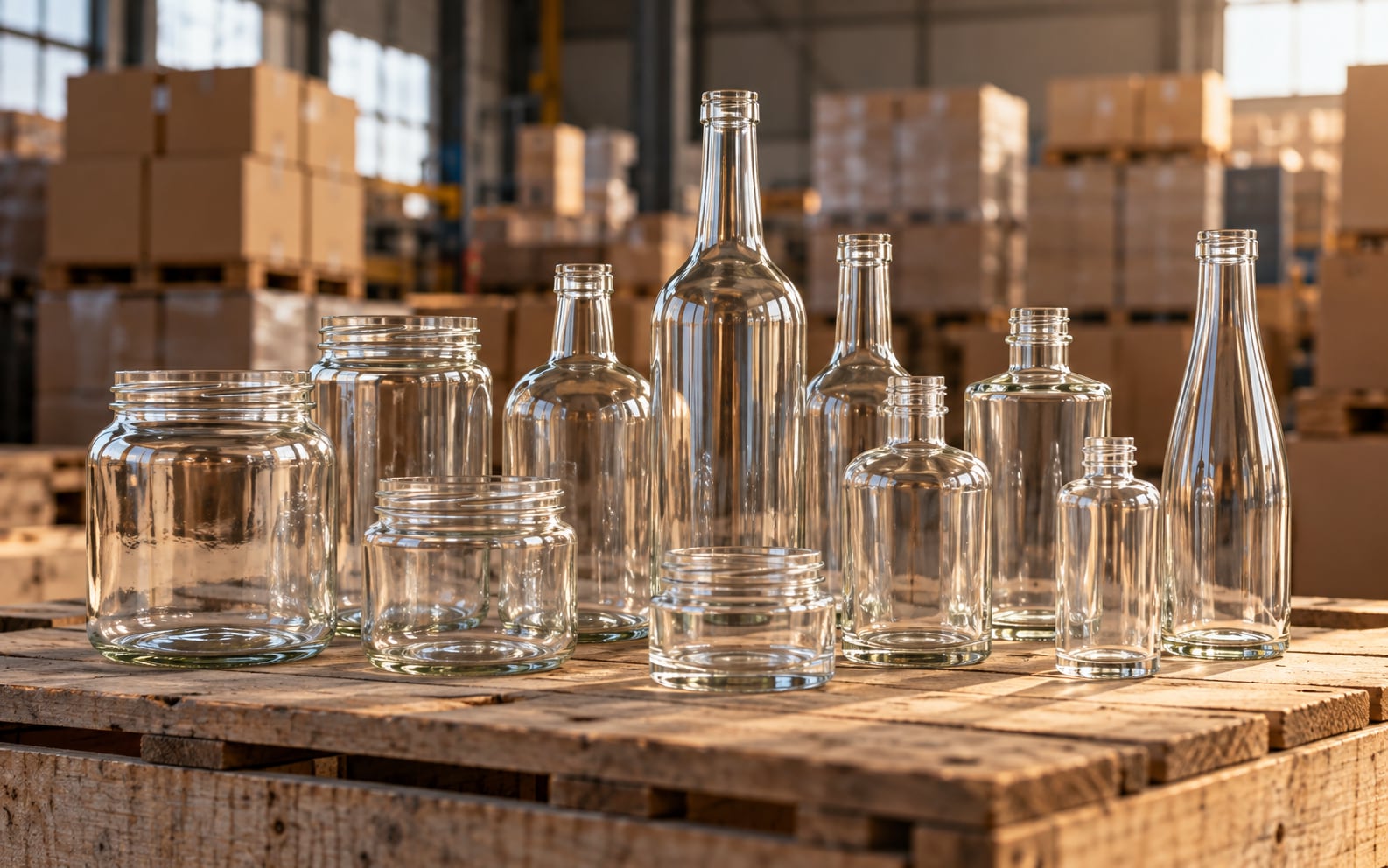
If you import jars, bottles, flasks or other glass containers from China, extra duty now applies at the border. The UK Trade Remedies Authority’s provisional anti-dumping measure on certain glass containers originating in China took effect on 9 September 2026, with rates running from 24.65% to 52.97% ad valorem, according to trade remedies notice 2026/25. HMRC collects the duty under additional codes 8A92 to 8A95, and every importer of the affected goods must lodge a guarantee for the estimated amount for up to six months while the UK decides whether a definitive measure should follow. See also autonomous tariff suspension update. See also Bonded Warehouse Ecommerce Network Design 2026.
The measure matters beyond glass suppliers. Any UK food, drinks, cosmetics or household-goods business with Chinese-sourced glass packaging in its supply chain now faces higher landed costs and a new cash-flow question: a bank guarantee lodged with HMRC, sized on customs value, that only becomes payable if the Trade Remedies Authority confirms a definitive duty. Get the paperwork wrong during the provisional period and you do not pay the exporter’s agreed rate — you pay the residual 52.97%.
Key Takeaways
- Provisional anti-dumping duty of 24.65% to 52.97% applies to certain glass containers from China from 9 September 2026, per trade remedies notice 2026/25.
- Exporter-specific rates: 26.87% for Huaxing Group (code 8A92), 24.65% for SPG Group (8A93), 25.88% for co-operating non-sampled exporters (8A94), 52.97% for all others (8A95).
- A guarantee — bank guarantee, bond or cash — is mandatory for all importers and is sized on the customs value of the goods.
- Without a valid commercial invoice carrying the Annex 2 declaration, the residual 52.97% rate applies.
- Affected commodity codes sit in the 7010.90 range; ampoules, tubular glass, vessels of 2.5 litres or more and standalone closures are excluded.
- The provisional period runs for a maximum of 6 months, or until a definitive measure is imposed, whichever comes first.
What the Provisional Duty Is and Who Decided It
The Trade Remedies Authority opened investigation AD0087 on 5 March 2026 after a complaint from UK glass producers. Its preliminary finding, published on 8 September 2026, was that Chinese producers sold the goods into the UK below normal value — in other words, they dumped them — and that this caused injury to UK industry, with evidence of undercutting and price suppression, according to the GOV.UK announcement “Clear protection for British glass: provisional measure imposed”.
The rates are not uniform. Notice 2026/25, Annex 1 sets exporter-specific rates:
| Exporter | Rate | Additional code |
|---|---|---|
| Huaxing Group | 26.87% | 8A92 |
| SPG Group | 24.65% | 8A93 |
| Non-sampled co-operating exporters | 25.88% | 8A94 |
| All other exporters (residual) | 52.97% | 8A95 |
| Goods outside the description | 0.00% | 8A96 |
The Secretary of State for Business, Innovation and Trade accepted the TRA’s recommendation to impose the provisional measure, which the government described as tariffs of up to 53%. The measure lasts a maximum of six months — so until roughly 8 or 9 March 2027 — or until a definitive remedy is imposed, whichever comes sooner, per trade remedies notice 2026/25.
How the Guarantee Works — and Why It Ties Up Cash
All importers must give HMRC a guarantee for the estimated duty during the provisional period. Acceptable forms are a bank guarantee, a bond or cash, according to trade remedies notice 2026/25. The recommended amount is the provisional ad valorem rate applied to the customs value of the goods.
The mechanics matter for cash-flow planning. If the TRA’s final recommendation leads to a definitive duty, the guaranteed amount becomes payable. If no definitive measure follows, the guarantee is released and no duty is collected. In practice, your bank treats the guarantee as committed credit for the duration of the provisional period, so a large glass programme can consume credit lines even before any duty is paid. Importers running high-volume food or beverage packaging should quantify the exposure now: customs value multiplied by the applicable provisional rate, per consignment, aggregated across the six-month window.
Two practical points. First, ask your bank early — guarantee issuance has lead times, and HMRC will expect the security in place as goods arrive under the additional codes. Second, if a definitive measure is not imposed, you have paid nothing beyond the cost of the guarantee facility, so the temptation to under-declare is not worth the penalty exposure: HMRC treats inaccurate declarations on trade-remedies goods as a compliance matter, and the additional codes make affected entries highly visible.
Which Goods Are In and Out of Scope
The measure covers carboys, bottles, flasks, jars, pots, phials, preserving jars and other glass containers used for the conveyance or packing of goods, with or without closures, per the goods description in notice 2026/25. That description maps onto the UK Global Tariff 7010.90 subheadings. The affected commodity codes listed in the notice are:
- 7010 9010 00
- 7010 9041 00
- 7010 9043 00
- 7010 9045 00
- 7010 9047 00
- 7010 9051 00
- 7010 9053 00
- 7010 9055 00
- 7010 9057 00
- 7010 9061 00
- 7010 9067 00
- 7010 9071 00
- 7010 9079 00
- 7010 9091 00
- 7010 9099 00
The exclusions are just as important as the inclusions. The measure does not cover ampoules, containers of tubular glass, glass containers with a nominal capacity of 2.5 litres or more, or glass stoppers, lids and other closures presented separately. Pharmaceutical businesses importing ampoules are outside the scope; producers of large-format vessels at 2.5 litres and above are also outside. Check the capacity specification against your product range before assuming exposure — a 2.4-litre jar is in, a 2.5-litre container is out.
Classification is the fulcrum here: the additional code and the duty rate both follow from the 10-digit commodity code on your customs declaration. The fastest route is the UK Integrated Online Tariff itself, or a classification workflow tool such as TariffFlow that checks the code and the live trade-remedies measure together and keeps the decision on record. Mis-code the goods and two things go wrong at once: you apply the wrong anti-dumping rate, and you file an incorrect customs declaration for the underlying tariff line.
What Importers Must Do Now
The provisional measure creates three immediate obligations per consignment: the correct additional code, a compliant invoice and a guarantee.
First, the additional code. On the CDS import declaration, add the exporter-specific additional code (8A92, 8A93, 8A94 or 8A95) to the commodity code. If your supplier is Huaxing Group or SPG Group, use their named code; if your supplier co-operated with the TRA investigation but was not sampled, use 8A94; if not, the residual code 8A95 and its 52.97% rate apply. Ask your Chinese supplier directly which category they fall into, and get it in writing.
Second, the invoice declaration. A valid commercial invoice must be presented to HMRC at importation, carrying a signed declaration in the wording set out in Annex 2 of notice 2026/25, per the notice. Without that signed statement on the invoice, the exporter-specific rate is unavailable — the residual 52.97% applies even if your supplier is actually SPG Group. This is paperwork, not negotiation: circulate the Annex 2 wording to your Chinese suppliers’ export teams, insist it appears on every invoice, and keep copies with your entry documents. If your supplier will not sign the declaration, treat that as a pricing signal — you are about to pay an extra 28 percentage points over their named rate.
Third, the guarantee. Lodge the bank guarantee, bond or cash with HMRC before goods arrive, sized on customs value at the applicable provisional rate. Your broker or customs agent can confirm the current amount methodology; the figure follows the notice, not your landed-cost spreadsheet.
If your goods are genuinely outside the product description — ampoules above, or closures entering under their own code — use additional code 8A96, which carries a 0.00% rate, and keep the evidence that supports the out-of-scope position. The distinction between an in-scope jar and an out-of-scope closure is exactly the kind of classification question worth getting right: our guide to UK anti-dumping duties covers how to check measures before you import. For the paperwork that carries the rate, see commercial invoice requirements for UK imports.
What Happens Next: The Definitive Duty Decision
The provisional measure is a bridge, not a destination. The TRA will now complete its investigation and submit a final recommendation to the Secretary of State before the investigation closes. If a definitive duty is imposed, HMRC collects it, and your lodged guarantees convert into payable duty. If the TRA recommends no definitive measure, guarantees are released. Either way, the definitive decision is expected before the six-month provisional window lapses — around March 2027 at the latest on the current timetable.
Watch two parallel threads. First, a separate TRA anti-subsidy investigation into glass containers from Turkey is also running, per the same GOV.UK announcement — so a second measure on a second origin could follow, and importers who diverted sourcing from China to Turkey should not assume the problem is solved. Second, the exporter-specific rates can change between the provisional and definitive stages as the TRA refines its dumping calculations, so named suppliers’ rates today are not guaranteed tomorrow.
Do not conflate this case with measures in other jurisdictions. The United States runs its own trade-remedy actions against Chinese glass containers through its own authorities; rates and scope there are different, and coverage of a “global” glass duty is inaccurate. This article concerns the UK measure only.
Reducing Exposure Without Breaking the Rules
You cannot opt out of a trade-remedies measure, but you can manage around it legitimately.
Review the sourcing decision with the numbers in front of you. A 24.65% provisional rate on SPG Group material is material in a packaging budget; a 52.97% residual rate on an un-named supplier is often decisive. For UK food and drink producers, the counterweight is domestic supply: the sampled UK producers behind the complaint employ around 2,099 people and generated £244 million in gross value added, according to the GOV.UK announcement of 8 September 2026, and domestic lead times for standard jars and bottles have improved as UK capacity has been defended.
Check the exclusions against your product specification. If part of your range sits at or above 2.5 litres, or counts as ampoules or tubular glass, that part is out of scope — split it out on your declarations rather than pulling it under the measure.
Keep records that prove the rate you used. The invoice declaration, the supplier’s confirmation of its co-operation status, the additional code filed on each entry and the guarantee reference together form the audit trail. If a definitive measure lands with different rates, retrospective adjustments are far easier with a clean paper trail. For the underlying mechanics of how additional codes and duty calculations interact, see how commodity codes drive your duty bill, and for the entry-level mechanics see CDS import declaration codes.
The next milestone is the TRA’s final recommendation. Set a diary entry for early 2027, monitor trade remedies notice updates on GOV.UK for the definitive measure, and re-run your landed-cost model when the definitive rates are published — because between now and then, every Chinese glass container you land carries the provisional rate, the additional code, and a guarantee your finance team should already know about.