Key Takeaways
- Italy remains a major UK supply market: UK imports from Italy were £34.4 billion in 2024, according to the ONS-backed UK-Italy trade factsheet on business.gov.uk.
- Italian goods can enter at 0% customs duty under the UK-EU Trade and Cooperation Agreement, but only when they meet the relevant rules of origin and the importer holds valid origin evidence.
- Fashion imports need careful commodity-code work because clothing, footwear, leather goods and accessories can sit in different tariff chapters with different fallback duty rates.
- Food and drink imports split sharply by product type: shelf-stable pasta is straightforward, while cheese, cured meats and some composite products may need IPAFFS pre-notification and health certification under the Border Target Operating Model.
- Import VAT still applies even when customs duty is 0%, so postponed VAT accounting and clean CDS data matter for cash flow and audit control.
The short answer
Importing from Italy is no longer an intra-EU movement. It is a customs import, with a CDS declaration, GB EORI, commodity code, customs value, origin and VAT treatment for every consignment.
The good news is that many Italian-made goods can enter the UK at 0% customs duty under the UK-EU Trade and Cooperation Agreement (TCA). The bad news is that the 0% rate is not automatic. You must classify the goods correctly, claim preference on the customs declaration and hold the right statement on origin from the Italian exporter.
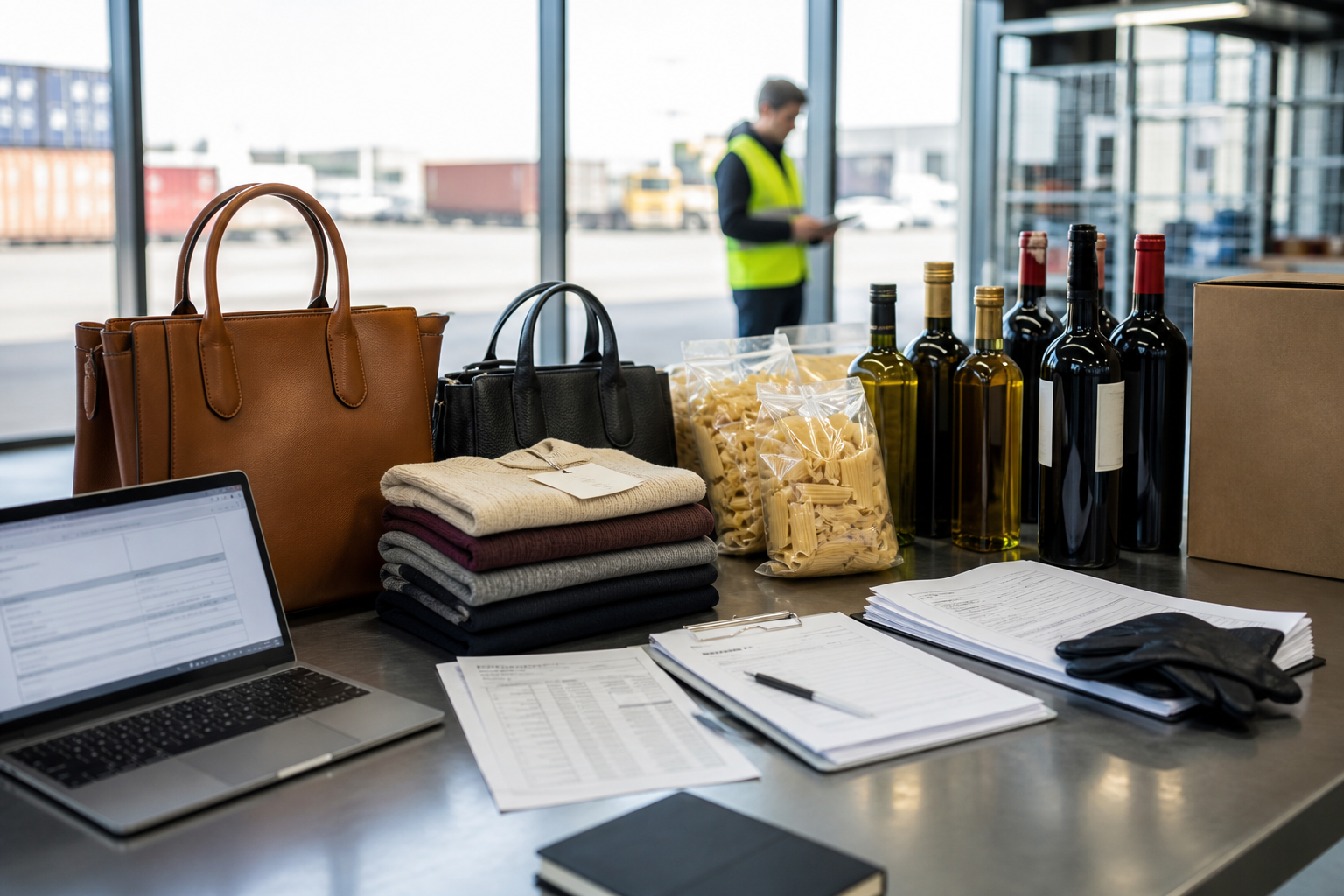
That distinction matters most in two Italian categories UK buyers import heavily: fashion and food. A Milan-made jacket, a Tuscan leather bag, a pallet of Parmigiano Reggiano and a mixed order of pasta, sauces and cured meat all follow the same broad customs process, but their duty rates, documents and border controls differ. Treating them as “EU goods” without product-level checks is how importers overpay duty, miss SPS requirements or delay a trailer at the border.
Use this guide before you place the order, not after the lorry has left.
Why Italy needs product-level import planning
Italy is one of the UK’s largest European trading partners. The ONS-sourced UK-Italy factsheet on business.gov.uk puts total trade at £52.8 billion in 2024, including £34.4 billion of UK imports from Italy and £18.5 billion of UK exports to Italy. That scale shows up in everyday supply chains: apparel, footwear, wine, specialist food, machinery, furniture, packaging, cosmetics and design-led consumer goods.
The operational trap is familiarity. UK buyers often have long-standing Italian suppliers, so the shipment can feel routine. Since Brexit, routine does not mean customs-light. Every commercial consignment from Italy needs a CDS declaration with the correct commodity code, origin, customs value, procedure code and preference claim.
Build the import file at SKU level. For each SKU, record the commodity code, country of origin, supplier origin statement, invoice description, net weight where needed, UK duty rate, VAT rate and any licence, excise or SPS requirement. That file supports your broker, landed-cost model and HMRC audit trail.
TCA preference: 0% duty is conditional
The UK-EU TCA keeps customs duty at 0% for qualifying goods that originate in the EU or UK. GOV.UK’s list of UK trade agreements in effect confirms the TCA remains the active UK-EU trade agreement, but the agreement gives a preference only where the product-specific origin rule is met. Dispatch from Italy is not enough.
For simple Italian-origin products, the position may be straightforward. Olive oil produced from Italian olives, wine made in Italy from Italian grapes or cheese made in Italy from EU milk will often be EU-origin, subject to the detailed rule for that commodity code. For fashion goods, the answer can be less obvious. A garment sewn in Italy from imported fabric may or may not qualify, depending on the tariff classification of the materials and the product-specific processing rule.
To claim the preference, you normally need a statement on origin from the exporter on the invoice or another commercial document. For EU exporters, consignments above EUR 6,000 generally require the exporter to include its Registered Exporter (REX) number. Below that threshold, the statement may be made without a REX number, but the wording and the supporting evidence still matter.
Keep the statement with the import entry record. You do not usually submit it with the customs declaration, but HMRC can ask for it later. If you claimed 0% duty and cannot produce evidence during a post-clearance check, HMRC can reassess the entry at the non-preferential rate, with interest and possible penalties.
The practical rule is simple: do not ask the broker to claim TCA preference unless the supplier has given you a valid origin statement and you believe the goods meet the rule. Use the rules of origin guide alongside your product file.
Commodity codes for Italian fashion
Fashion imports from Italy need classification work before pricing, not after purchase. The UK Integrated Online Tariff separates apparel, footwear, leather goods and accessories into different chapters, and small design differences can move a product from one heading to another.
Common fashion areas include:
| Product type | Typical tariff area | Why it matters |
|---|---|---|
| Knitted or crocheted clothing | Chapter 61 | Fibres, garment type and gendered cut can change the heading |
| Woven clothing | Chapter 62 | Suits, coats, shirts and dresses are treated separately |
| Leather bags and accessories | Chapter 42 | Material, outer surface and use affect the code |
| Footwear | Chapter 64 | Upper material, sole material and use drive classification |
| Jewellery and imitation jewellery | Chapter 71 | Precious-metal content changes the duty and compliance position |
If the goods qualify as EU-origin and you hold a valid statement on origin, the customs duty rate under the TCA is normally 0%. If they do not qualify, the UK Global Tariff rate applies. The research notes for this article point to typical fallback ranges of roughly 8-12% for clothing, 3-8% for footwear and 3-5% for leather goods, but you should always check the exact code in the UK Integrated Online Tariff before quoting a landed cost.
The most common fashion error is confusing “made in Italy” branding with preferential origin. Labelling rules, consumer-facing country-of-origin claims and customs origin are related but not identical. If a jacket is designed in Milan, cut in Italy and sewn from non-EU fabric, the TCA rule for that heading decides whether it qualifies. Marketing language on a lookbook does not.
For high-volume SKUs, document the classification rationale once and reuse it. Note the construction, fibre composition, material percentages, intended user, photographs and supplier technical sheet. For complex product ranges, a workflow tool such as TariffFlow can help check HMRC tariff data and retain the classification decision for audit.
Food and drink: separate shelf-stable from controlled goods
Italian food imports need two parallel checks: customs treatment and sanitary or phytosanitary (SPS) control. Pasta, olive oil, balsamic vinegar and many ambient packaged foods are usually simpler than cheese, meat, fish, plants or high-risk composite products. The product’s commodity code matters, but so does its BTOM risk category.
GOV.UK’s Border Target Operating Model sets the post-Brexit framework for risk-based controls on EU imports. Low-risk goods may move with commercial documentation only. Medium-risk goods can require an export health certificate, IPAFFS pre-notification and possible documentary or physical checks. High-risk goods face tighter controls and may need to enter through an approved border control post.
In practical terms:
| Italian product | Customs point | Regulatory point |
|---|---|---|
| Dry pasta | Usually 0% duty if EU-origin | Usually low regulatory burden if shelf-stable |
| Olive oil | Origin and classification still required | Marketing standards and labelling need checking |
| Wine | TCA duty may be 0% if originating | UK alcohol excise and movement controls still apply |
| Cheese | TCA origin plus correct Chapter 4 classification | May need health certification and IPAFFS depending on risk category |
| Prosciutto and cured meats | Chapter 2 or 16 classification affects treatment | SPS controls are likely to be more demanding |
| Fresh fruit and vegetables | Check commodity code and origin | GOV.UK says EU fruit and veg plant-health controls are currently treated as low risk, with marketing standards controls not expected before 1 February 2027 |
Do not let a mixed pallet travel on vague descriptions such as “Italian groceries” or “food products”. Your broker needs product-level descriptions, commodity codes, weights, invoice values and any certificates. A vague description can lead to the wrong risk routing and a delay while the carrier or agent asks for missing detail.
Alcohol deserves separate planning. Italian wine may qualify for 0% customs duty under the TCA if it is EU-origin, but UK excise duty is a different charge from customs duty. Make sure the importer, warehouse or excise specialist knows who is accounting for excise and how the movement is being declared.
The import documents you need
Most Italy-to-UK imports need the same core document set, built before dispatch.
Start with the commercial invoice. It should show seller and buyer details, invoice number and date, Incoterms, currency, line-level product descriptions, quantities, unit values, total value, country of origin and transport references where available. If you are claiming TCA preference, the statement on origin must appear on the invoice or another commercial document that clearly identifies the goods.
Add a packing list with cartons, pallets, weights and dimensions. This matters for freight planning, but also for border checks and warehouse receiving. If you import food, the packing list should match the product descriptions on any certificates and IPAFFS notification.
You also need transport evidence, usually a CMR note for road freight, an airway bill for air freight or a bill of lading for sea freight.
Before the declaration is submitted, confirm the importer’s GB EORI number and CDS access. The customs entry then needs the commodity code, customs value, origin, preference claim, procedure code, VAT treatment and any licence, certificate or excise reference.
For food, add the SPS documents. Depending on the product and risk category, that may include an export health certificate, IPAFFS notification, catch certificate, phytosanitary certificate, organic certificate or marketing-standard evidence. Do not assume the Italian supplier’s EU paperwork is enough for UK import. Ask the broker or regulatory adviser before collection.
VAT, duty deferment and landed cost
Even where customs duty is 0%, import VAT normally still applies. UK import VAT is calculated on the customs value plus duty and certain transport or insurance costs, depending on the valuation and Incoterms position. For standard-rated goods, that usually means 20% VAT accounted for at import.
Postponed VAT accounting is available to UK VAT-registered importers and can remove the cash-flow hit of paying import VAT at the border. Instead of paying VAT to the carrier or deferment account and reclaiming it later, you account for it on the VAT return. Your monthly postponed import VAT statement then becomes a key reconciliation document for finance.
Duty deferment is separate. If customs duty, excise or import VAT is payable at the border, a duty deferment account lets you pay HMRC by monthly direct debit rather than per consignment. Regular importers should decide whether to use their own deferment account, a broker’s account or immediate payment. The wrong setup can create avoidable holds when a consignment reaches the UK.
Build landed cost from the same data used for the customs declaration. At minimum, include supplier price, inland collection, international freight, insurance, UK clearance, duty, excise where relevant, port or terminal charges, delivery and any inspection or storage costs. If you use DAP, DDP, FOB or FCA terms without modelling who pays which cost, your margin analysis will be wrong. The FOB vs CIF guide helps explain how freight terms change the landed-cost calculation, while the Incoterms guide covers responsibility for clearance, freight and risk.
Practical checklist before the first shipment
Use this checklist before the supplier books collection:
- Confirm the UK importer has a valid GB EORI number and CDS registration.
- Classify every SKU using the UK Integrated Online Tariff and record the commodity code.
- Confirm the true country of origin for each SKU, not only the country of dispatch.
- Ask the Italian supplier for a valid TCA statement on origin where preference will be claimed.
- Check whether the exporter needs to include a REX number for consignments above EUR 6,000.
- Decide the Incoterm and make sure export and import clearance responsibilities are clear.
- Build a line-level commercial invoice with usable descriptions, values, quantities and origins.
- For food and drink, check BTOM risk category, IPAFFS, health certificates, excise and labelling.
- Decide whether import VAT will be handled through postponed VAT accounting.
- Send the broker a structured pre-alert with invoice, packing list, transport document and certificates.
The best time to fix a customs issue is before dispatch. Once goods are at the border or an airport shed, every missing document becomes urgent.
FAQ
Do I pay customs duty when importing from Italy to the UK?
You may pay 0% customs duty if the goods qualify as EU-origin under the UK-EU TCA and you claim preference correctly on the customs declaration. If the goods do not qualify, or you do not hold a valid statement on origin, the UK Global Tariff rate applies. The rate depends on the commodity code, so check the UK Integrated Online Tariff before pricing the shipment.
Is Italian-made clothing automatically duty-free?
No. Italian dispatch and Italian branding are not enough. The garment must meet the TCA product-specific rule of origin, and the exporter must provide a valid statement on origin. Clothing made in Italy from non-EU materials may qualify in some cases, but the answer depends on the precise tariff heading and the processing carried out.
Do I need IPAFFS for Italian food imports?
It depends on the product and BTOM risk category. Shelf-stable foods such as dry pasta are usually simpler, while products of animal origin such as cheese or cured meat may need IPAFFS pre-notification and health certification. Check the current GOV.UK guidance for the product category before the goods leave Italy.
Can I use postponed VAT accounting for imports from Italy?
Yes, UK VAT-registered importers can usually use postponed VAT accounting for imports from Italy. It lets you account for import VAT on your VAT return instead of paying it at the border and reclaiming it later. You still need accurate CDS declarations and monthly postponed VAT statements for reconciliation.
What Incoterm is best for Italy-to-UK imports?
There is no single best term, but FCA and DAP are often cleaner than EXW for regular UK importers. EXW can leave the UK buyer dealing with Italian export formalities, while DDP can create UK tax and customs complications for the Italian seller. Choose the term that matches who can realistically handle export clearance, freight, insurance, import clearance and VAT.