Key Takeaways
- Carriers are only partially back through the Suez Canal. Drewry’s base case, set out by head of container research Simon Heaney, has transits reaching 80% of pre-diversion levels by February 2027 — a forecast, not a settled re-opening.
- Asia–Europe spot rates fell for 12 consecutive weeks to the Drewry World Container Index reading of 1 October 2026, then bounced 3% on 15 October. The one-way slide is over, at least for now.
- Suez routings save carriers roughly USD 1m per round voyage, or about USD 43 per slot — thin margins that war-risk premiums can wipe out entirely.
- UK importers are still paying surcharges: MSC’s combined piracy and Suez Canal charges run at USD 91 per TEU through October 2026, and Maersk raised its Felixstowe emergency fuel surcharge to £4.13 per import laden container from 1 October.
- Rate relief and surcharge relief are separate things. Falling spot rates will not pull surcharges off your invoice unless you contract for it.
What Has Actually Changed
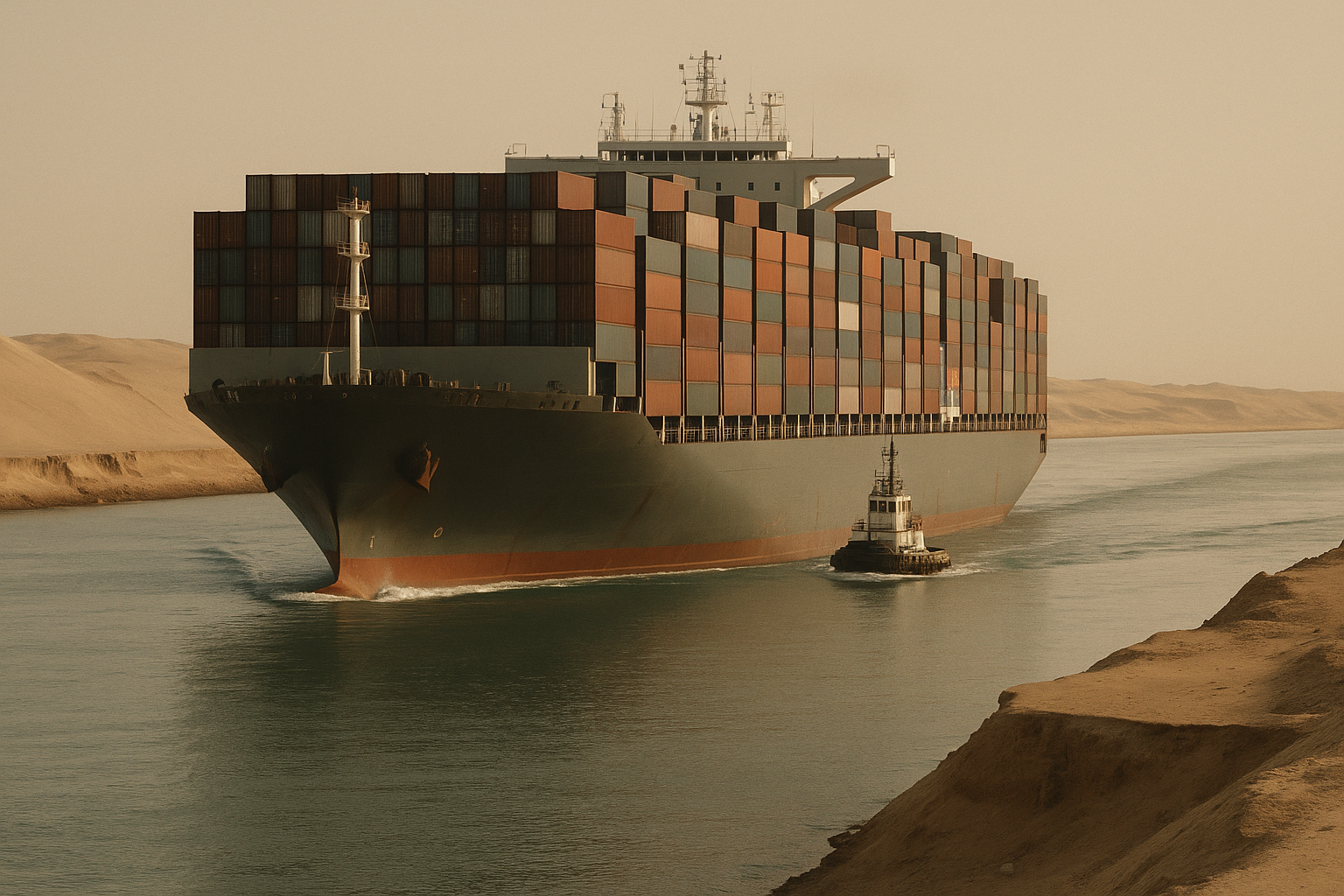
Some of the world’s biggest carriers are steaming through the Suez Canal again — but only some, and only on some legs. The shift started modestly in July and August 2026, and Drewry now expects phased transits to reach 80% of pre-diversion levels by February 2027, with the rate then held flat through its forecast horizon. That positioning matters: Drewry frames the return as optionality-driven, meaning carriers want the ability to use Suez when economics allow, not a commitment to abandon the Cape route.
The named sailings make the partial nature clear. CMA CGM has run eastbound Suez transits on its AE5 service from Algeciras on 22 September, its AE11 from Vado Ligure on 28 September, and has scheduled its ME2 from Port Tangier for 31 October, according to reporting by Carra Globe. Two further CMA CGM services — MEX/OA MED2 and FAL1/OA NEU4 — have had their backhaul legs rerouted via Suez, which cuts round-trip transit time by one week and frees one vessel per service. That last detail is the commercial logic in miniature: a shorter loop means less tonnage needed to run the same schedule.
The transit numbers support the story. Suez Canal Authority data, as reported in trade press summaries of the Drewry World Container Index, showed containership transits in week 39 of 2026 running 68% higher than the same week a year earlier. That is a large increase, but you should read it against a very low base: for most of 2024 and 2025, the bulk of Asia–Europe tonnage avoided the canal entirely after attacks on shipping in the Red Sea.
None of this amounts to a full re-opening. Carrier behaviour is inconsistent by design, and the risk picture has not improved in step. CU Lines’ 2,400 TEU CUL Klang came under small-arms fire in the southern Red Sea in early October 2026, per The Loadstar — yet other carriers continued Suez routings regardless. If you assumed safety drove every routing decision, that inconsistency should correct your assumption. Carriers are weighing slot economics, canal discounts, war-risk premiums and schedule reliability, and different carriers are landing in different places.
The Rate Picture for UK-Bound Boxes
The Drewry World Container Index tells a story in three readings this month. On 1 October 2026, the composite stood at USD 4,434 per 40ft container, down 1% week on week, with Asia–Europe the main drag as Golden Week factory closures in China thinned cargo volumes. A week later, on 8 October, the index slipped a further 2% to USD 4,351 per 40ft. Then on 15 October it rose 3% to USD 4,485 per 40ft — mainly on an Asia–Europe increase, the first reversal after the 12-week slide.
For UK importers, the most relevant figure is Shanghai–Rotterdam, the closest proxy for North Europe. It fell 2% to USD 3,399 per 40ft in the 1 October reading, then to USD 3,337 on 8 October. Compare that with the transpacific trades: Shanghai–Los Angeles was flat at USD 7,835 and Shanghai–New York rose 1% to USD 10,428 in the same reading. Asia–Europe is, on the index, less than half the cost of Asia–US East Coast — a gap that reflects how much capacity the returning Suez routings have released onto the Europe trade.
Two cautions apply. First, the WCI is a market average across assessed spot transactions, not a quote you can ship on; your actual rate depends on your contract, your volume and your carrier mix. Second, date-stamp everything. These figures are as at mid-October 2026, and the market has already reversed direction once this month. If you are budgeting Q4 landed costs on the assumption that the 12-week slide continues, the 15 October uptick is your warning.
Why the Capacity Came Back
The Suez route saves carriers roughly two weeks per round voyage compared with routing via the Cape of Good Hope. On a scheduled service, two weeks is not a nuisance — it is a ship. Shorter loops mean fewer vessels to charter, less fuel burnt and more annual sailings per string, which is why backhaul rerouting alone let CMA CGM free a ship on each of two services.
But the raw saving is smaller than the transit-time advantage suggests. Drewry’s slot-cost comparison, set out by Simon Heaney in the firm’s “Back to Suez” analysis, puts the benefit of Suez versus the Cape at about USD 1m per round voyage for a service of 24,000 TEU ships — roughly USD 43 per slot. That figure excludes war-risk premiums and canal discounts, and both move the answer.
War risk can swallow the saving outright. A premium of 0.3% of hull value on a 24,000 TEU newbuild priced at USD 225m adds roughly USD 1.35m per round voyage — enough on its own to tip the economics marginally back towards the Cape, per Drewry’s analysis. In other words, the entire Suez decision is being made on a margin thinner than one insurance line item.
Carriers that do use Suez often offset the economics with canal discounts negotiated with the Suez Canal Authority, which is why the return has been selective: the carriers with the best discount arrangements and the lowest war-risk premiums move first. Meanwhile capacity discipline is loosening elsewhere — Drewry recorded 10 announced blank sailings for the week after 1 October 2026, down from 13 the previous week, with five on Asia–Europe, down from six. Fewer blank sailings mean more effective capacity on the water, which is itself a downward pressure on rates.
The Surcharges UK Importers Are Still Paying
Here is the part that matters most for your landed cost: the return to Suez has not switched off the surcharges. Two concrete examples.
MSC extended its Piracy Risk and Suez Canal surcharges through October 2026 at a combined USD 91 per TEU — USD 55 piracy risk plus USD 36 Suez Canal, per the carrier’s advisories reported via Drewry. On a fully laden 24,000 TEU ship, those charges amount to a theoretical USD 2.18m per voyage. Reported practice among insurers is to rebate around 50% on incident-free voyages, but the rebate is the carrier’s problem, not the shipper’s — the invoice line you pay is the headline surcharge.
UK gateway costs are adding their own layer. Maersk raised its Emergency Fuel Surcharge at the Port of Felixstowe from £3.82 to £4.13 per import laden container with effect from 1 October 2026, according to the carrier’s customer advisory of 17 September. That sits alongside the Port of Felixstowe’s own charge for all import full containers, set at £23.55 in the port’s 2026/27 tariff covering 1 April 2026 to 31 March 2027.
Note what these figures are and are not. The Maersk line is a fuel recovery tied to congestion and quayside activity at Felixstowe — you can read more on that in our article on the Felixstowe emergency fuel surcharge. The Felixstowe £23.55 is a port infrastructure charge. Neither is a “Suez surcharge” in the strict sense, though both land on the same invoice as the Asia–Europe rate you negotiate. UK importers largely absorb these carrier and port surcharges as pass-throughs on the freight invoice; there is no published UK-wide total, so track your own by invoice line.
The takeaway is simple: rate relief and surcharge relief are different things. Spot rates can fall for three months while your per-container surcharge stack stays exactly where it is.
The Insurance Trap When Routing Changes Mid-Contract
This is where the partial return creates genuine risk for shippers. War-risk cover is priced per voyage, and the premium depends on the route. If your cargo is booked on a Cape-of-Good-Hope routing with insurance basis reflecting that, and the carrier quietly switches the vessel to a Suez transit after the booking, the cover may not follow the ship.
Antonis Rigalos of ShiftX, quoted by The Loadstar, made the case for what shippers actually need from a routing decision: plannable, safe and consistent. A carrier that changes routing between booking and sailing is — from the cargo owner’s chair — none of those three, even if the change is commercially sensible for the operator.
The practical protection is paper, not trust. Before fixing a booking on any Asia–Europe service this quarter, get two things in writing: the agreed routing or the carrier’s right to change it with notice, and the insurance basis — who bears war-risk premium and on what route assumption. If you are buying on CIF terms, your seller arranges the insurance and you inherit its assumptions; if you are buying FOB and arranging your own cover, you control this directly. The allocation of cost and risk between buyer and seller is set by your Incoterms 2020 rule, and it determines whether the routing-change problem is yours to manage or your counterparty’s.
What to Do in Q4 Contracting
The returning-capacity window is a negotiating opportunity, but only if you contract for the volatility. A concrete checklist for Q4 discussions with your carriers or forwarders:
- Fix the quoted rate’s validity period. With the index bouncing 3% in a single week, a quote without a stated validity date is an invitation to a mid-negotiation re-price.
- Put the routing in the contract. Name the routing basis (Suez or Cape) and any notice period for a change. If the carrier switches from Cape to Suez after booking, you want agreed terms on lead time and insurance.
- Cap surcharge pass-through. MSC’s USD 91 per TEU is “extended through October 2026” — nothing says it continues at that level into November. Negotiate a cap, an expiry date or a pass-through formula rather than an open-ended line.
- Allocate war-risk premium explicitly. Ask who bears it and whether it is included in the quoted rate. With USD 1.35m of potential premium per voyage swinging carrier decisions, this is not a rounding error in your freight budget either.
- Set a re-quote trigger. Agree a market move — for example, a percentage change in the Drewry WCI Asia–Europe assessment — that reopens the rate. This protects both sides from a market that is clearly not done moving.
Where UK gateway congestion interacts with your schedule — Felixstowe and Southampton capacity, dwell time and the knock-on for your lead times — our overview of UK port delays in 2026 has the wider picture. And if you want the baseline story of how the diversion itself drove UK import costs, that is covered in our piece on the Red Sea crisis and UK import costs.
Frequently Asked Questions
Is the Red Sea safe for shipping again?
No — the risk has not gone away, and carrier behaviour proves the point. CU Lines’ CUL Klang came under small-arms fire in the southern Red Sea in early October 2026, as reported by The Loadstar, yet other carriers continued Suez transits. Carriers are making commercial routing decisions route by route, service by service. Treat any claim that “the Red Sea is open again” as marketing, not fact.
Will Asia–Europe rates keep falling?
They fell for 12 consecutive weeks to the 1 October 2026 Drewry WCI reading, then rose 3% on 15 October — the first reversal. Nobody can promise the direction; the reversal suggests the slide has at least paused. For budgeting, use a range rather than a trend line, and date-stamp whatever figure you use.
Are the piracy and Suez surcharges coming off?
Not yet. MSC’s combined USD 91 per TEU surcharge is extended through October 2026, and carriers can levy surcharges independently of the headline rate. Falling spot rates and falling surcharges are separate conversations with separate drivers. Ask your carrier directly when each surcharge will be reviewed, and get the answer in writing.
Does Suez routing shorten my lead time?
Yes, materially — roughly two weeks per round voyage versus the Cape, which is why CMA CGM advertised its Japan–North Europe string as a trans-Suez service with a 30-day transit to Europe. But only on services actually routed via Suez, and carriers may change routing after booking. Confirm the routing at booking stage and check whether your lead-time planning reflects it.
Is my cargo insured if the carrier reroutes?
Only if your insurance basis covers the actual route. War-risk cover is priced per voyage and route-specific. If the carrier switches from a Cape to a Suez routing after your booking, your cover may not follow. Get the routing and insurance basis in writing before fixing, and if you are on CIF terms, check what assumptions your seller’s policy carries.