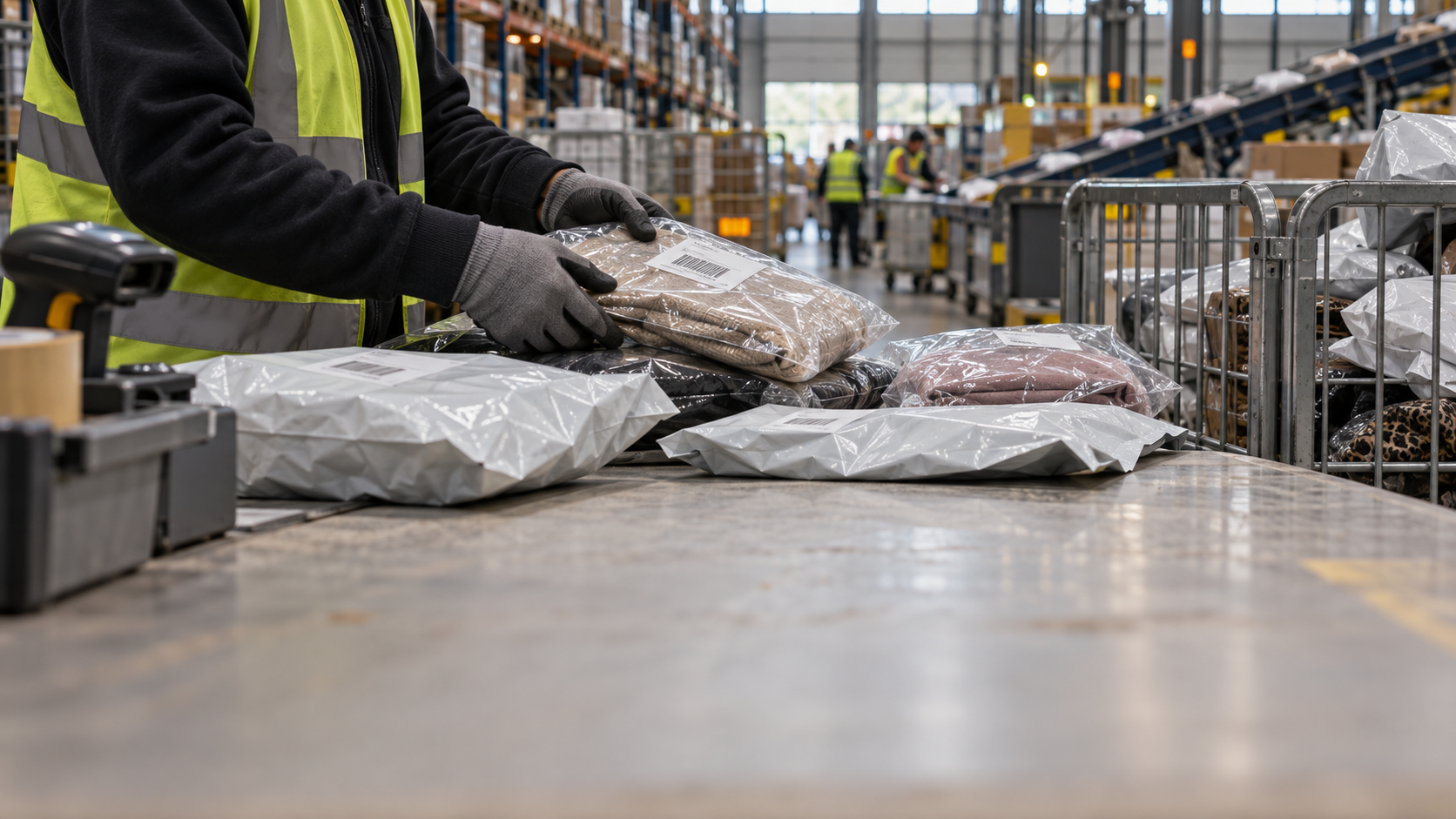
Chinese ecommerce is now a measurable part of UK warehouse demand, but it is not the whole market. The practical point for occupiers, landlords and 3PLs is more specific: Chinese platforms and their logistics partners are adding pressure to Grade A fulfilment space while retailers and logistics operators are already taking most large units.
JLL’s 2026 note on Chinese ecommerce in the UK says operators including JoyBuy/JD.com, Shein, Temu and TikTok Shop are reassessing their UK logistics footprint. The same note says Chinese ecommerce operators and their logistics partners have taken less than 8 million sq ft of Grade A big-box logistics space in Great Britain over the past decade, which makes the category smaller than some headlines suggest. The change in 2026 is that this demand is becoming more operationally complex, with local fulfilment, returns handling and regional coverage moving higher up the agenda.
That matters because the wider warehouse market is already tight in the places ecommerce operators want to be. JLL’s UK Big-Box Market Dynamics for H1 2026 reported 12.9 million sq ft of big-box take-up, up 3.0% year on year, with 10.9 million sq ft under offer at the end of H1. Logistics Manager, reporting BNP Paribas Real Estate data, put H1 2026 take-up for units above 100,000 sq ft at 15.9 million sq ft.
Key Takeaways
- Chinese ecommerce is a fast-growing source of demand, not the sole driver of UK warehouse take-up in 2026.
- The strongest immediate pressure is on Grade A fulfilment units with returns capability, labour access and parcel-carrier connectivity.
- The Midlands remains the natural first choice, but full UK service coverage points towards a more distributed network over time.
- 3PLs should expect more tenders that combine inbound handling, pick-pack, returns grading and customs/VAT data control.
- Low-value import reform may change parcel economics, but warehouse planning should use confirmed GOV.UK timelines rather than assumptions.
The Market Backdrop Is Already Tight
Large-warehouse demand in 2026 is not waiting for one occupier category to move it. JLL reported UK big-box take-up of 12.9 million sq ft in H1 2026, while BNP Paribas Real Estate figures reported by Logistics Manager put the equivalent large-unit figure above 100,000 sq ft at 15.9 million sq ft. The two datasets are not identical, but both point in the same direction: demand for larger logistics buildings stayed active through the first half of the year.
Retail and logistics occupiers are the important context. Logistics Manager’s report said logistics operators accounted for 45.5% of H1 2026 take-up and retailers for 36.7%, meaning those two groups together represented more than four-fifths of large-warehouse demand. Chinese ecommerce sits inside that broader retail and logistics story rather than outside it.
Availability is also not loose enough to absorb every new requirement easily. Logistics Manager reported that available big-box industrial space fell 2.5% during Q2 2026 to just over 58 million sq ft, with Grade A availability down 4.2% quarter on quarter. JLL said Grade A big-box supply was 3% higher quarter on quarter at the end of Q2 2026 but still 3% lower year on year, and prime headline logistics rents rose 1.4% in the six months to June 2026.
For occupiers, that means Chinese ecommerce demand is arriving in a market where good space already has a queue. If you need a modern unit with automation readiness, high yard capacity, parcel sortation space and fast access to labour, you are competing with food, fashion, general retail, parcel carriers and contract logistics providers.
What Makes Chinese Ecommerce Demand Different
The distinctive feature is the move from import-led parcel flow towards local fulfilment. A cross-border parcel model can be run through air freight, postal channels, courier hubs and customs brokers without committing to many large UK warehouses. A domestic fulfilment model needs stock positioning, returns capacity, carrier injection points and systems that can handle very high SKU variety.
JLL says existing Chinese ecommerce logistics networks in the UK are still concentrated in the Midlands. That makes sense because the region offers national reach, motorway access and an established base of parcel, 3PL and big-box occupiers. For the first wave of expansion, a Midlands fulfilment centre can cover much of the country while keeping transport options open.
The next wave is different because delivery promises and returns economics become harder to manage from one national node. JLL frames the requirement as geographically distributed fulfilment centres with modern ecommerce functions, including returns processing capability.
The named occupiers show that this is not only about marketplace brands taking space in their own names. Logistics Manager reported that Chinese ecommerce and fulfilment companies accounted for 12% of total UK take-up in Q2 2026, up from 6.2% across 2025, and named Cainiao, J&T Express, TopCloud Logistics and SHEIN among occupiers. Some requirements will therefore come from platform-owned operations, while others will come through logistics partners, parcel networks and specialist ecommerce fulfilment providers.
Why The Midlands Is Still First In Line
The Midlands remains the default location for national ecommerce distribution because it gives the best compromise between reach, labour and logistics infrastructure. Logistics Manager reported Midlands take-up of 10.4 million sq ft in H1 2026, up 58.4% year on year, including more than 3 million sq ft from facilities larger than 500,000 sq ft. That volume shows how heavily the region is being used for large-format logistics decisions.
For Chinese ecommerce operators, the attraction is straightforward. A Midlands hub can receive inbound containers, feed parcel carriers, serve a wide delivery radius and connect with 3PL labour pools that already understand peak ecommerce volumes. It is also easier to benchmark costs, service levels and carrier cut-off times in a mature logistics cluster than in a new location with fewer comparable operations.
The risk is that the same cluster advantage creates congestion in the property search. A platform or fulfilment partner that waits for a perfect building may find itself bidding against grocery, parcel, fashion and general merchandise requirements. If the brief includes mezzanine potential, automation power, clear eaves, cross-docking options, good welfare space and room for returns grading, the shortlist can shrink quickly.
That does not mean every Chinese ecommerce requirement will land in the Midlands. Once operators have proven volumes, returns rates and carrier performance, secondary nodes around the South East, North West, Yorkshire or Scotland become easier to justify.
The Shift From Storage To Fulfilment
Warehouse demand from Chinese ecommerce should not be read as simple storage demand. The more valuable requirement is fulfilment capacity that can process inbound stock, pick single orders, manage returns, support marketplace data flows and inject parcels into several carriers. That is a more complex operating model than a bulk import warehouse.
The building specification follows the process. Operators need floor area for inbound sortation, pick faces, returns inspection, repacking, quality checks and outbound despatch. They also need yard layouts that can handle frequent trailer movements, courier collections and seasonal peaks without blocking inbound replenishment. A generic storage-and-pick proposal is unlikely to win mature tenders; the stronger offer will show how returns are triaged, stock accuracy is maintained and carrier labels are controlled.
If you are choosing between outsourced and owned operations, the decision should be tied to control points rather than ideology. An outsourced model can be faster if a provider already has labour, systems and carrier integrations in place. An in-house model may be better where returns grading, product data and marketplace reputation are too sensitive to hand over. Our guide to 3PL versus in-house logistics sets out that trade-off in more detail.
What 3PLs Should Prepare For
3PLs should expect Chinese ecommerce tenders to test speed and flexibility more than storage price alone. The customer may be a platform, a seller aggregator, a parcel operator, a fulfilment partner or a brand using Chinese supply chains. Each version has a different risk profile, but the common requirement is the ability to scale activity quickly without losing inventory control.
The first preparation step is to map operational capacity by process, not only by square footage. A building may have space on paper but still lack the labour plan, packing benches, returns stations or parcel collection windows needed for a high-volume ecommerce account.
The second step is data readiness. Ecommerce clients will ask for stock accuracy, order status visibility, carrier scan performance and returns-cycle reporting. For cross-border sellers, the same data discipline also supports customs valuation, VAT accounting and audit trails. If the operation uses bonded or customs-controlled stock, the network choices in bonded warehouse ecommerce design are relevant here.
The third step is to be honest about automation. Automation can help where the volume profile is stable enough to justify it, but Chinese ecommerce can bring a wide, fast-changing SKU base. Before committing to robotics, conveyors or automated sortation, test whether the product mix, order profile and returns condition support the investment. Our article on UK warehouse automation ROI is a useful benchmark for that decision.
What Landlords And Developers Should Watch
Landlords should treat Chinese ecommerce as a specification-led demand source. The occupier may want power capacity, goods-in segregation, mezzanine consent, deeper yards, office space for operations teams, high-speed connectivity and enough parking or transport access for shift labour. These details can decide whether a nominally suitable big-box unit actually works.
Lease structure will also matter. Some ecommerce operators will want rapid occupation and flexibility because market share can move quickly. Others may need a long commitment if the building is being fitted out with automation, conveyors, bespoke racking or returns infrastructure.
Location strategy should also look beyond the first warehouse. If a platform starts with a Midlands hub, the next decision may be whether to add regional nodes or use carrier line-haul to reach the rest of the UK. Sites close to dense parcel networks, labour pools and motorway corridors will stay attractive if operators move from a single-node model to a distributed fulfilment network.
Developers should be cautious about building only for the most visible brand names. The named take-up reported in 2026 includes logistics and fulfilment partners as well as ecommerce brands. A unit that works for a specialist fulfilment provider may capture the demand even when the end customer is a platform, marketplace seller or overseas retailer.
Low-Value Import Reform Is A Planning Variable
The customs policy backdrop is important, but it should not be overstated. GOV.UK’s consultation on reforming the customs treatment of low-value imports says the government reviewed increased volumes of low-value imports valued at £135 or less. The Autumn Budget 2025 announcement said the relief would be removed by March 2029 at the latest, with the consultation outcome added on 13 July 2026.
That timetable gives operators a direction of travel rather than a fully detailed operating model for every parcel route. It may encourage more stock to be held domestically if cross-border low-value parcel economics become less attractive.
For warehouse planning in 2026, the sensible approach is to build scenarios rather than make one policy bet. If more inventory moves into UK fulfilment, demand for pick-pack and returns capacity rises. If some sellers absorb the change through pricing, parcel routing or marketplace structures, the warehouse impact may be more gradual.
The practical link is data. Operators that know product values, commodity codes, origin, VAT treatment and seller responsibility will adapt faster than operators with fragmented product records. Even where the article is about warehouses, the customs data attached to the goods can determine whether the fulfilment model remains profitable.
How Importers And Retailers Should Respond
UK importers and retailers should start by separating property decisions from service decisions. A larger warehouse is not automatically the answer if the real bottleneck is returns processing, late inventory visibility, poor carrier performance or weak product data. Chinese ecommerce competition raises the standard for speed and availability, but it also exposes process weaknesses inside existing networks.
Review your warehouse footprint against order density and returns behaviour. If most sales are concentrated around a few regions, a single national node may still work. If service promises, carrier costs or returns cycle times are worsening, a second node or a different 3PL model may be justified before the peak season forces the decision.
You should also review contracts for flexibility. Chinese ecommerce growth can affect labour competition, carrier capacity and local rent expectations even if you never handle goods for those platforms. A renewal or tender that ignores those market pressures may lock in assumptions that no longer hold by the time the operation goes live.
Finally, connect warehouse planning with wider ecommerce logistics changes. Demand from platforms, fulfilment partners and parcel operators is part of the same pressure described in our UK ecommerce logistics trends for 2026.
Frequently Asked Questions
Is Chinese ecommerce driving all UK warehouse demand in 2026?
No. The evidence supports Chinese ecommerce as a growing segment within a broader market led by retail and logistics occupiers. Logistics Manager reported that logistics operators accounted for 45.5% of H1 2026 large-warehouse take-up and retailers for 36.7%, while Chinese ecommerce and fulfilment companies accounted for 12% of total UK take-up in Q2 2026. That is significant, but it is not the whole market.
Why do Chinese ecommerce operators favour the Midlands?
The Midlands offers national reach, strong motorway links, parcel-carrier depth and an established logistics labour market. It is a practical first location for a UK fulfilment hub because one site can serve much of the country. The trade-off is competition for high-quality buildings, especially large units with ecommerce and returns capability.
Will low-value import reform force more UK warehousing?
It may encourage more domestic fulfilment, but the exact warehouse impact depends on the final operating model and how sellers respond. GOV.UK has confirmed the direction of reform for low-value imports valued at £135 or less, with removal of the relief by March 2029 at the latest. Operators should plan scenarios rather than assume one immediate outcome.
What kind of warehouse space is most exposed to extra demand?
Modern Grade A space with ecommerce fit-out potential is most exposed. The strongest demand is likely to be for units that can support inbound sortation, high SKU counts, pick-pack, returns grading, parcel despatch and reliable labour access. Older stock can still work, but only if the process design and building constraints line up.
What should 3PLs do before chasing this work?
3PLs should prove process capacity, not just quote space and rates. They need a clear plan for returns, inventory accuracy, carrier integration, peak labour and marketplace data flows. A credible tender response should show how the provider will protect service levels when order volumes, SKU counts and returns all rise together.