Key Takeaways
- Robotics as a Service is a contract and financing model, not a separate robot category.
- The model can suit UK warehouses that need automation capacity but cannot justify heavy upfront capital spend.
- Subscription, pay-per-robot and pay-per-pick pricing all need whole-life cost modelling before signature.
- Service levels, WMS integration, data rights and exit terms matter as much as the robot hardware.
- RaaS works best where volumes are clear enough to price, but variable enough to make flexibility valuable.
What Robotics as a Service Means
Robotics as a Service, usually shortened to RaaS, lets a warehouse use robotic systems through a recurring service contract rather than a one-off equipment purchase. The robot might be an autonomous mobile robot, a goods-to-person storage system, a picking cobot or another automation platform. RaaS describes how the equipment, software and support are bought. It does not describe a single technology.
That distinction matters for UK operators comparing options. A bought autonomous mobile robot and a RaaS autonomous mobile robot can move the same tote through the same aisle. The difference sits in the commercial model: who owns the asset, who maintains it, how software upgrades are handled, what happens when volumes rise, and what the warehouse owes if volumes fall.
The model has become more relevant because automation demand is rising while many operators remain cautious about capital spend. Grand View Research data cited by OPEX projects the UK warehouse automation market reaching an estimated £2.7 billion by 2030, with a 19.5% CAGR from 2025 to 2030. That is strong enough to make automation a board-level topic, but it does not remove the cash-flow problem for a mid-sized 3PL or retailer that still has to fund racking, labour, energy, leases and systems work.
RaaS offers a way to test and scale robotics with a lower initial commitment. It can also make seasonal capacity easier to plan. But it is not automatically cheaper than buying, and it is not a shortcut around process design.
Why UK Warehouses Are Looking at RaaS Now
The pressure is coming from e-commerce volume, labour constraints and the need for more predictable fulfilment performance. Logistics UK cites Office for National Statistics data showing UK online retail sales reached £128.6 billion in 2025, equal to 29% of total retail sales. That share creates demand for smaller orders, later cut-offs, faster replenishment and more returns processing than many legacy warehouses were built to handle.
The labour picture is more complicated than a simple shortage story. The UK logistics workforce totalled around 2.6 million people in Q4 2025, about 8% of total UK employment, according to Logistics UK’s Employment and Skills Report 2026 as reported by trans.info. Warehouse operatives were the largest group, at 413,800 roles. That scale shows why automation decisions affect workforce planning, not just engineering budgets.
For many operators, the issue is capability as much as headcount. Peak-ready fulfilment now needs supervisors who can manage exception queues, engineers who can diagnose automation faults, and planners who understand how slotting, replenishment and picking logic interact. RaaS can reduce some maintenance burden because vendors typically include remote support, upgrades and replacements.
There is also a competitive benchmark problem. OPEX reports that more than 85% of UK fulfilment warehouses are expected to be automated by 2030. Treat that as a market projection, not a guarantee, but it gives a useful signal: automation is moving from exceptional project to expected operating capability. Warehouses that wait for perfect certainty may find themselves comparing manual cost bases against competitors already using goods-to-person picking, mobile robots or automated sortation.
How RaaS Contracts Usually Work
Most RaaS agreements combine hardware access, software, maintenance and support into one commercial package. Interlake Mecalux and AutoStore both describe models ranging from recurring fees to pay-per-use structures, with services such as maintenance, software upgrades, training, remote assistance and replacement support included. In practice, the contract shape matters more than the label.
Common pricing models include:
| Model | How it works | Best fit | Main risk |
|---|---|---|---|
| Fixed monthly subscription | You pay a recurring fee for agreed robot capacity and support. | Stable throughput with predictable shifts. | Paying for unused capacity in quiet periods. |
| Pay-per-robot | Fees scale with the number of deployed robots or modules. | Sites adding capacity in phases. | Cost rises quickly if productivity assumptions are wrong. |
| Pay-per-pick or pay-per-move | Charges follow completed work units. | Seasonal fulfilment or 3PL customer variability. | Minimum volume commitments can weaken the flexibility benefit. |
| Hybrid model | A base fee plus usage or peak charges. | Warehouses with known baseline demand and volatile peaks. | Harder budgeting and more complex invoice checking. |
The accounting treatment is often part of the appeal. RaaS can shift spend from capex towards opex, which may help when capital approval is slow or when a customer contract does not justify buying permanent automation. Finance teams still need to model the full contract life. A low entry cost can hide a higher five-year cost if minimum terms, index-linked increases, software charges or termination fees are not understood.
Service levels need careful drafting. A useful RaaS contract should define uptime, response times, parts availability, software update windows, data access, cybersecurity obligations and what happens when the system misses agreed throughput. It should also say who pays for layout changes, WMS integration changes and extra training when the operation changes. These points are not legal niceties; they decide whether the warehouse can keep shipping during peak week.
Technologies Commonly Offered as RaaS
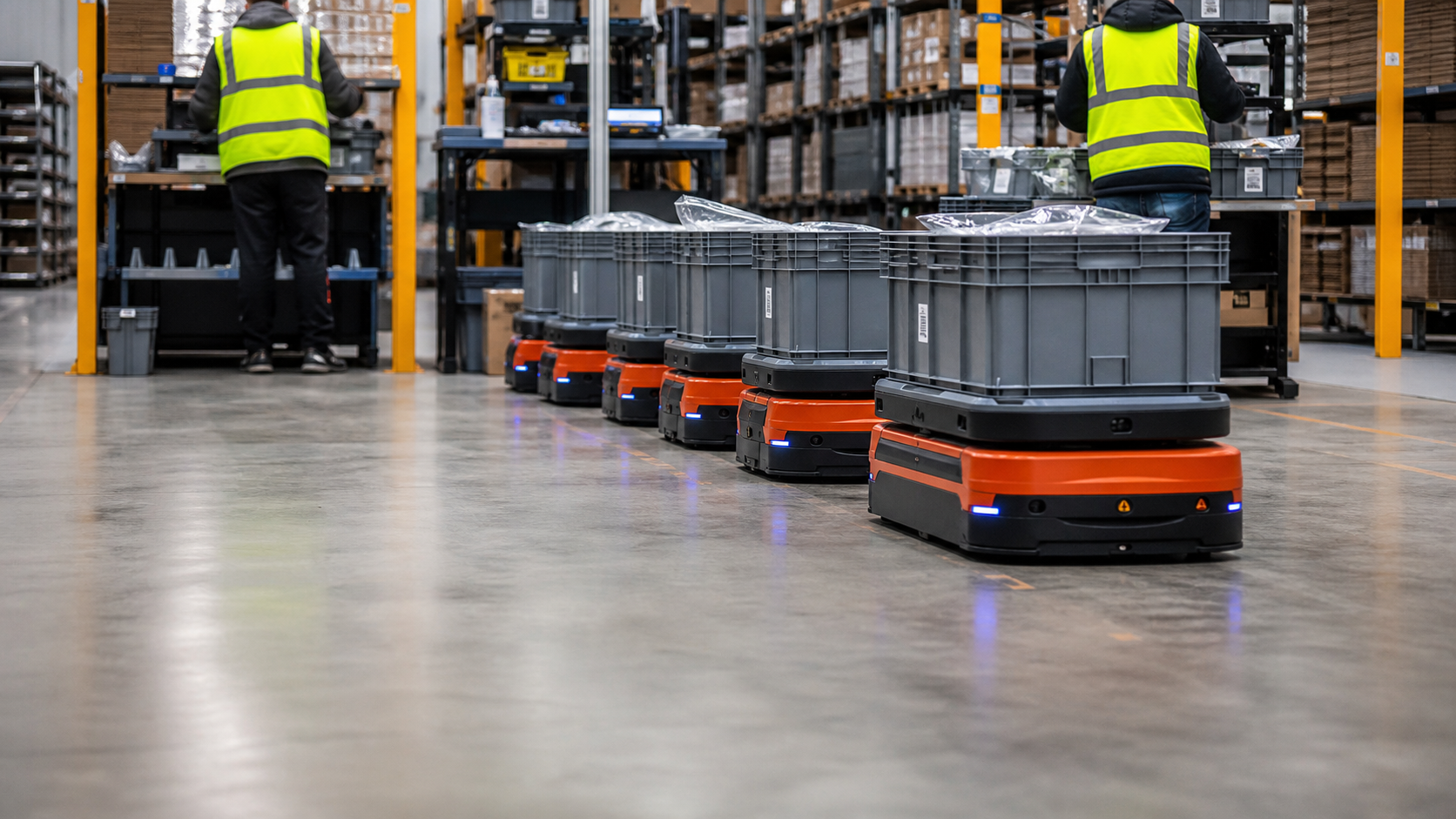
Autonomous mobile robots are the most visible RaaS use case because they can often be deployed in existing buildings with less fixed infrastructure than traditional conveyor or high-bay automation. AMRs can move totes, carts or shelves between storage, pick, pack and dispatch areas. For a warehouse already reviewing layout options, they sit naturally alongside decisions covered in warehouse layout design principles.
Goods-to-person and automated storage systems can also be sold through service-style models. These usually involve more infrastructure and a deeper operational redesign, but they can deliver higher storage density and shorter walking time when volumes justify the change. AutoStore’s pay-per-pick style discussions show how even capital-heavy systems are being packaged in ways that connect cost to output rather than equipment ownership.
Cobots and robotic picking arms are a different case. They can help with repetitive presentation, depalletising, each picking or packing support, but performance depends heavily on product range, packaging variability and exception handling. A cobot that performs well on uniform cartons may struggle with reflective bags, soft goods or constantly changing SKU profiles. RaaS can reduce technology risk, but trials must use real order profiles, not a tidy demonstration set.
Many UK warehouses will end up with hybrid operations rather than fully robotic sites. Humans handle exceptions, replenishment decisions, quality checks and awkward products while robots reduce travel, waiting time or repetitive movements. That makes RaaS a systems project, not a procurement shortcut. The operating model must define who releases work, who clears exceptions, how robot queues are prioritised, and what supervisors do when orders fall behind.
Benefits for UK Operators
The first benefit is lower upfront capital. Buying automation can tie up cash before the warehouse has proved that volumes, labour savings and service improvements will arrive. RaaS can make the first deployment smaller and faster, particularly for SMEs, regional retailers and 3PLs whose customer contracts do not justify permanent assets.
The second benefit is scalability. Seasonal peaks in fashion, gifts, grocery and consumer electronics can make permanent automation look either underused for most of the year or insufficient for the busiest weeks. A well-structured RaaS agreement can let the operator add robots, shifts or work units when demand rises. That flexibility is especially useful when combined with a broader 3PL selection process where service commitments and demand forecasts are already being tested.
The third benefit is access to ongoing support and upgrades. Robotics 24/7 reported Grand View Research figures suggesting the AMR-focused RaaS market could grow from $1.33 billion in 2023 to $4.12 billion by 2030, at a 17.5% CAGR. One reason for that growth is that operators want the productivity benefit of robotics without taking every obsolescence and maintenance risk onto their own balance sheet.
Performance claims should still be treated carefully. Logistics UK says automation can reduce picking errors by up to 99.9% and increase fulfilment speed by 300% in high-volume facilities. The words “up to” and “high-volume” are doing important work there. Those figures are useful as upside signals, but your business case should use conservative assumptions based on your SKU range, order profile, shift pattern, replenishment discipline and current baseline performance.
Risks and Decision Factors
The biggest risk is mistaking a monthly fee for a complete cost. Whole-life cost should include integration, Wi-Fi or network upgrades, floor preparation, safety work, WMS changes, training, project management, downtime during installation, internal engineering time and contract exit. A RaaS invoice may be simple. The operating change behind it rarely is.
Integration with the WMS is another hard gate. Robots need clean task instructions, location data, SKU attributes, inventory accuracy and exception logic. If your warehouse is already reviewing systems, compare RaaS requirements with the questions in WMS software selection for UK warehouses. A robotics vendor can provide middleware, but it cannot compensate for poor inventory control or vague process ownership.
Data rights deserve attention. Robot systems generate useful information about travel paths, congestion, pick rates, dwell time, failed missions and operator interactions. The contract should say who owns that data, how long it is retained, whether it can be exported, and whether the vendor can use aggregated operational data for benchmarking or product development. This matters for 3PLs handling customer-sensitive volume and service data.
Exit terms are just as important as launch terms. Ask what happens if the customer contract ends, the warehouse relocates, the vendor is acquired, or the technology underperforms. Check whether you can buy the equipment, extend the term, move it to another site, or remove it without punitive charges. A flexible operating model loses much of its value if the contract traps you in a system that no longer fits.
Who Should Consider RaaS
RaaS is strongest where demand is real but uncertainty is high. A mid-sized e-commerce warehouse with rising order volume, high walking time and seasonal peaks may be a better candidate than a stable bulk storage operation with slow-moving pallets. The more your cost problem comes from travel, touches, picking accuracy or peak labour, the more likely robotics can help.
3PLs should look closely at contract alignment. If a 3PL signs a five-year RaaS agreement to serve a three-year customer contract, it needs a plan for redeployment or shared use across accounts. If the RaaS fee can be mapped to customer charging, peak surcharges or per-order pricing, the model becomes easier to explain commercially. Without that mapping, automation risk can sit with the 3PL while the customer receives most of the benefit.
Retailers and brands should focus on service promises. Later order cut-offs, next-day delivery, lower mis-picks and better stock accuracy may justify automation even where direct labour savings look modest. The business case should include avoided errors, reduced overtime, improved capacity and better use of floor space, not just fewer picker hours. It should also include the cost of managing the vendor relationship properly.
RaaS is less suitable when volumes are too low, product handling is highly irregular, or the site lacks basic process control. If stock accuracy is poor, locations are not disciplined or replenishment routinely interrupts picking, start with the operating basics. Robotics can then amplify a good process rather than automate a bad one.
Implementation Checklist
Start with the process you want to improve, not the robot you want to trial. Measure current pick rates, walking time, error rates, order profiles, peak ratios, replenishment delays and exception causes. Use those figures to define the work that robots should remove or improve.
Build the commercial model over the full contract term. Compare subscription, pay-per-robot and pay-per-pick pricing against a buy option, including maintenance, software, finance cost and internal support. Stress-test the model with lower volumes, higher peaks, customer loss and slower-than-promised productivity gains.
Run the pilot on real SKUs and real orders. Include awkward products, returns, damaged packaging, short picks, replenishment interruptions and system exceptions. A clean demo proves the robot can move. A realistic pilot proves whether your warehouse can operate with it.
Finally, assign an internal owner before go-live. RaaS includes vendor support, but it still needs someone inside the business to manage performance, invoice checks, change requests and operational adoption.
Frequently Asked Questions
Is RaaS cheaper than buying warehouse robots?
RaaS is cheaper at the start because it reduces upfront capital spend. It is not always cheaper over the full contract life. A subscription or pay-per-pick model can cost more than ownership if volumes are stable, utilisation is high and the system remains useful for many years. Compare both options over three to five years, including maintenance, software, finance cost, integration and exit charges.
Does RaaS replace warehouse staff?
RaaS usually changes warehouse roles rather than removing every manual task. Robots can reduce walking, carrying, waiting and repetitive movement, but people still handle exceptions, replenishment, packing checks, supervision, maintenance coordination and awkward products. The best projects plan training early so supervisors and operatives understand how work will be released, monitored and recovered. Poor communication can damage adoption even when the technology works.
Which warehouse robots can be bought as a service?
Common RaaS options include autonomous mobile robots, goods-to-person systems, automated storage and retrieval systems, robotic picking arms, sortation technology and some cobot applications. The exact offer depends on the vendor and the site. Some models are close to rental with support, while others are output-based contracts linked to picks, moves or storage capacity. Treat “RaaS” as a commercial structure and inspect the actual system behind it.
What should a RaaS contract include?
A RaaS contract should define pricing, minimum terms, service levels, uptime, response times, maintenance cover, software updates, cybersecurity, data ownership, integration responsibilities, training, insurance, safety obligations and exit rights. It should also explain what happens during peak periods and what remedy applies if the system misses agreed performance. Ask for clear invoice data if charges depend on picks, moves or robot usage.
When should a UK warehouse avoid RaaS?
Avoid RaaS when the warehouse has low or unpredictable volumes, poor stock accuracy, weak WMS discipline, unsuitable floors or product handling that the robot cannot reliably manage. It may also be a poor fit where customer contracts are shorter than the robotics agreement and there is no redeployment plan. In those cases, fix process stability first or choose a smaller pilot with limited commercial exposure.