Key Takeaways
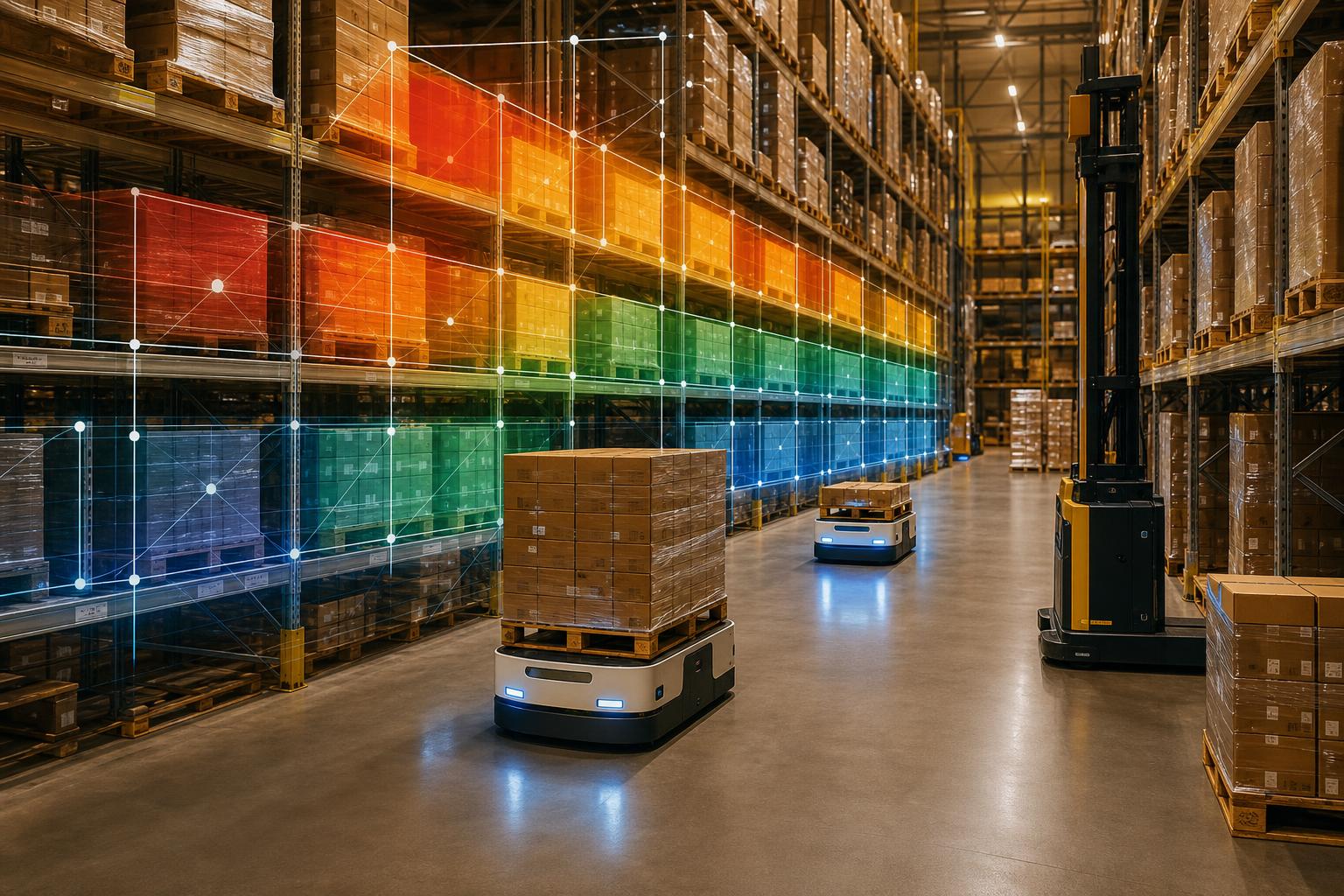
- Dynamic slotting uses real-time demand signals and machine learning to move SKUs to better pick locations continuously, replacing one-off ABC reviews.
- UK warehouses that optimise slotting typically cut picker walk time by 15–30%, with dynamic models delivering up to 45% travel reduction versus static layouts.
- AI-driven slotting integrates with your WMS and can run on existing racking, so gains often come without new robots, conveyors, or major capex.
- The strongest results come when slotting is combined with pick-route and pack-station optimisation, with combined savings reaching 35–60% in published benchmarks.
- A two-week pilot on your top 500 SKUs is enough to prove ROI before rolling dynamic slotting across the whole facility.
What Is Dynamic Slotting?
Warehouse slotting is the practice of deciding where each SKU lives. The goal is simple: put the most-picked items in the easiest-to-reach locations so pickers spend less time walking and more time picking. Traditional slotting uses ABC analysis. A-items sit close to dispatch, B-items a little further back, and C-items fill the remaining space. The problem is that ABC analysis is static. Demand changes, new SKUs arrive, pack sizes shift, and seasonal peaks reorder the velocity table. Within a few months the original layout is no longer optimal. If your location plan is still being set by a quarterly spreadsheet, the basics in our warehouse layout design guide are worth tightening before you automate the decision.
Dynamic slotting fixes this by treating SKU placement as a continuous optimisation problem rather than a one-off project. The system monitors pick frequency, order patterns, SKU affinity, product dimensions, and labour availability, then recommends or automatically triggers reslot moves when the current layout diverges from reality. According to Optioryx, dynamic slotting can cut picker travel by up to 45% compared with static slotting models, because it reacts to what is actually happening on the warehouse floor rather than what was forecast six months ago.
AI makes dynamic slotting practical at scale. Instead of a warehouse manager reviewing spreadsheets every quarter, machine-learning algorithms score thousands of SKU-location combinations and surface the moves with the highest expected impact. The human team approves the moves, or the WMS executes them directly if the confidence threshold is high enough. The result is a warehouse layout that stays tuned to demand without constant manual intervention.
How AI-Driven Dynamic Slotting Works
At its core, AI-driven slotting is a recommendation engine fed by warehouse data. The inputs include historical order lines, real-time pick transactions, inventory levels, product dimensions and weights, storage constraints, pick-path data, and labour schedules. The model learns which SKUs are frequently picked together, which items spike during promotions, and which slow movers are blocking prime locations.
The algorithm then evaluates every SKU against every feasible location, scoring each option against a set of objectives. Common objectives include minimising total pick travel, keeping fast movers at ergonomic height, grouping affinity SKUs into the same zone, and respecting physical constraints such as weight limits or temperature requirements. The system does not aim for a theoretically perfect layout; it aims for the best layout that can actually be operated given the available labour, forklifts, and time windows.
Modern implementations embed this logic inside the WMS or connect to it through APIs. Oracle notes that AI-driven slotting algorithms can continuously suggest optimised item placement based on demand patterns and item popularity, such as placing higher-demand items closer to packing and shipping areas. JASCI and Optioryx take this further with digital-twin capabilities that let you simulate reslot scenarios before moving a single pallet. You can model the impact of a seasonal peak, a new product launch, or a shifted packing station, then commit only the moves that pass a clear ROI test. That makes WMS selection more important than the slotting module alone; our WMS software selection guide sets out the integration questions to ask before buying.
Why UK Warehouses Are Adopting It Now
UK warehouse operators face a specific set of pressures in 2026. Labour costs are rising, agency staff availability is volatile, and order volumes continue to grow while delivery windows shrink. Keymas identified AI-driven slotting and picking optimisation as one of the top ten UK warehouse automation trends for 2026, noting that warehouses are moving from static ABC analysis toward continuous optimisation models driven by data maturity and cheaper computing power.
The business case is strongest for operations with high SKU counts, volatile demand, and limited capital budgets. If you already run a WMS and have barcode scanning in place, dynamic slotting is largely a software upgrade. You do not need to install robots, rebuild racking, or rewire conveyors. Synkrato reports clients achieving efficiency increases of over 25% without investing in new capital equipment, by identifying small pick-path and slotting inefficiencies that compound into major time savings.
For smaller UK 3PLs and mid-sized e-commerce fulfilment centres, this matters. A capex-heavy automation project may take years to approve, but a slotting optimisation pilot can show results in weeks. The CFO sees a productivity number; the operations manager sees fewer miles walked per shift; and the pickers spend more time with product in hand rather than walking empty aisles.
The Financial and Operational Impact
The headline numbers from published benchmarks are striking. Optioryx states that warehouses with proper slotting typically reduce walk distance by 15–30%. When slotting is combined with pick-route and pack-station optimisation, total savings can reach 35–60%. A 2025 paper on ResearchGate found that AI-optimised warehouse layouts can improve space utilisation by up to 30%, which is valuable for sites where expansion is physically or financially constrained.
These figures translate into operational headroom. A warehouse that processes 10,000 order lines per day and cuts average pick time by 20% can either absorb 20% more volume with the same labour or reduce overtime and agency spend. In a market where agency labour can cost 30–50% more than permanent staff, that flexibility directly protects margin.
The impact also shows up in accuracy. Shorter pick paths mean less fatigue, fewer distractions, and lower error rates. Ergonomic improvements reduce injury risk and absence. Better space utilisation defers the need for additional storage capacity. None of these benefits require a fully automated warehouse; they require a WMS that treats slotting as a live operational lever rather than a historical filing decision. Track those gains through the same measures you use for pick accuracy, lines per hour and space utilisation; the practical framework in our warehouse KPI guide works well for slotting pilots.
Technology Options and Integration
Dynamic slotting is offered as a module by several WMS vendors and as a specialist tool by slotting-focused platforms. JASCI’s AI Dynamic Slotting continuously optimises SKU placement using real-time data and machine learning. Optioryx Pulse runs on a digital twin of the warehouse and calculates optimal placement based on pick frequency and product affinity. Lucas Systems applies machine-learning algorithms to recommend locations using SKU velocity, affinity, pick paths, and product information.
Enterprise WMS players are also embedding similar capability. Oracle’s warehouse management stack uses AI to recommend item placement, while newer cloud-native WMS platforms are adding slotting as a standard feature. For a UK operator choosing between vendors, the critical questions are integration depth, not algorithm sophistication alone. Can the tool read real-time pick transactions from your WMS? Can it push reslot tasks back to the RF terminals? Can it simulate a move before committing it?
Integration-first architecture is another 2026 trend highlighted by Keymas. Disconnected systems are becoming a major competitive disadvantage. A slotting tool that cannot talk to your WMS, ERP, and labour-management system becomes another dashboard, not an operational control layer. The best implementations treat slotting as part of a unified data platform where WMS, ERP, and reporting pipelines share the same real-time stock and performance data.
Implementation Roadmap
Start with a pilot, not a warehouse redesign. Pick your top 500 SKUs by pick frequency and run a two-week optimisation cycle. Measure before and after pick time, walk distance, and order lines per hour. If the numbers move, expand to the next velocity band. If they do not, diagnose whether the issue is data quality, constraint modelling, or operator adoption before scaling.
Data preparation is usually the slowest part. The model needs clean SKU master data, accurate dimensions, pick-history transactions, and a correct map of locations and constraints. Many warehouses discover that their location master data is out of date, which undermines the model before it runs. Fix the data first. A slotting algorithm running on bad data will recommend moves that look optimal on screen but fail on the floor.
Change management matters too. Pickers and supervisors need to understand why locations are changing and how to execute reslot tasks. If the WMS can automate the moves through directed putaway, the transition is easier. If moves are manual, schedule them during low-volume windows and communicate clearly. A brilliant slotting plan that nobody follows is worse than a mediocre plan that is executed.
Finally, set governance. Decide who approves recommended moves, how often the model runs, and which constraints are hard rules versus soft preferences. Dynamic slotting should feel like a co-pilot for the warehouse manager, not an autopilot that ignores operational reality.
Frequently Asked Questions
What is the difference between static and dynamic slotting? Static slotting assigns SKUs to fixed locations based on a periodic review, often quarterly or annually. Dynamic slotting continuously reviews pick velocity, SKU affinity, and operational constraints, then recommends or executes reslot moves as demand changes.
Can dynamic slotting work without automation hardware? Yes. The core requirement is a WMS that can receive slotting recommendations and create reslot tasks. You can gain significant travel reduction with existing racking, handhelds, and forklifts. Robots and conveyors amplify the benefits but are not prerequisites.
How long does a dynamic slotting pilot take? A focused pilot on the top 500 SKUs can run for two weeks and produce measurable results. The full rollout depends on warehouse size and data cleanliness, but many UK operations see material gains within the first month.
What data does the AI need? The model needs historical and real-time pick transactions, SKU dimensions and weights, location constraints, current inventory levels, and ideally labour schedules or shift patterns. Clean master data and an accurate warehouse map are more important than advanced algorithms.
Is dynamic slotting only for large warehouses? No. While large SKU counts make the ROI more obvious, mid-sized fulfilment centres and 3PLs also benefit. If pickers spend more than half their shift walking, there is almost certainly value in optimising where products sit.
How does dynamic slotting relate to pick-route optimisation? Slotting is the foundation. Route optimisation can cut travel by 20–50%, but only if fast movers are already close to packing. If your best sellers are scattered across the warehouse, even the smartest routing algorithm is fighting a bad layout. Combine both for the biggest impact.