Key Takeaways
- Felixstowe’s autonomous truck fleet is expanding to 100 battery-electric terminal tractors after a third order confirmed in July 2026.
- The trucks operate in live mixed terminal traffic, which makes the deployment more relevant than a fenced-off pilot.
- The first 34 vehicles moved more than 140,000 containers in 12 months, according to Fleet News.
- Battery swapping, private 5G, LiDAR, cameras, and radar matter as much as the vehicle itself.
- UK hauliers should treat the project as a signal for port shuttles and yard moves before expecting driverless motorway freight at scale.
Felixstowe Has Moved Past Pilot Automation
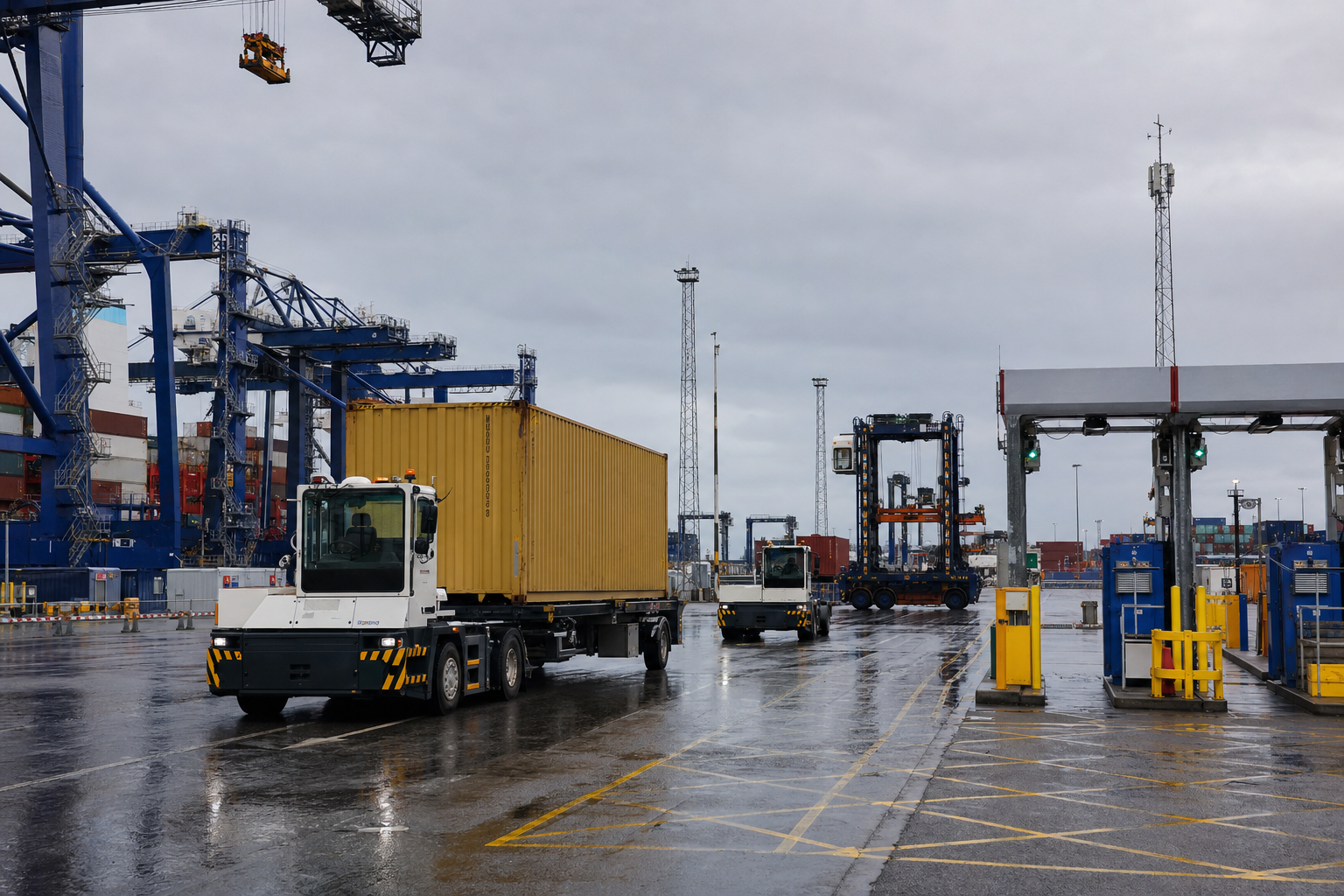
Felixstowe’s autonomous trucks are no longer a technology trial on the edge of the terminal. The Port of Felixstowe is expanding the fleet to 100 battery-electric Westwell Q-Trucks after a third order announced in July 2026, according to theenergyst, trans.info, and Fleetpoint. The first 34 trucks entered operation in early 2025, a second batch of 34 followed, and the latest order takes the deployment into full operational scale rather than proof-of-concept territory.
That matters because Felixstowe is the UK’s largest container port and one of the few places where automation immediately touches national freight flow. A container moved from quay crane to yard crane at Felixstowe often sits at the start of a longer journey by road, rail, depot, warehouse, and final delivery. When the port changes how boxes are moved inside the terminal, importers, forwarders, and hauliers eventually feel the effect in slot reliability, turnaround planning, and exception handling.
The most important detail is that these vehicles are working in mixed terminal operations. They are not confined to a demonstration lane away from normal traffic. They run alongside driven terminal tractors, straddle carriers, cranes, engineering vehicles, and people working within port safety rules. That makes the Felixstowe project more useful to operators watching from outside the port because most logistics automation fails at the handover between controlled systems and messy live operations.
For wider context, the autonomous fleet sits alongside other changes already affecting UK freight planning. Port delays, digital community systems, energy costs, and driver capacity all shape whether an importer can move containers predictably; if you are mapping those risks, the background in our UK port delays guide and UK port community systems guide is worth reading alongside this article.
What The Trucks Actually Do
The Westwell Q-Trucks are autonomous terminal tractors built for moving containers between quay cranes and yard cranes. They are not road-going HGVs leaving the gate for the A14. Their job is narrower but commercially meaningful: repeatable short-distance moves inside a high-volume port, where every delay between crane, yard, and onward mode can ripple through the terminal plan.
Each vehicle combines autonomous driving hardware with port-specific workflow integration. Research notes from the 2026 deployment describe 128-line LiDAR, 360-degree camera vision, monocular and stereo cameras, and radar. The third batch adds enhanced perception systems, according to coverage from theenergyst, SMMT, and Fleetpoint, which points to an incremental operating model rather than a single dramatic switch from manual to autonomous.
Connectivity is also central. Felixstowe’s private 5G network is described by SMMT, Fleetpoint, and theenergyst as one of the largest industrial private 5G deployments in the UK. In a port environment, latency and reliability are not nice extras: the control layer has to track vehicle position, traffic state, mission assignment, charging status, and intervention needs without depending on patchy public connectivity.
The energy system is equally practical. Battery-electric trucks only improve availability if charging does not leave too many units out of rotation during peaks. Felixstowe uses automated battery swapping, with depleted packs exchanged for charged units in about five to six minutes, according to theenergyst and SMMT. The latest order includes a second automated swap station, which suggests the port is planning around utilisation and resilience rather than treating charging as an afterthought.
For operators used to conventional terminal haulage, the useful comparison is not “driverless versus driver”. It is whether the port can make high-frequency, repetitive transfer moves more consistent while keeping people focused on exceptions, engineering, crane interfaces, planning, and safety supervision. That is the same business logic behind many warehouse automation projects, where the better question is covered in our warehouse automation ROI guide: which repeatable task is stable enough to automate, and what work still needs skilled human judgement?
Why Mixed-Traffic Operation Is The Hard Part
Autonomous movement inside a port is easier than autonomous movement on a public motorway, but it is not simple. The environment is private, access-controlled, and mapped, yet it is still dense, dynamic, and unforgiving. Cranes move boxes overhead, terminal tractors cross paths, maintenance teams enter working zones, and weather can change visibility at the quayside.
Mixed-traffic operation is the key technical and safety threshold. A separate automated zone can deliver predictable results because every actor inside the zone is designed around the same operating logic. Felixstowe’s deployment is more demanding because the autonomous vehicles share the working environment with conventional terminal equipment. The system has to recognise more than lane markings; it has to behave sensibly around the real rhythm of a container terminal.
That explains why the vehicle hardware is only one part of the story. Port automation depends on dispatch software, safe route design, communications, battery availability, crane scheduling, maintenance response, and operational discipline. If any of those pieces fails, the truck may be able to drive but the operation still loses reliability.
Safety and labour concerns also need plain treatment. The BBC reported in September 2025 that the port said no jobs would be at risk from increasing the automated fleet, while Unite raised safety concerns and continued dialogue with the employer. Both points can be true at the same time: automation may not remove existing jobs in a direct headcount sense, but it still changes work patterns, training needs, supervision, incident response, and how people experience risk in a live terminal.
For importers and hauliers, the takeaway is to avoid simplistic claims. Autonomous terminal trucks are not a magic answer to congestion or labour constraints. They are a controlled operational tool that may improve predictability when deployed with the right safety case, infrastructure, and workforce involvement.
The Measured Efficiency Gain So Far
The strongest operating figure is the 140,000-container milestone. Fleet News reported in May 2026 that the original 34-truck fleet moved more than 140,000 containers in 12 months. That does not prove every business case on its own, but it shows the deployment had moved beyond a small staged trial.
Container moves are a useful metric because terminal automation has to earn its place through repeatable throughput. A vehicle that drives autonomously but cannot keep pace with crane plans, yard availability, and shift patterns is not operationally useful. The reported volume suggests Felixstowe has found enough stable work for the autonomous trucks to become part of normal terminal planning.
The 100-truck target also changes the operational question. With 34 vehicles, the port can automate a meaningful slice of internal transfer work. With 100, it can start designing more of the flow around the autonomous fleet, including battery-swap capacity, maintenance patterns, and traffic rules. That shift is where importers may eventually see benefits through fewer terminal bottlenecks, cleaner handovers, or more predictable collection windows.
The benefits will still be uneven. Automation inside the terminal does not remove weather disruption, customs holds, vessel bunching, road incidents, or driver availability problems outside the gate. It also does not guarantee faster release for a specific container if documentation, inspection, or inland transport is not ready. If your import operation is struggling with handover costs rather than port movement alone, our freight costs guide gives a wider view of where delays and charges usually accumulate.
The Environmental Case Is Strong But Narrow
The environmental case is strongest inside the terminal boundary. The Q-Trucks are fully electric, and Felixstowe has used certified renewable electricity since April 2023, according to trans.info and SMMT. Fleetpoint and theenergyst also report the port’s target to reach net-zero Scope 1 and 2 emissions by 2035.
That combination matters because electrifying short, repetitive terminal moves is more mature than electrifying long-distance heavy road freight. Terminal tractors return to known locations, work on planned routes, and can use dedicated charging or battery-swap infrastructure. Those characteristics make them better candidates for early electrification than vehicles that need flexible national range and public charging certainty.
The limitation is scope. A cleaner quay-to-yard move does not make the whole container journey low-carbon. The vessel, inland haulage, warehousing, packaging, and final delivery still dominate many supply-chain emissions calculations. Importers should welcome the port-side progress without counting it as a complete answer to their own Scope 3 reporting.
The practical question for shippers is whether port electrification can align with their own transport planning. If a container lands at a port using renewable-powered terminal equipment but then moves inland on an inefficient routing plan, the overall benefit is diluted. The Felixstowe deployment is therefore a good signal for freight decarbonisation, but it should be folded into a broader routing and mode strategy rather than treated as a standalone sustainability claim.
What This Means For Hauliers And Forwarders
Hauliers should watch Felixstowe for changes in terminal reliability before expecting direct replacement of road drivers. The autonomous trucks work inside a controlled port environment, not on public roads. They may improve internal transfer consistency, but they do not collect containers from inland depots, handle customer calls, solve paperwork gaps, or manage real-world delivery exceptions.
Forwarders should pay attention to how automation changes the timing assumptions around container availability. If terminal movements become more predictable, the next bottleneck may move to gate booking, customs status, haulage capacity, or warehouse receiving windows. Better port performance can expose weak links elsewhere in the chain.
Importers should ask suppliers and forwarders more specific questions. “Does Felixstowe use autonomous trucks?” is less useful than “Will this change expected collection timing, demurrage exposure, or communication when a box is delayed?” The answer may vary by service string, quay plan, yard location, and onward mode.
The labour point also matters for service risk. A deployment that is technically successful but poorly communicated to the workforce can still create friction. Operators should therefore watch safety reporting, union engagement, incident data, and port communication, not just headline fleet size. Automation that works operationally needs trust as well as sensors.
The Wider UK Road-Freight Signal
Felixstowe is a port automation story first, but it points towards the likely first use cases for autonomous HGVs in the UK. The eFREIGHT Autonomous consortium, led by Voltempo with Connected Places Catapult and Berkeley Coachworks, published a nine-month study in May 2026 identifying hub-to-hub motorway trunking and intermodal port or rail shuttle operations as the most viable early deployment routes, according to SMMT, Fleet News, and GREENFLEET.
That finding fits the Felixstowe evidence. Shorter, repeatable routes with controlled handover points are easier to specify, monitor, insure, and regulate than general-purpose delivery work. Ports, rail terminals, distribution campuses, and fixed depot-to-depot shuttles are natural early candidates because the environment can be mapped and operating rules can be tightened.
The Automated Vehicles Act 2024 creates a legal route for more autonomous vehicle use in Great Britain, but regulation is only one part of the adoption curve. Operators still need insurance models, safety cases, maintenance capability, cyber controls, incident procedures, and customer acceptance. In freight, the hardest commercial question is often not whether a vehicle can move itself; it is who carries responsibility when a delivery misses a slot, a system hands back control, or a mixed manual and automated process breaks down.
Driver availability adds pressure. SMMT cites an RHA figure that UK logistics needs 40,000 new HGV drivers annually for the next five years. Autonomous technology may reduce pressure in tightly defined tasks over time, but it will not remove the need for trained drivers across construction logistics, urban delivery, specialist loads, international work, or customer-facing operations. The near-term story is task redesign, not wholesale substitution.
Felixstowe therefore gives the UK sector a realistic benchmark. Autonomous freight will probably arrive first where routes are repeatable, infrastructure is owned or tightly managed, and the economics of utilisation are clear. That is why port shuttles and terminal transfers deserve attention now, while fully driverless general haulage remains a longer and more regulated transition.
FAQ
Are Felixstowe’s autonomous trucks driving on public roads? No. The Westwell Q-Trucks are autonomous terminal tractors working inside the Port of Felixstowe. They move containers between quay and yard operations, not between the port and inland customer sites.
How many autonomous trucks does Felixstowe have in 2026? Felixstowe is expanding the fleet to 100 autonomous electric trucks after a third order confirmed in July 2026. The first 34 trucks entered service in early 2025, followed by further orders as the port scaled the deployment.
Do the trucks operate separately from human-driven vehicles? No. The important feature of the deployment is mixed-traffic operation. The autonomous trucks work alongside conventional terminal equipment, which makes the safety case and control systems more demanding than a segregated demonstration zone.
Will autonomous trucks remove port jobs? The BBC reported in September 2025 that the port said no jobs would be at risk from increasing the automated fleet. That does not mean work stays unchanged: automation can alter training, supervision, maintenance, safety processes, and the balance between routine movement and exception handling.
Why does battery swapping matter? Battery swapping protects vehicle availability. Felixstowe’s system can exchange depleted packs for charged units in about five to six minutes, according to theenergyst and SMMT, which helps electric terminal tractors stay in the operating cycle during busy periods.
What should UK importers do with this information? Treat it as a planning signal, not a promise of instant faster collections. Ask your forwarder whether terminal automation is changing container availability, gate booking reliability, and exception communication on the specific Felixstowe services you use.