Key Takeaways
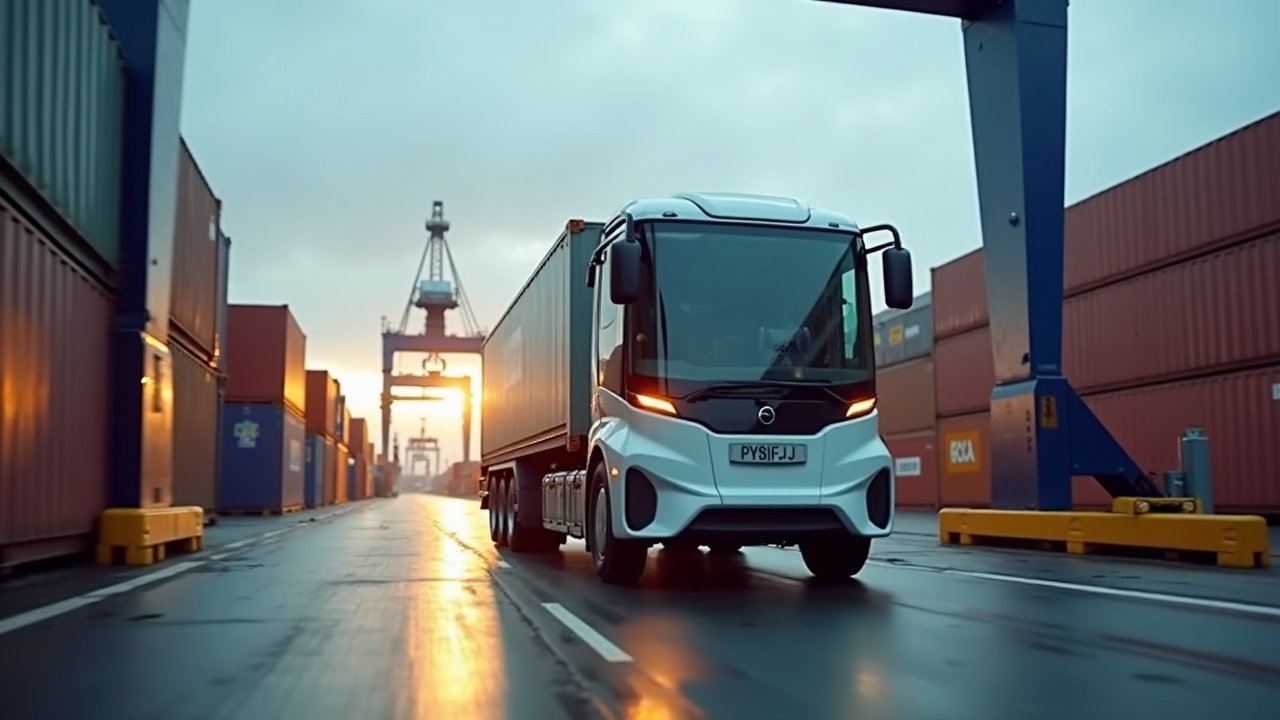
- Port of Felixstowe has deployed 100 Westwell autonomous Q-Trucks — Europe’s largest mixed-traffic autonomous vehicle fleet in a live container terminal
- DP World is investing £170 million in automated container handling at London Gateway, with a £36 million construction contract running from mid-2026 to mid-2028
- Hutchison Ports targets Net-Zero Scope 1 and 2 emissions by 2035 across its three UK ports, with Felixstowe running on 100% renewable-certified electricity since April 2023
- The global automated container terminal market is projected to grow from $12.1 billion in 2026 to $22.4 billion by 2035
- Automation is reshaping port workforce requirements — the shift is from manual equipment operation toward technical, data, and systems-management roles
The Automation Tipping Point
UK ports handled approximately 10.5 million TEU at their pre-pandemic peak in 2019, with Felixstowe alone processing over 4 million TEU annually — roughly 48% of the country’s containerised trade. For years, automation in UK ports meant incremental upgrades: better terminal operating software, some remote-controlled cranes, a few OCR gates at the entrance. That era is over.
Two major investment programmes are now reshaping how containers move through Britain’s largest gateways. At Felixstowe, Hutchison Ports has built Europe’s first mixed-traffic autonomous truck fleet operating in a live container terminal. At London Gateway, DP World is midway through a £170 million automated container handling project that will transform its stacking and retrieval operations. Together, they represent the most significant port automation investment in the UK since containerisation itself.
The driver is not novelty. It is capacity pressure, decarbonisation deadlines, and a labour market that cannot supply enough skilled equipment operators at the wages ports can offer. The same capacity logic sits behind many inland projects covered in our warehouse automation ROI guide, but ports have the added constraint of fixed quay length and tidal vessel windows. Automation is becoming an operational necessity, not a competitive differentiator.
Felixstowe: 100 Autonomous Trucks in Mixed Traffic
The Port of Felixstowe’s autonomous truck programme is the most visible automation project in UK ports. Starting with an initial deployment of 34 Westwell Q-Trucks in early 2025 at Trinity Terminal, the fleet has now expanded to 100 units following a third order confirmed in July 2026.
These are not segregated vehicles running on dedicated lanes. They operate in mixed traffic alongside conventional diesel terminal tractors, straddle carriers, and other port equipment — a far harder technical challenge than the greenfield autonomous terminals seen in Rotterdam and Shanghai. Each Q-Truck is fully electric and equipped with 128-line LiDAR, 360-degree cameras, monocular and stereo cameras, and radar. The sensor suite generates a real-time 3D map of the vehicle’s surroundings, allowing it to navigate around moving obstacles, parked trailers, and unpredictable human-driven traffic.
Battery management has been a particular focus. Rather than plug-in charging — which would take vehicles out of operation for hours — Felixstowe installed an automated battery swap station that exchanges a depleted battery for a fully charged one in five to six minutes, with no manual intervention. A second swap station was included with the latest order, doubling throughput capacity as the fleet scales.
The entire autonomous operation runs on one of the largest private 5G networks in the UK, installed specifically to handle the low-latency data requirements of real-time vehicle coordination. The network also supports conventional equipment telemetry, giving the terminal’s nGen management system — developed in-house by Hutchison Ports — a unified view of every asset on the yard.
Beyond Trucks: Cranes, Gates, and Terminal Software
Felixstowe’s automation extends well beyond the tractor fleet. The port has deployed 17 Konecranes Automated Rubber-Tyred Gantry cranes (ARTGs), ordered in late 2021 and delivered in three phases through to Q4 2025. These cranes stack and retrieve containers in the yard without a driver in the cab, using laser-based container profiling and automated spreader positioning.
On Berths 8 and 9, semi-automated remote-controlled ship-to-shore cranes operate in automated mode for the majority of each shift. Operators sit in a central control room rather than a crane cab 40 metres above the quay, managing multiple cranes from a single workstation during routine moves and taking manual control only for complex lifts.
The software layer tying this together is nGen — Hutchison Ports’ proprietary terminal management system, modified specifically to coordinate semi-automated and remote-controlled equipment alongside autonomous trucks. It integrates with PARIS, a real-time multimodal transport planning tool that optimises container moves across road, rail, and short-sea feeder connections. For customers, the UBI mobile app provides live container tracking, while the OCEAN platform consolidates shipping schedules and vessel information.
OCR (optical character recognition) gate systems are now standard at both Felixstowe and London Gateway, automatically capturing container numbers, ISO codes, and truck registrations as vehicles enter and exit. This eliminates the paper-based gate-in/gate-out process that used to add 5-10 minutes per truck transaction. Combined with automated appointment systems, OCR gates have cut average truck turnaround times significantly — though neither port publishes exact before-and-after figures publicly.
London Gateway: £170 Million Automated Container Handling
DP World’s London Gateway is taking a different approach. Rather than autonomous horizontal transport, the investment focuses on the container stack — the yard where boxes are stored between vessel discharge and road or rail collection.
In October 2025, DP World announced a £170 million ($217 million) investment in automated container handling technology at London Gateway. A £36 million construction contract was awarded in April 2026, with work running from mid-2026 to mid-2028. The system will automate the stacking and retrieval of containers in the yard, using automated stacking cranes (ASCs) to replace the current manual rubber-tyred gantry operations.
This is part of a broader £1 billion expansion at London Gateway that includes a fourth berth and increased rail capacity. The automation investment is designed to increase yard density — stacking containers higher and closer together than manual operations allow — while reducing the dwell time between vessel discharge and onward transport.
The London Gateway approach reflects a different operational philosophy from Felixstowe. Where Felixstowe has focused on automating horizontal movement (the trucks that shuttle containers between quay and stack), London Gateway is automating the vertical storage layer. Both approaches target the same outcome: higher throughput per acre of terminal land, with fewer people exposed to heavy equipment operations.
The Decarbonisation Driver
Port automation in the UK is not being driven by efficiency alone. Decarbonisation targets are accelerating the business case.
Hutchison Ports has committed to Net-Zero Scope 1 and 2 emissions by 2035 across its three UK ports: Felixstowe, Harwich International, and London Thamesport. Felixstowe has used only renewable-certified electricity since April 2023, meaning every electric autonomous truck, automated crane, and electric terminal tractor is effectively zero-emission at the point of use.
The shift from diesel to electric autonomous trucks eliminates tailpipe emissions entirely from horizontal transport — historically one of the largest sources of Scope 1 emissions at container terminals. The battery swap system also removes the downtime associated with diesel refuelling, improving vehicle utilisation.
The UK Emissions Trading Scheme (UK ETS) adds a further financial incentive. As the carbon price rises and free allowances phase down, port operators face increasing costs for every tonne of CO2 emitted from diesel equipment. Electric automation converts that liability into a fixed electricity cost — and one that can be hedged through power purchase agreements.
Workforce and Skills Transformation
The most sensitive dimension of port automation is what it means for the workforce. The Port Skills and Safety (PSS) group published an updated five-year skills plan in January 2026 that directly addresses this tension.
The plan acknowledges that automation eliminates some traditional roles — particularly manual equipment operation — but argues that it creates new ones in systems management, data analysis, remote operations, and equipment maintenance. The shift is from physical to technical: a terminal tractor driver becomes a fleet controller monitoring six autonomous vehicles from a screen; a crane operator becomes a remote operations specialist managing multiple cranes from a control room.
Skills England’s 2026 annual report highlights a new Level 4 AI and Automation Practitioner apprenticeship, introduced in 2025, as one pathway into these roles. EngineeringUK estimates the country needs 173,000 new engineers and technicians annually — a figure that includes the port and maritime sector’s growing demand for automation-capable staff.
The UK offshore wind workforce is projected to grow from 32,000 to over 104,000 by 2030, with approximately 30% of those roles being port-based or port-supported, according to RenewableUK. This creates a parallel skills demand that competes with — but also complements — the automation skills pipeline at major container ports.
The TT Club, a leading transport and logistics insurer, has noted that automation in ports creates “new technology-based roles” and that the net employment effect depends heavily on retraining investment. Ports that invest in skills transition alongside automation tend to retain and redeploy staff; those that do not face industrial relations friction and skills shortages in the new technical roles.
The Market Context
The global automated container terminal market was valued at approximately $12.1 billion in 2026 and is forecast to reach $22.4 billion by 2035, representing a compound annual growth rate of 7.9%, according to Research Nester.
DP World’s own surveys indicate that 94% of shipping executives anticipate stable or higher container volumes in 2026, reinforcing the investment case for capacity expansion through automation rather than physical footprint — particularly at UK ports where available waterfront land is scarce and expensive.
Brownfield automation — retrofitting existing terminals rather than building new automated ones — presents particular challenges. High upfront capital expenditure, the need to maintain operations during installation, and workforce reskilling all add cost and complexity. This is why most fully automated terminals globally have been greenfield projects (Rotterdam Maasvlakte II, Shanghai Yangshan Phase IV, Tuas Mega Port in Singapore). Felixstowe and London Gateway are notable precisely because they are automating existing, operating terminals.
What This Means for UK Importers and Logistics Professionals
For freight forwarders, customs brokers, and importers, port automation has several practical implications:
Faster and more predictable turnaround times. OCR gates and automated appointment systems reduce the variability in truck processing. When combined with autonomous yard equipment that operates 24/7 without shift-change downtime, container availability becomes more predictable.
Improved real-time visibility. The tracking platforms being deployed — Felixstowe’s UBI app, London Gateway’s customer portal — give importers and forwarders live container status. This reduces the phone calls and emails currently needed to establish whether a box is available for collection. It also strengthens the data hand-off into downstream customs clearance workflows when a shipment needs inspection, hold management, or faster exception handling.
Potential for lower handling costs over time. Automation requires high upfront investment but lower per-move operating costs once deployed. Whether those savings flow through to port charges depends on commercial decisions by the terminal operators, but the direction of travel is toward more cost-efficient operations.
Reduced disruption from labour shortages. The HGV driver shortage has been well documented; port equipment operator shortages are less visible but equally real. Automated equipment insulates terminal operations from labour market volatility, reducing the risk of congestion caused by operator unavailability. For shippers building resilience into their provider base, port reliability should sit alongside carrier cover, warehousing capacity, and the criteria in a UK freight forwarder selection process.
New data requirements for customs and compliance. As ports digitise, the data flowing through port community systems becomes richer. Forwarders and brokers who can integrate with these data feeds will have an edge in clearance speed and exception management.
Frequently Asked Questions
Will port automation reduce the fees I pay as an importer?
Not immediately. The capital cost of automation is substantial — Felixstowe’s 100-truck programme and London Gateway’s £170 million investment are multi-year projects with long payback periods. However, automated operations have lower per-move operating costs once deployed, and competitive pressure between UK ports should, over time, constrain handling charges. The more immediate benefit for importers is reliability and predictability rather than lower fees.
How does automation affect container dwell times?
Automated yard equipment can operate continuously without shift changes, meal breaks, or fatigue-related slowdowns. This should reduce average dwell times — the period between vessel discharge and container availability for collection. However, dwell time is also heavily influenced by customs clearance speed, importer collection behaviour, and rail/road capacity, so automation alone is not a silver bullet. The same point applies to disruption planning: better terminal systems help, but importers still need contingency plans for the kind of congestion covered in our UK port delays guide.
Are other UK ports automating beyond Felixstowe and London Gateway?
Southampton, Liverpool, and Teesport have all invested in OCR gate systems and terminal operating software upgrades, but none have announced autonomous vehicle or automated stacking crane programmes on the scale of Felixstowe or London Gateway. The Port of Tyne has invested in digital twin technology for port planning. Smaller ports are watching the Felixstowe and London Gateway programmes closely — if the ROI case proves out, expect wider adoption from 2028 onward.
What happens to port workers when automation arrives?
The evidence from ports that have already automated — Rotterdam, Los Angeles, Hamburg — is that employment shifts rather than collapses. Manual equipment operator roles decline, but systems management, remote operations, data analysis, and equipment maintenance roles grow. The net employment effect depends on retraining investment. The PSS five-year skills plan and the new Level 4 AI and Automation Practitioner apprenticeship are designed to support this transition in UK ports.
Is automated port equipment safer than manual operations?
Yes. Removing people from heavy equipment operations — crane cabs 40 metres up, terminal tractors moving between stacks of containers — eliminates the most common sources of serious injury in ports. Autonomous trucks do not get fatigued, distracted, or complacent. The safety case for automation is one of its strongest arguments, and it is a key reason port operators can secure board-level investment approval for these programmes.
How does port automation affect customs clearance?
Port automation primarily affects physical container handling rather than customs processes. However, the digitisation that accompanies automation — OCR gates, integrated terminal operating systems, real-time tracking platforms — generates better data that can feed into customs systems. A container that is tracked and located in real time is easier to route to inspection facilities when HMRC selects it for examination. The broader move toward digital customs (CDS, the Single Trade Window) aligns with the data-rich environment that automated ports create.