Key Takeaways
- The DfT’s January 2026 consultation proposes ending sales of new non-zero-emission HGVs up to 26 tonnes by 2035 and all new non-zero-emission HGVs by 2040, so procurement cycles set in the next 12 months should assume a finite diesel runway.
- The Depot Charging Scheme offers £170m between April 2026 and 2030, with £66m available across two windows in 2026 — but it funds chargepoints and civils, not the grid connection upgrade that most often wrecks depot budgets.
- Zero-emission HGVs still cost two to three times their diesel equivalents according to the DfT consultation evidence, so grant stacking and phased replacement planning matter more than headline vehicle prices.
- Fuel transition lines — HVO, biomethane under the RTFO, and diesel price exposure — belong in the 2026/27 budget as a separate, risk-weighted line, not buried in general running costs.
- Operators who model diesel price sensitivity now are better placed: research published in May 2026 suggested HGV operating costs could rise between 1.8% and 13% in 2026 depending on diesel prices.
What actually changes in 2026
The regulatory clock is now visible. In January 2026 the Department for Transport opened a consultation on a new HGV CO₂ emissions regulatory framework, running from 6 January to 17 March 2026, which proposes ending the sale of new non-zero-emission HGVs up to and including 26 tonnes by 2035, and all new non-zero-emission HGVs by 2040. The government response was still pending as of autumn 2026, which means the dates are proposals rather than law — but the direction is set, and the consultation document itself acknowledges that zero-emission HGV models remain two to three times the price of diesel equivalents.
For budget planning purposes, treat 2035 as the planning horizon for anything under 26 tonnes and 2040 for the heavier fleet. A tractor unit bought in 2026 on a typical eight-year replacement cycle will still be in service when the 2035 boundary arrives, so every procurement decision from now onwards is, in effect, a decarbonisation decision whether you frame it that way or not.
There is also a cost-side signal worth reading. Research covered by Motor Transport in May 2026 modelled a potential HGV operating cost increase of between 1.8% and 13% in 2026 depending on diesel prices, with knock-on effects of 0.02% to 0.17% on consumer prices. That spread is the point: your exposure to diesel price volatility is now itself a budget line, and the wider the spread you can tolerate, the stronger your case for partial electrification or alternative fuels.
The four budget lines to plan
A credible decarbonisation budget for 2026/27 has four distinct lines. Blending them into one “green fleet” number is how operators end up underfunded mid-year.
Vehicles: the capital line
Zero-emission HGVs cost two to three times the diesel equivalent according to the DfT’s own consultation evidence. A diesel tractor unit at £100,000 implies £200,000–£300,000 for a battery-electric equivalent before infrastructure. The Zero Emission Van and Truck Grant (ZEVTG) reduces the van-side premium materially, and grant-supported HGV models exist for heavier classes, so the practical budgeting question is the net cost after grants, not the list price. Build the line on total cost of ownership: lower energy cost per mile for electric and no diesel price exposure in exchange for higher depreciation and, for now, uncertain residual values. Many fleets are budgeting pilots — two or three vehicles on a predictable urban or regional return-to-base route — rather than full conversion, which is the right shape of commitment while the regulatory response is still pending.
Depot charging: the grant line
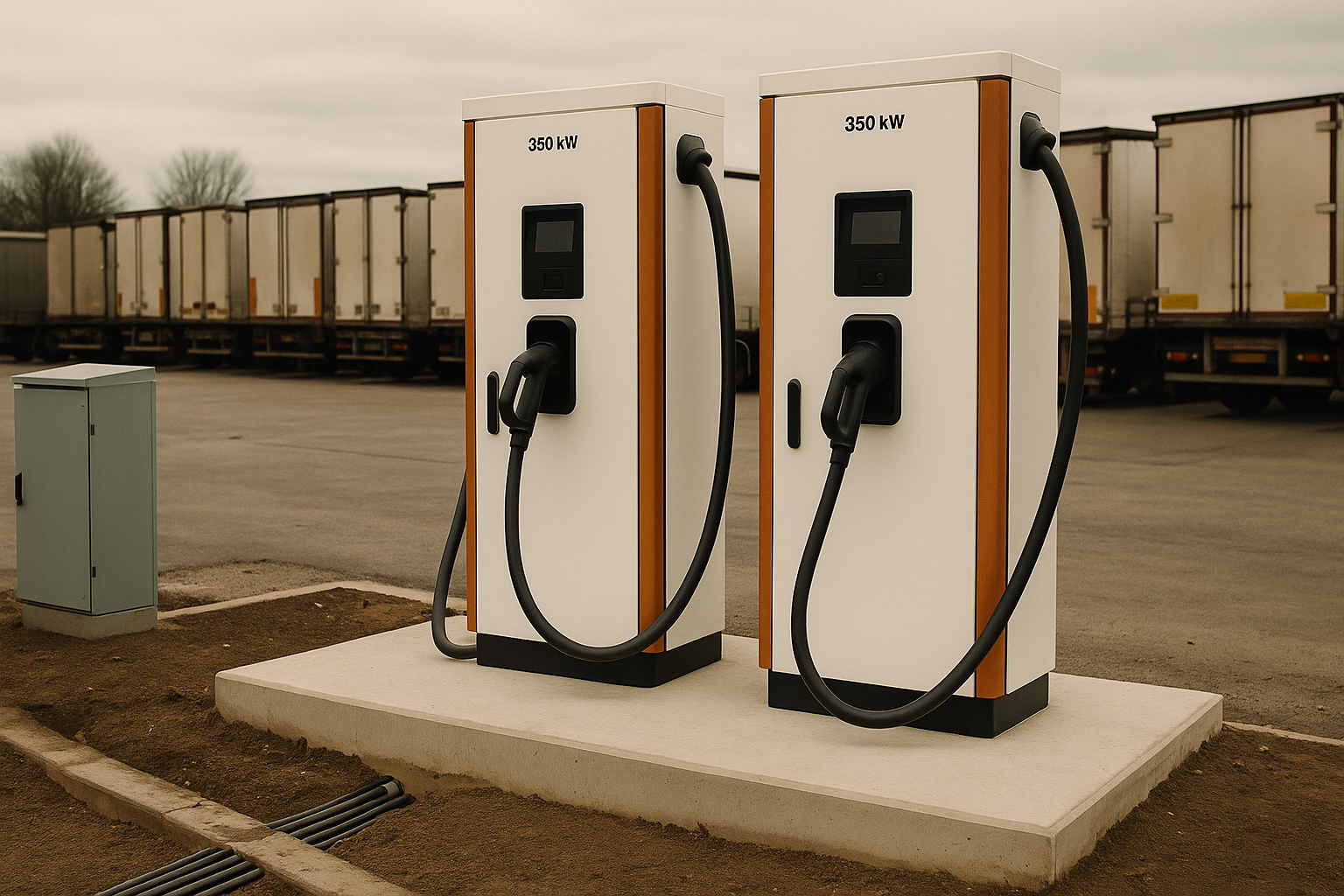
The Depot Charging Scheme is the most concrete money on the table. Per the GOV.UK Find a grant service, it is a £170m multi-year programme running from April 2026 to 2030, with £66m available across two windows this year: £28m in window 1 for 2026/27 and £38m in window 2 for 2027/28. Window 1 ran from 25 March to 30 June 2026, funded 70% of chargepoint and civil costs capped at £1m across all sites, allowed one application per organisation, and required works to be completed by 31 March 2027.
Window 2 is expected to run from 28 October 2026 to 29 January 2027, with projects starting in April 2027 and delivery due by 31 March 2028; rates had not been confirmed at the time of writing. If you missed window 1, your budget calendar for the next quarter should have a placeholder application cost — charging site surveys, grid capacity assessments, electrical design fees — ready before the window opens.
Grid connections: the line everyone misses
The Depot Charging Scheme funds chargepoints and civil works but not the grid connection upgrade, which is the cost operators most often underestimate — a point made explicitly in commentary on the scheme by consultants TwentyForty in May 2026. Applicants must prove sufficient grid capacity, and a depot needing a new substation or an upstream reinforcement can wait 12 to 36 months for a distribution network operator connection, depending on region and queue position.
Budget for three things here: the connection application and design fees, the reinforcement share itself, and — crucially — the time. A grid connection that will not be energised until late 2027 changes which depot you electrify first. Operators with multiple sites should sequence applications by grid feasibility, not by fleet size, and should start the DNO conversation before, not after, a grant window opens. The smartest budgets treat lead time, not money, as the binding constraint.
Fuel transition: the operating line
The Renewable Transport Fuel Obligation remains live, with 2026 compliance guidance covering fuel passing the duty point between 1 January and 31 December 2026. Fuel suppliers — not hauliers — carry the obligation, but its economics flow through your fuel invoices, and certificate trading influences the relative pricing of renewable diesel options. For a fleet that is not ready to electrify, HVO (renewable diesel) offers an immediate emissions cut in existing engines, typically at a price premium over diesel; and biomethane book-and-claim schemes exist for gas-fuelled vehicles; the GLEC Framework gives fleets a recognised method for reporting those savings to customers (see our GLEC Framework guide). Budget the premium realistically — a 5% to 15% fuel cost uplift on the affected vehicles — and treat it as transitional spend, not permanent overhead.
Building the 2026/27 decarbonisation budget
Start by scoring your depots on grid capacity and route electrifiability. The vehicles that suit first electrification are those on fixed daily duty cycles returning to base — urban distribution, supermarket delivery trunk routes, shunt and yard work. Pull twelve months of telematics for each depot, rank daily mileage against realistic chargepoint provision, and you will find that usually a minority of vehicles account for the majority of electrifiable miles.
Then sequence the money. A workable structure for a mid-sized fleet looks like this: a grant-funded depot charging application in window 2 (October 2026 to January 2027); a grid connection application lodged in parallel because it is the long pole; a pilot order of two or three zero-emission vehicles under ZEVTG for the most electrifiable route, for delivery late 2027; and an HVO or biomethane line covering the interim years for the remainder of the fleet.
Model diesel price sensitivity explicitly. The May 2026 research suggesting operating cost increases of 1.8% to 13% in 2026 depending on diesel prices (reported by Motor Transport) should prompt a simple scenario table in your budget: what happens to total fuel spend per year at, say, £1.30, £1.50 and £1.70 per litre. One illustrative annualised increase often quoted in 2026 commentary is around £19,400 for a single HGV — treat that as an illustration of exposure rather than an official figure, but the order of magnitude explains why hedging the fuel line matters. This scenario work also feeds your wider rate-setting; the same volatility pressures flows through haulage pricing as discussed in our UK logistics rates planning guide.
Finally, budget the management time. Grant applications, DNO engagement, charging site design and pilot vehicle onboarding each consume weeks of competent internal effort. Operators who allocate a named person to the Depot Charging Scheme window are consistently the ones who submit in time.
What to watch before you commit
The pending government response to the HGV regulatory framework consultation is the single biggest piece of uncertainty. If the response confirms the 2035/2040 dates with mandate mechanics added, residual values on diesel tractor units will soften and the case for early electrification strengthens. If it is delayed or softened, diesel remains viable longer but the grant windows do not wait — the charging infrastructure you build now has value under every scenario, which is why infrastructure-first sequencing beats vehicle-first sequencing for most operators in 2026.
The same grid-capacity economics show up across the wider network in our briefing on energy transition charges.
Watch the window 2 rate confirmation for the Depot Charging Scheme closely; if the 70% rate and £1m cap carry over, the economics of a modest two-to-four-chargepoint depot installation are straightforward. If they tighten, prioritise the depots with the strongest grid position and the highest electrifiable daily mileage.
Frequently Asked Questions
When will new diesel HGV sales end in the UK? Under the proposals in the January 2026 DfT consultation, sales of new non-zero-emission HGVs up to and including 26 tonnes would end by 2035, and all new non-zero-emission HGVs by 2040. These are consultation proposals with the government response still pending as of autumn 2026, so operators should plan against them without treating them as final law.
What does the Depot Charging Scheme actually cover? It funds chargepoint hardware and associated civil works. Per the GOV.UK Find a grant service, £170m is available from April 2026 to 2030, with window 1 funding 70% of chargepoint and civil costs capped at £1m per organisation. It does not fund the grid connection upgrade itself — applicants must demonstrate sufficient grid capacity.
Can I still apply for the Depot Charging Scheme in 2026? Yes — window 2 is expected to run from 28 October 2026 to 29 January 2027, with £38m available for projects starting April 2027 and completing by 31 March 2028; the GOV.UK grant listing carries the live detail. Rates had not been confirmed at the time of writing, so check the GOV.UK grant page before budgeting an application.
Why is the grid connection the biggest hidden cost? Because it sits outside the grant, carries five-figure to six-figure costs at constrained depots, and can take 12 to 36 months depending on your distribution network operator’s queue. Consultants TwentyForty highlighted in May 2026 that this is the cost operators most often underestimate, and the waiting time forces your electrification sequencing more than the money does.
Is HVO worth budgeting for before electrification? For fleets with vehicles that cannot electrify soon, HVO delivers immediate emissions reductions in existing engines. Budget a fuel premium typically in the 5% to 15% range over diesel, treat it as transitional spend, and note that the RTFO’s certificate market influences renewable fuel pricing. It does not replace a charging infrastructure plan — it bridges to it.
How much should we assume a zero-emission HGV costs? According to the DfT’s 2026 consultation evidence, zero-emission HGV models remain two to three times the price of diesel equivalents. Build budgets on net cost after applicable grants such as ZEVTG, and test total cost of ownership against your real duty cycles rather than list price, since energy cost per mile favours electric on return-to-base routes.