Key Takeaways
- Chilled fresh produce that needs temperature control should normally be kept at or below 8°C in England, Wales and Northern Ireland, with 5°C used as a practical operating buffer.
- The cold chain is only defensible if you can connect supplier instructions, vehicle temperature records, arrival checks and goods-in decisions.
- Fruit and vegetable imports do not normally need a health certificate, but plant-health, IPAFFS and Border Control Post rules still matter for regulated goods.
- Medium-risk fresh fruit and vegetables from the EU have a postponed phytosanitary certificate and IPAFFS requirement until 31 January 2027, based on current trade guidance.
- Higher-risk food and feed of non-animal origin must enter through an authorised Border Control Post and may face identity or physical checks before release.
- A good goods-in process records temperature, product condition, documentation gaps and the commercial decision on acceptance, rejection or shortened shelf life.
Fresh produce cold chain control is a quality system before it is a transport system. The importer has to prove that the product arrived safely, that legal and customer requirements were checked, and that any temperature breach was handled before the goods moved into saleable stock.
For UK importers, the difficult part is the overlap between food safety, plant-health controls, customs timing and commercial shelf life. A consignment of berries, herbs or salad vegetables can be customs-cleared but still be commercially damaged if the trailer sat warm during a port delay. Equally, perfect temperature records do not rescue a load that should have been pre-notified through IPAFFS or routed through an authorised Border Control Post.
This guide sets out the practical controls importers need at three points: before shipment, during movement and at goods-in. It sits alongside the broader food import regulations guide, the UK food import health certificates guide and the UK cold chain automation guide for teams designing a fuller compliance process.
Start With The Temperature Baseline
The legal ceiling for many chilled foods is 8°C. Food Standards Agency temperature-control guidance states that relevant chilled foods in England, Wales and Northern Ireland must be kept at or below 8°C, subject to the exemptions and handling tolerances in the legislation. The same guidance treats the range from 8°C to 63°C as the danger zone where bacterial growth is fastest.
That does not mean an importer should set 8°C as the operating target. In practice, 5°C is a more sensible control point because it leaves a buffer for unloading, cross-docking, pallet checks and short door-open periods. If you only react when the load hits 8°C, the operational decision may already be late.
Fresh produce creates an extra complication because not every product wants the same temperature. Leafy greens, berries, herbs, tomatoes, bananas and avocados can have different product-specific windows, chilling-injury risks and ripening requirements. Your control plan therefore needs a product specification from the supplier or customer, not just a generic chilled-food rule copied into a procedure.
Use the 8°C figure as the food-safety ceiling where it applies, then build tighter commercial limits by product. For a mixed trailer, record the controlling product and the most restrictive customer requirement. If one pallet needs 2°C to 5°C and another can tolerate a warmer range, your vehicle and acceptance criteria should be set around the tighter risk.
Put Controls In Before The Truck Moves
The best goods-in process cannot fix a shipment that was set up badly. Before the vehicle leaves the packhouse or consolidation point, the importer should have the product specification, route, expected arrival time, Incoterms position, pre-notification requirement and escalation contact agreed in writing.
For temperature-controlled produce, the supplier should confirm the required carriage temperature, acceptable tolerance, packaging condition and any pre-cooling requirement. If the goods are loaded warm, the trailer is being asked to remove field heat rather than maintain an already stable load. That usually creates slower pull-down, uneven pallet temperatures and disputes at arrival.
The logistics provider should confirm the set point, equipment type and how temperature evidence will be shared. A trailer printout may be enough for simple lanes, but higher-value produce benefits from logger data at pallet, carton or consignment level. If a customer later challenges shelf life, a single reefer unit reading may not prove what happened inside the warmest pallet.
Documentation should also be checked before departure. GOV.UK guidance on importing fruit and vegetables says imports from third countries must meet the same hygiene standards and safety procedures as food produced in Great Britain. It also says you do not normally need a health certificate to import fruit and vegetables, but that statement should not be confused with plant-health or higher-risk food controls.
Check IPAFFS, Plant Health And BCP Routing
Fresh produce import controls depend on risk category, origin and product. Many fruit and vegetable consignments will move without a health certificate, but regulated plants and plant products can still need phytosanitary documents, IPAFFS pre-notification and routing through a Border Control Post.
IPAFFS is the UK system for pre-notifying imports of regulated plants, plant products, animals, food and feed. For commercial consignments of regulated plants that require a CHED-PP, trade guidance commonly works to at least one working day before arrival at the UK Border Control Post. That timing matters because a late notification can create a border hold even when the physical load is sound.
Plant and plant-product imports are grouped into high, medium and low risk. High and medium-risk goods can need phytosanitary certificates, documentary checks, identity checks and physical inspections. Low-risk goods generally face fewer border formalities, but the importer still needs to retain product identity, supplier and traceability records.
There is one current timing detail EU produce importers should keep visible. Trade guidance from Customs-Declarations.UK, reflecting the 2026 position, states that the requirement for phytosanitary certificates and IPAFFS pre-notification for medium-risk fresh fruit and vegetables from the EU has been postponed until 31 January 2027. Treat that as a date to monitor, not a reason to leave systems until the last week before implementation.
Higher-risk food and feed of non-animal origin is different again. GOV.UK guidance says higher-risk food and feed of non-animal origin can only enter Great Britain through authorised Border Control Posts where official controls are carried out. Products subject to special conditions, such as some aflatoxin-risk dried fruits, need planned routing and document checks before the haulier reaches the port.
Build A Goods-In Check That Holds Up
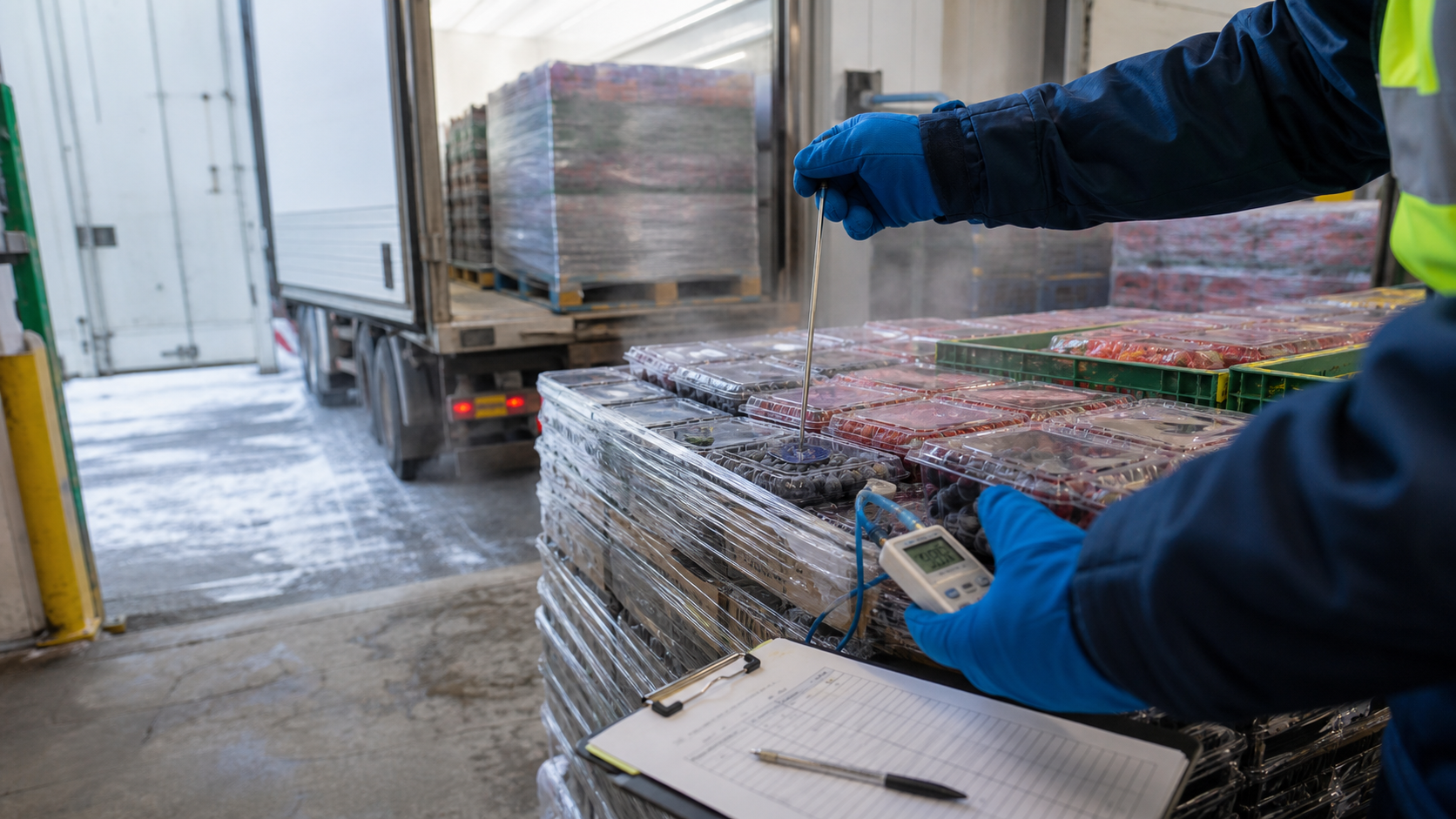
Goods-in is where the cold chain becomes an evidence trail. The receiving team should check vehicle temperature, product temperature, packaging condition, seal status, delivery documents, required certificates and any visible deterioration before the goods are booked into available stock.
Temperature checks need a written method. Decide whether staff record air temperature from the vehicle, product surface temperature, probe temperature or logger download, and use the same method consistently. If you mix methods without saying so, a later investigation may compare numbers that do not mean the same thing.
The first reading should be taken before the load is disturbed where possible. Doors, dock levellers and long inspection periods all change the environment, so a reading taken after 25 minutes of unloading may say more about the receiving bay than the journey. If the warehouse is busy, prioritise high-risk, short-life and customer-critical lines for immediate checks.
Condition checks should be specific. “Damaged” is less useful than “two pallets collapsed on nearside rear, cartons wet, pulp temperature 9.2°C, product moved to quarantine bay at 07:40”. Photograph evidence is useful where customer claims, carrier claims or supplier disputes are likely, but the written record still needs to state who made the decision and what happened next.
Do not let customs release become the acceptance decision. A consignment can be legally entered and still fail your commercial quality standard. Your goods-in process should allow quarantine, partial acceptance, shelf-life reduction, supplier concession, rework or rejection, with manager approval thresholds for each outcome.
Decide What To Do After A Temperature Breach
A temperature excursion is not automatically a destruction decision, but it is automatically a decision point. The Chilled Food Association notes that if a chilled food storage place exceeds 8°C, the shelf life of the foodstuff may need to be reduced. For importers, that means the breach has to be assessed before goods are released into normal picking.
Start with the product specification and the evidence. How high did the temperature go, how long did it last, where was it measured, and was the product itself affected or only the air around it? A short door-open spike in trailer air is different from a logger showing several hours above the agreed product limit.
Next, involve the right technical owner. For higher-risk foods, ready-to-eat produce or products with strict customer specifications, quality assurance should decide whether microbiological risk, shelf life or labelling is affected. Warehouse staff can record the facts, but they should not be left to make food-safety judgements alone.
Finally, preserve the record. Keep the logger file, goods-in note, photographs, supplier correspondence and release decision together. If you reduce shelf life, make sure the warehouse management system and customer paperwork reflect that decision. If you reject or claim against the carrier, the evidence needs to show both the temperature event and the contractual requirement that was breached.
Documentation Controls For Produce Importers
Fresh produce documentation should tie together identity, safety, plant health and traceability. At minimum, the importer should be able to identify supplier, origin, product description, lot or batch, quantity, packing date where relevant, transport unit, arrival time and receiving decision.
Where plant-health controls apply, retain the phytosanitary certificate, CHED-PP reference and any Border Control Post release evidence. Where IPAFFS is used, keep the notification reference with the commercial file rather than leaving it only in a portal login. If the person who made the notification is off shift, the receiving team still needs the reference.
For food-safety controls, GOV.UK guidance points importers to contaminant controls under the Contaminants in Food regulations, including limits for nitrate, mycotoxins, metals, 3-MCPD, dioxins and PAHs. Those risks are product-specific, so the importer should map which categories need supplier declarations, sampling evidence or special-condition routing.
Customs documentation still has to be consistent with the physical goods. Commodity code, origin, quantity, packaging type and supplier details should match the commercial invoice, packing list and any plant-health document. If the food team and customs team work from different product descriptions, errors become much harder to spot before arrival.
A Practical Importer Checklist
Use this checklist as a control framework, then adapt it by product and lane.
| Stage | Control | Evidence to keep |
|---|---|---|
| Supplier set-up | Product temperature range, shelf life, origin and risk category agreed | Supplier specification, purchase terms, technical approval |
| Pre-shipment | Vehicle set point and pre-cooling confirmed | Booking note, haulier confirmation, loading record |
| Border planning | IPAFFS, phytosanitary and BCP requirements checked | CHED-PP reference, certificate copy, BCP routing plan |
| In transit | Temperature monitoring method agreed | Reefer download, logger file, exception alerts |
| Goods-in | Temperature, condition, seal and documents checked | Goods-in record, photos, exception report |
| Release decision | Accept, quarantine, reject or reduce shelf life | QA approval, WMS status, supplier or carrier correspondence |
The important point is ownership. A checklist that belongs to nobody will become a tick-box exercise. Assign each control to a role: buyer, customs broker, freight forwarder, quality assurance, warehouse receiving or transport manager.
Review exceptions monthly. If the same supplier repeatedly ships warm, fix the supplier process. If the same lane creates delays, change the service level, port routing or buffer stock. If goods-in checks are routinely missing, the problem is training and workload, not a lack of forms.
Where Automation Helps
Cold chain automation is most useful when it removes blind spots. Continuous temperature sensors, reefer telematics, pallet loggers and warehouse alerts can show whether a breach happened before loading, during transit, at the dock or inside storage.
Automated alerts also shorten response time. A manual check at the end of a shift may discover that a bay door was left open for hours. A sensor alert can route the issue to a named supervisor while the stock is still recoverable.
The risk is data without decisions. Importers do not need thousands of readings that nobody reviews. They need exception thresholds, alert owners, calibration records and a clear rule for when quality assurance must be involved.
For larger operations, link cold chain data to the warehouse management system. Quarantine status, release status and shelf-life changes should follow the stock, not sit in a separate spreadsheet. That connection is what turns temperature monitoring into an operational control.
Frequently Asked Questions
What temperature must chilled fresh produce arrive at?
Where chilled food temperature-control rules apply, the legal ceiling is generally 8°C in England, Wales and Northern Ireland, according to Food Standards Agency guidance. Many importers use 5°C as the operating target because it gives a practical buffer below the legal ceiling. Product specifications may be tighter or different, especially for sensitive produce. Always apply the stricter of the legal, supplier and customer requirements.
Do fruit and vegetable imports need a health certificate?
GOV.UK guidance says you do not normally need a health certificate to import fruit and vegetables. That does not remove other controls. Regulated plants and plant products may need phytosanitary documents, IPAFFS pre-notification and Border Control Post checks depending on risk category and origin. Higher-risk food and feed of non-animal origin has separate authorised-entry and official-control requirements.
When should IPAFFS pre-notification be made?
For regulated plant consignments needing a CHED-PP, trade guidance commonly works to at least one working day before arrival at the UK Border Control Post. The exact requirement depends on product, route and regime, so check the current IPAFFS and plant-health instructions before shipment. Late pre-notification can hold a load even if the temperature record is clean. Build the notification deadline into the booking process rather than leaving it to the day of arrival.
Are EU fresh produce imports treated differently?
Some EU-origin fresh produce controls are still under phased implementation. Current 2026 trade guidance states that phytosanitary certificate and IPAFFS pre-notification requirements for medium-risk fresh fruit and vegetables from the EU have been postponed until 31 January 2027. Importers should still classify the product risk and prepare systems before that date. The postponement does not remove food-safety, traceability or customer quality obligations.
What should I do if a load arrives warm?
Quarantine the affected stock until quality assurance or the named technical owner has reviewed the evidence. Record the product temperature, air temperature, time, vehicle details, visible condition and any logger data. Compare the result with the product specification, legal ceiling and customer requirement. The decision may be full acceptance, reduced shelf life, partial rejection, supplier concession or carrier claim, but it should never be undocumented release into normal stock.