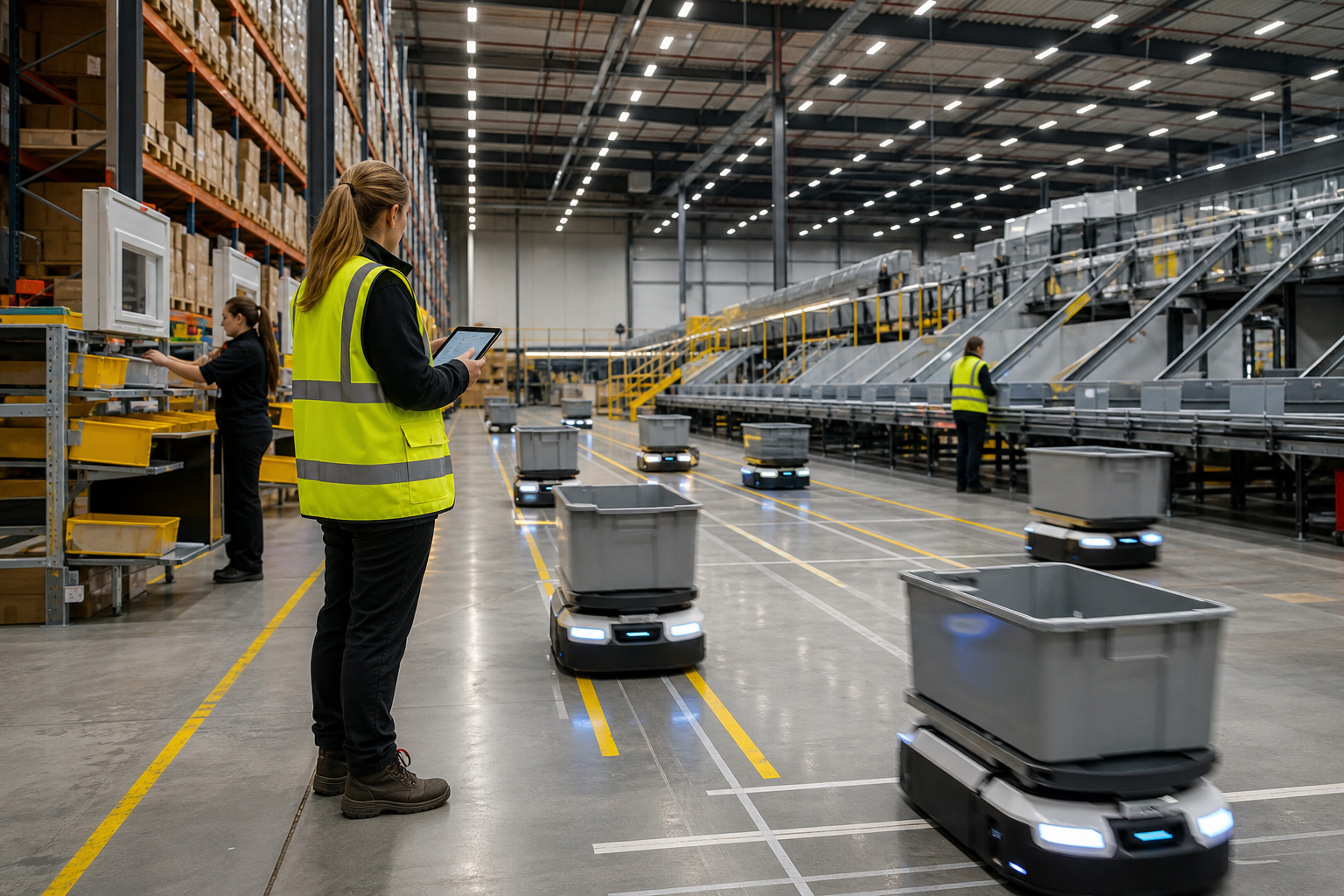
UK warehousing is not heading towards a clean split between fully manual sheds and fully automated dark warehouses. The more useful picture for 2026 is messier and more practical: hybrid labour models, where people, software, conveyors, autonomous mobile robots and specialist agency teams share the same operating plan.
That matters because most UK operators cannot pause the business, spend heavily on a full automation rebuild and wait years for payback. They still need to ship orders this week. Automation changes the labour mix; it does not remove the need for labour planning.
The pressure is real. Logistics UK says the UK warehousing estate now covers about 695 million sq ft and points to continued ecommerce volume as a driver of automation investment. Its warehouse automation briefing cites ONS-linked online retail sales of £128.6 billion in 2025, equal to 29% of total retail sales, and more than 4.4 billion online orders processed annually by the sector Logistics UK. At the same time, the same source describes an average warehouse worker shortage of 8% and automation investment growing by 14% annually.
The operational question is no longer whether automation belongs in the warehouse. It is where automation should carry repetitive movement, where people should retain judgement, and how the labour model changes without creating a brittle operation.
Key Takeaways
- Hybrid labour models work best when automation removes travel, lifting and repetitive scanning while people keep control of exceptions, quality and flow.
- UK operators should plan labour and automation together, rather than treating robots as a separate capital project owned only by engineering or IT.
- The first automation targets are usually high-travel, high-volume, low-complexity tasks such as goods-to-person movement, sortation and pallet transfer.
- Supervisors need new routines for queue management, robot availability, slotting changes and exception work, not just a smaller headcount plan.
- A phased hybrid model often gives a clearer route to return on investment than attempting a full dark-warehouse conversion.
Why Hybrid Beats the Dark-Warehouse Myth
The idea of a warehouse with almost no people is compelling in board papers, but it is a poor baseline for most UK sites. Warehouses are full of awkward edge cases: damaged inbound cartons, substituted products, mixed pallets, late carrier changes, mislabelled stock, customer-specific packing rules and seasonal product ranges that do not behave like the model expected.
Automation is very good at repeated movement through a known process. It is less useful when the work requires improvisation, commercial judgement or a quick decision about whether to hold, rework, quarantine or ship. That is why the strongest hybrid models use automation to stabilise the flow around people, not to pretend every exception can be engineered away.
Keymas describes the direction of travel as modular and selective, with autonomous mobile robots, AI-assisted warehouse management and conveyor integration being adopted around specific process segments rather than entire people-free facilities Keymas. That framing is closer to what operators can actually implement. A pick module might become goods-to-person. A sortation area might be conveyor-led. A pallet movement route might be handled by autonomous trucks. The site still needs people at the points where customer promise, product condition and operational judgement meet.
The better phrase is not labour replacement. It is labour redeployment. A warehouse that previously spent thousands of hours on walking, searching, lifting and repetitive confirmation can move more human effort into control, replenishment, quality, maintenance and exception handling.
What Is Pushing UK Warehouses Towards Hybrid Labour?
The first driver is volume volatility. Ecommerce demand has raised the number of individual order lines, cut order sizes and increased the importance of late carrier cut-offs. That pushes labour into short, sharp peaks. A fully permanent labour model can become too expensive in quiet weeks and too thin in peak weeks. A fully agency-led model can lose process discipline. Hybrid automation gives operators another lever, alongside the wider decisions covered in the 3PL guide and 3PL cost planning.
The second driver is labour availability. Logistics UK’s briefing points to an 8% average warehouse worker shortage across the sector Logistics UK. Open Sky Group also cites Gartner analysis that, in early 2024, 76% of supply chain operations reported notable workforce shortages Open Sky Group. Even when operators can hire, they still face churn, training time, absence and peak recruitment risk.
The third driver is ergonomics. Manual handling, long walking distances and repetitive scanning make the job harder than it needs to be. Hybrid automation can remove some of the work that causes fatigue and inconsistency. Goods-to-person systems reduce walking. Conveyor-assisted sortation reduces carrying. Autonomous pallet movement reduces tugging and forklift congestion. That does not make the warehouse effortless, but it changes the physical shape of the job.
The fourth driver is service expectation. Retailers and manufacturers now treat warehouse performance as a customer-facing capability. Missed cut-offs, wrong items, poor packing quality and slow returns processing feed straight into customer service costs. Automation can lift accuracy when the process is stable; people protect service when reality does not match the process.
The Hybrid Toolkit
Hybrid labour is not one technology. It is a design choice about which tasks should be machine-led, person-led or jointly controlled.
Autonomous mobile robots are often the entry point. In a person-to-goods model, the picker spends a large share of the shift walking between locations. AMRs can reduce that travel by bringing totes, shelves or carts into a controlled pick zone. The human role shifts towards accurate selection, exception recognition and pace control. Logistics UK says robotics can increase picking speeds by two to three times, reduce warehouse travel time by up to 70%, lift order accuracy towards 99.9% and improve labour productivity by 25-40% in appropriate use cases Logistics UK.
Conveyor and sortation systems are another common hybrid layer. They do not remove people from inbound, pick or pack, but they reduce manual movement between zones. The labour model changes because supervisors must now manage induction timing, chute capacity, jam response and packing balance. A poor sortation design can simply move the bottleneck downstream, so labour planning still matters.
Robotic pallet transport and automated guided vehicles can help in larger facilities where repeatable pallet routes create congestion. These systems are most useful on predictable movements: inbound to reserve, reserve to replenishment, production to despatch staging, or empty pallet return loops. People still need to handle mixed, damaged or urgent loads, but fewer hours are spent on routine shuttling.
AI-assisted slotting is less visible but often just as important. If the warehouse management system can recommend slot changes based on velocity, cube, pick sequence and carrier cut-offs, supervisors can cut travel and congestion before adding more labour. The gain comes from pairing software recommendations with human knowledge of awkward products, supplier behaviour and site constraints. Import-heavy sites also need this plan to work around customs release timing, not against it; the customs clearance guide explains where those hand-offs can slow warehouse flow.
Cobots and assisted packing equipment can also fit where product handling is repetitive but not fully uniform. The useful test is whether the technology improves flow without turning every exception into a stoppage.
How Human Roles Change
The biggest mistake is to plan automation as if the only output is fewer pickers. Some manual roles may shrink, especially long-distance walking, repetitive scanning and simple transport tasks. New work appears around the system.
Supervisors need stronger control-room habits. They must understand queue depth, robot availability, downtime, replenishment pressure and exception backlogs. A manual pick supervisor can often see the problem by walking the floor. In a hybrid operation, some of the problem is visible only in dashboards, alerts and missed hand-offs between zones.
Engineers and first-line technicians become more important. A small mechanical fault can block a high-volume process if there is no local response capability. Operators do not always need a large in-house engineering team from day one, but they do need clear cover, spares discipline, escalation paths and downtime routines.
Team leaders need to coach different behaviours. Pick accuracy, safe interaction with moving equipment, exception labelling and restart routines become part of daily performance management. The best sites avoid treating automation as mysterious. They teach colleagues what the equipment is doing, what the system needs from them and when to stop the line.
Planning roles also become more analytical. Labour planners must forecast headcount, equipment capacity, charging windows, maintenance downtime and the mix between automated and manual flows.
This creates a skills gap. Robotics Jobs UK reports that 81% of manufacturers struggle to find qualified automation staff and cites UK robot density at about 112 units per 10,000 workers, below the European average Robotics Jobs UK. Those figures should be treated as labour-market indicators rather than warehouse-specific certainties, but the message is familiar: automation changes which people are scarce.
The Workforce Mix: Permanent, Agency and Automated Capacity
A practical hybrid labour model usually has three layers.
The permanent core owns the standards. These are the supervisors, experienced operatives, trainers, inventory specialists, engineers and problem-solvers who understand the building. They protect quality, train temporary workers and keep the system honest.
The flexible layer absorbs demand swings. Agency labour, temporary contracts and overtime still matter, particularly for peak, stock builds, promotional volume and returns. Automation does not make peak disappear; it changes where extra people are useful. Instead of adding walkers everywhere, operators may add people at induction, packing, replenishment, exception handling and dispatch marshalling.
The automated layer carries predictable movement. AMRs, conveyors, sorters and transport systems should be planned like a labour pool. They have throughput, downtime, constraints and failure modes. They cannot be treated as free capacity once installed.
The art is matching those layers by process. A warehouse might run automated goods-to-person picking for fast movers, manual pick faces for slow and awkward lines, conveyor sortation for standard parcels and a human-led bench for fragile or regulated products. That mix is usually stronger than forcing every product through one operating model.
Return on Investment Without Losing Flexibility
Full automation can make sense for very high-volume, stable, long-contract operations. Many UK warehouses do not have that certainty. Customer profiles change, leases have limits, product ranges move and capital budgets compete with transport, IT and property needs.
Hybrid investment can be staged. A site might begin with slotting improvements and scan discipline, then add conveyor links, then pilot AMRs in one pick zone, then automate a repeatable pallet movement route. Each stage should have its own baseline: travel time, picks per hour, overtime hours, agency dependency, damages, error rate and missed cut-offs.
This is where operators need to be strict. Automation vendors can model impressive throughput, but the return depends on site-specific constraints: aisle widths, floor quality, fire routes, battery charging, WMS integration, product dimensions, replenishment rhythm and labour agreements.
The best business cases also count avoided cost. If automation reduces the need for peak recruitment, cuts training churn, lowers injury risk or protects carrier cut-offs, the value may not appear only as a direct headcount reduction. A hybrid model should be judged on service stability as well as labour productivity.
Planning a Hybrid Transition
Start with a process map, not a technology shortlist. Measure where time is actually going: walking, searching, waiting for replenishment, rework, manual pallet movement, carrier staging, returns triage or exception resolution. A warehouse that automates the wrong bottleneck can spend heavily and still miss cut-offs.
Then separate work into four groups. The first is high-volume and predictable; these tasks are candidates for automation. The second is repetitive but variable; these may suit assisted technology or better WMS rules. The third is low-volume and awkward; these usually stay manual. The fourth is exception work; this needs skilled people, clear rules and fast escalation.
Next, design the labour model around the future process. Decide which permanent roles own system health, who trains flexible labour, who clears exceptions, who authorises manual workarounds and who speaks to the automation provider when performance drops.
Pilot before scaling. A contained AMR or sortation pilot should prove real labour impact, safety behaviour, WMS integration and supervisor routines. Track the baseline before the pilot starts. Picks per hour on its own is not enough. Include overtime, error rate, agency hours, absence cover, walking distance, replenishment misses and carrier failures.
Finally, keep a manual fallback. Hybrid operations should be resilient, not fragile. If a robot fleet, sorter lane or integration fails, the site needs a controlled degraded mode. The fallback should be rehearsed before peak, not invented during it.
The Management Discipline Behind Hybrid Warehousing
Hybrid labour models are not just an automation project. They are a management discipline. The warehouse has to run with a clearer view of constraints, a better-trained core team and tighter control of exceptions.
That discipline starts with honest language. Robots do not “solve labour” in a general sense. They solve specific movement, sorting or handling problems. People do not simply “fill the gaps”. They make the decisions that keep customers, carriers and inventory records aligned when reality gets untidy.
For UK warehousing in 2026, the strongest operators will be the ones that combine both without pretending either is enough on its own. They will use automation to remove wasted travel and repetitive strain, use permanent teams to protect standards, use flexible labour where demand genuinely flexes, and build supervisor routines that hold the whole system together.
The result is not a people-less warehouse. It is a warehouse where human work is used more deliberately.
FAQ
Are hybrid labour models only for large warehouses?
No. Large sites have more obvious automation opportunities, but smaller warehouses can still use hybrid principles. Slotting discipline, conveyor links, assisted packing, better WMS workflows and selective use of AMRs can all reduce wasted labour without a full rebuild.
Does warehouse automation reduce headcount?
It can reduce hours spent on repetitive movement, but the outcome depends on growth, service promises and process design. Many sites redeploy labour into replenishment, packing, quality, maintenance and exception handling rather than simply removing roles.
What should a UK warehouse automate first?
Start with high-travel, high-volume and low-complexity tasks. Common candidates include goods-to-person picking for fast movers, conveyor-assisted sortation, pallet shuttle routes and AI-assisted slotting. Avoid automating rare or messy exceptions first.
How should operators plan agency labour in an automated warehouse?
Agency labour should be planned around the automated flow, not added as a general buffer. Temporary staff are often most useful at induction, packing, replenishment, dispatch marshalling and returns, while trained permanent staff handle control, exceptions and system recovery.
What is the biggest risk in a hybrid warehouse?
The biggest risk is creating a system that works only when everything is perfect. Operators need clear exception rules, maintenance cover, supervisor dashboards, trained fallback processes and realistic peak plans before they rely on automation for service-critical flow.