UK logistics firms are increasing automation and technology spend in 2026, but the pattern is more cautious than the headlines suggest. The strongest operators are not buying automation as a slogan. They are using it to protect service levels, reduce avoidable manual work, and make scarce labour go further.
The clearest signal comes from the Logistics UK and HSBC UK Logistics Investment Insight Report 2026. More than 77% of surveyed UK logistics firms increased technology spending in 2026 compared with 2025, while 70% expect further increases next year. The three highest investment priorities were cyber security at 20.9%, AI at 20.5%, and software modernisation at 20.5%.
That is not the same as a blank cheque for robots. The same reporting says 70.5% of firms have delayed or deferred planned projects in the previous 18 months, despite 70.4% saying finance is straightforward to secure. The investment problem is therefore less about whether logistics leaders believe in automation and more about confidence, integration risk, policy uncertainty, and the quality of the business case.
For UK operators, 2026 is the year to separate useful automation from fashionable automation. A good project should make throughput, accuracy, labour planning, or customer reliability measurably better. A weak project will add capital cost to a process that was never stable enough to automate.
Key Takeaways
- UK logistics technology spend is rising, with Fleet World reporting that more than 77% of firms increased spending in 2026 compared with 2025.
- Cyber security, AI, and software modernisation are the leading investment priorities, according to Motor Transport’s coverage of the Logistics UK and HSBC report.
- Warehouse automation is moving from large fixed systems towards modular cells, autonomous mobile robots, AI slotting, and integration-first projects.
- The best ROI cases start with labour redeployment, accuracy, cut-off reliability, and capacity, not just headcount reduction.
- Project delays are still common because operators are uncertain about growth, tax policy, infrastructure, and implementation risk.
- Automation should follow process discipline: barcode accuracy, clean master data, useful KPIs, and stable workflows come before major hardware spend.
Where UK logistics firms are spending in 2026
The 2026 investment mix shows a sector trying to modernise without losing control of risk. Cyber security sits at the top because logistics networks now depend on connected transport systems, warehouse management platforms, customer portals, telematics, and carrier integrations. A cyber incident can stop orders moving just as surely as a blocked port gate.
AI is close behind because it promises targeted gains rather than one single transformation. In practical logistics terms, AI investment usually means forecasting demand, improving slotting, predicting vehicle or equipment issues, spotting customs or documentation exceptions, routing work, or helping teams make faster decisions from messy operational data. It is more credible when it sits inside a defined workflow than when it is sold as a broad management layer.
Software modernisation matters because many automation projects fail at the joins. A warehouse can buy mobile robots, print-and-apply equipment, automated dimensioning, or a carrier selection engine and still lose value if the WMS, ERP, transport management system, and customer data do not talk cleanly. Before committing to hardware, operators should review whether core systems can support real-time instructions, exception handling, and reliable reporting.
This is why automation investment should be considered alongside operational basics. If you are already tracking warehouse KPIs properly, the automation case becomes easier to test. If you are still measuring performance by end-of-day anecdotes, the first investment may need to be data capture rather than equipment.
Warehouse automation is the front line
Warehouse operations are the most visible place for 2026 automation spend because they combine labour pressure, e-commerce volatility, service-level demands, and physical constraints. LogisticsUK.org cites UK online retail sales of £128.6 billion in 2025, representing 29% of total retail, and says the UK processes 4.4 billion e-commerce orders annually in 2026. Those volumes make manual exception handling expensive.
IMARC Group values the UK warehouse automation market at USD 2.4 billion in 2025 and projects it to reach USD 5.6 billion by 2034, a compound annual growth rate of 9.49%. Those figures point to steady adoption rather than a one-year spending spike. The underlying demand is not just for fully automated sheds; it is for targeted systems that remove repetitive work in constrained sites.
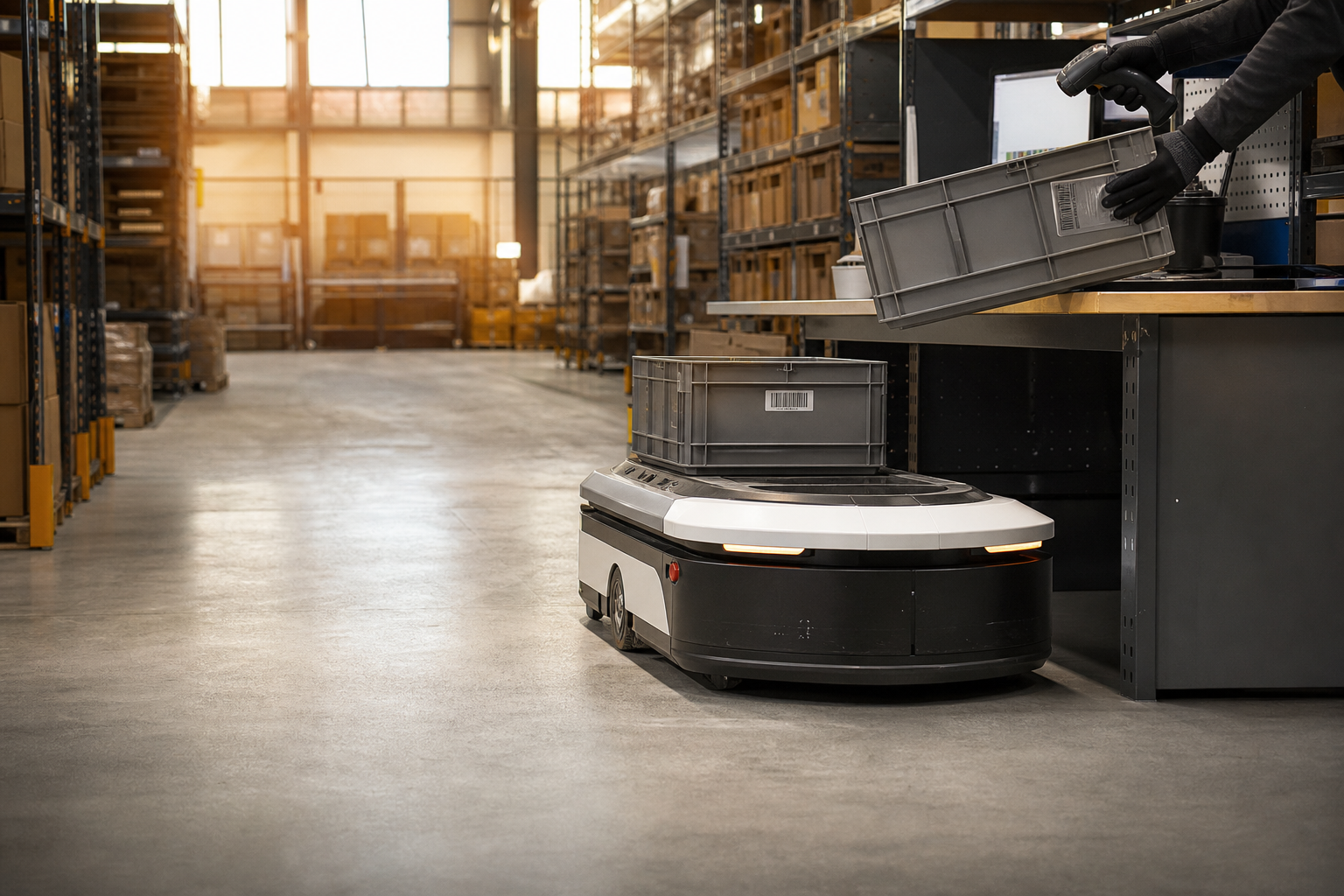
Autonomous mobile robots are part of that shift. They suit many brownfield UK warehouses because they can be introduced around existing racking, workstations, and pick paths more easily than heavy fixed automation. They are not magic, but they can reduce walking time and smooth peak labour requirements when the inventory profile is stable enough.
Other common investment areas include goods-to-person workstations, conveyors, sortation, dimensioning and weighing, print-and-apply, automated packing lines, and AI-assisted slotting. For a deeper implementation view, the existing LogisticsEdge guide to warehouse automation ROI covers the business-case mechanics in more detail.
The strongest projects are modular
Modular automation is attractive in 2026 because many operators do not trust demand forecasts enough to approve large, fixed, multi-year projects. A modular cell can be tested in one zone, measured against a baseline, then expanded if it performs. That reduces the risk of building an expensive system around a customer profile that may change.
The right module depends on the bottleneck. If picking travel is the problem, mobile robots or zone picking may help. If packing is the constraint, carton selection, weigh-checking, labelling, and print automation may create more value than robots. If replenishment is constantly late, automation at the pick face will not solve the root cause until inventory movement is fixed.
Integration is often the deciding factor. A modular system still needs clean item data, location discipline, exception rules, and a sensible way to pause or reroute work when something goes wrong. Operators should test these control points before signing for equipment, because the cost of integration failure is usually paid in overtime, customer credits, and missed cut-offs.
This also affects whether to automate in-house or use a third-party provider. If your volume is variable, the comparison with a partner-led model should include flexibility and minimum commitments, not just headline cost per order. The guides to what 3PL means and 3PL costs in the UK are useful references when that decision is still open.
How to make the ROI case credible
A credible automation business case starts with a measured baseline. You need order lines, picks per hour, travel time, labour hours, overtime, agency spend, returns caused by errors, carrier miss-cut-offs, rework, replenishment delays, and space use. Without a baseline, payback becomes a sales spreadsheet rather than an operating forecast.
Research notes for this article cite common automation payback ranges of 18 to 36 months for modular systems such as AMRs and pick-to-light in UK SME settings, with larger hub automation often taking three to seven years. Those are useful planning ranges, but they are not promises. Payback depends on utilisation, process stability, labour assumptions, and how much growth the system absorbs without extra shifts.
Labour saving should be handled carefully. If automation lets you avoid temporary labour, reduce overtime, or absorb growth without adding headcount, that has real value. If no headcount reduction or labour redeployment will happen, a business case that claims a full payroll saving is weak.
Accuracy and service reliability can be just as important as labour. LogisticsUK.org cites examples of high-volume automated facilities reducing picking errors by up to 99.9% and increasing fulfilment speed by 300%. Those numbers should not be copied into your own board paper unless your process and volume profile can support them, but they show why error cost and dispatch reliability belong in the model.
AI is useful when it owns a specific decision
AI investment is strongest when it improves a defined decision that already happens every day. In warehouses, that may mean slotting fast movers closer to packing, predicting replenishment shortages, flagging orders likely to miss carrier cut-off, or recommending labour allocation by zone. In transport, it may mean exception triage, ETA prediction, route adjustment, or maintenance prioritisation.
The weak version is a dashboard that summarises problems without changing what happens next. Operators already have enough reports. The investment test should be whether the AI output is trusted, timely, and connected to an action that someone can take.
Data quality is the limiting factor. If item dimensions are wrong, order profiles are misclassified, location scans are skipped, or exception codes are inconsistent, AI will mostly accelerate confusion. This is why software modernisation appears alongside AI in the Logistics UK and HSBC priority list. The operating data has to be fit for the decision.
Customs and documentation teams face the same issue. AI can help spot missing fields, classify exception types, or route work to the right person, but it cannot compensate for poor master data or unclear accountability. For customs-heavy operators, process quality still matters as much as technology, as shown by common issues in customs declaration errors and corrections.
Why projects are being delayed
The most interesting 2026 finding is that firms are delaying projects even when finance is available. Fleet World and Motor Transport both report that 70.5% of firms delayed or deferred planned projects over the previous 18 months. The main reasons cited include uncertainty over business growth at 19.8% and government policy at 16.3%.
That reflects a rational concern. Logistics assets are often built around customer contracts, leases, peak profiles, and network assumptions. If volumes are uncertain, tax policy is unsettled, or infrastructure constraints are unresolved, operators hesitate before committing to fixed systems.
Tax is a particular concern. Fleet World reports that more than half of respondents said tax policy makes them less likely to invest. Even where the business case works operationally, uncertainty over cost pressure can slow sign-off because cash has competing calls: fleet renewal, wage pressure, energy, property, insurance, cyber security, and compliance.
Decarbonisation adds another layer. Motor Transport reports Logistics UK president Phil Roe describing decarbonisation as “more of an infrastructure challenge than a vehicle challenge”. That matters because electric fleet investment, charging capacity, site power, and warehouse automation may all compete for capital and grid access at the same time.
What operators should do before signing a purchase order
Start with the process map, not the supplier demo. Identify the constraint, prove it with data, and write down what must improve. A good automation project has a narrow operational target: fewer pick walks, higher packing throughput, fewer misroutes, faster goods-in checking, lower rework, or more reliable cut-off performance.
Then test the data foundation. Item dimensions, weights, units of measure, location records, barcode coverage, packaging rules, carrier services, and customer service promises all need to be accurate enough for automation to follow. If the system will make decisions from bad data, the project is not ready.
Build the ROI model with conservative and strong-utilisation cases. Include capex, software, support, maintenance, site works, training, integration, downtime, and internal project time. On the benefit side, separate cash savings from capacity, quality, and risk reduction so the board can see what is certain and what depends on growth.
Finally, plan the human workflow. Automation changes supervision, engineering support, exception handling, training, and shift control. Hybrid human-robot operations work best when people know when to intervene, how to recover a failed job, and who owns performance tuning after go-live.
Frequently Asked Questions
What is driving UK logistics automation investment in 2026?
The main drivers are labour pressure, e-commerce demand, cyber risk, customer service expectations, and the need to modernise ageing systems. Fleet World reports that more than 77% of UK logistics firms increased technology spending in 2026 compared with 2025. Motor Transport reports cyber security, AI, and software modernisation as the leading priorities in the Logistics UK and HSBC survey.
Is warehouse automation only for large operators?
No. Large automated hubs still need major capital and long payback periods, but modular systems have lowered the entry point. AMRs, pick-to-light, packing automation, dimensioning, weighing, and print-and-apply can often be introduced one process at a time. Smaller operators still need a clear baseline and reliable data before buying.
What payback period should a UK warehouse expect?
For modular automation, a planning range of 18 to 36 months is commonly used in the research notes behind this article. Larger hub automation can take three to seven years because the capex, integration, and site-change costs are much higher. The actual result depends on utilisation, labour assumptions, accuracy gains, and whether the system absorbs growth.
Should AI come before physical automation?
Sometimes. If the main problem is poor planning, weak slotting, bad forecasting, or slow exception handling, AI or better software may produce value before hardware. If the main problem is repetitive travel, packing bottlenecks, or physical handling, equipment may be the better first step. The decision should follow the constraint.
Why are firms delaying projects if investment is rising?
Many firms believe automation is necessary but are cautious about timing. Fleet World and Motor Transport report that 70.5% of firms delayed or deferred projects in the previous 18 months, with uncertainty over business growth and government policy among the reasons. That points to confidence and risk management, not a lack of interest.
What is the safest first automation project?
The safest first project is usually a modular improvement with a clean baseline and a measurable bottleneck. Examples include packing automation, mobile robots in a defined pick zone, automated dimensioning and weighing, or print-and-apply where labelling slows dispatch. Avoid starting with a whole-site redesign unless the volume profile, lease, customer mix, and integration plan are stable.