Key Takeaways
- UK warehouse automation is moving from pilot projects to practical, phased investment, driven by labour pressure, e-commerce expectations, and the need for more resilient fulfilment operations.
- The strongest 2026 business cases are usually in picking, sortation, replenishment, goods-to-person workflows, and software orchestration rather than fully automated “lights out” sites.
- Autonomous mobile robots, automated storage and retrieval systems, vision-assisted quality checks, parcel sortation, and AI-supported warehouse management systems are the technologies operators should assess first.
- Integration is now the deciding factor. Automation that cannot share clean data with the WMS, ERP, carrier platform, and inventory systems will create new failure points.
- The lowest-risk route is a phased rollout: map the constraint, model the payback, pilot in one flow, measure the result, then scale only when the process is stable.
Why Warehouse Automation Matters in 2026
Warehouse automation in the UK is no longer a niche project for national retailers and parcel networks. It is becoming a practical operating decision for importers, e-commerce sellers, manufacturers, wholesalers, and 3PLs that need more throughput without matching labour growth.
The market signal is clear. IMARC Group estimates the UK warehouse automation market at about USD 2.4 billion in 2025 and forecasts it could reach USD 5.6 billion by 2034, with a 9.49% compound annual growth rate from 2026 to 2034.1 That growth includes software, conveyors, sortation, automated storage, scanning, machine vision, control systems, and the integration work that makes those systems usable in a live operation.
The operational pressure is just as important. Logistics UK notes that UK e-commerce demand has pushed fulfilment networks to handle billions of online orders each year, with online retail sales forming a large share of total retail activity.2 That demand has changed what a normal warehouse day looks like. More single-item orders, more cut-off pressure, more returns, and tighter customer expectations all increase the strain on manual processes.
For operators, the question is where automation removes a real constraint. A site with poor inventory accuracy, weak slotting, or unstable inbound discipline will not become efficient simply because robots arrive. The best automation projects start with a plain diagnosis: where does work queue, where do errors occur, and where does labour spend time walking, searching, waiting, or reworking?
The Forces Pushing UK Warehouses Towards Automation
The first driver is labour availability. Warehousing has always depended on temporary and flexible labour, especially in peak trading periods. That model is becoming harder to rely on. IMARC links UK automation demand partly to workforce shortages and post-Brexit labour-market friction, particularly in labour-intensive sectors.1 Even where vacancies are not severe, operators still face wage inflation, absence risk, training churn, and the practical challenge of staffing unsociable shifts.
Automation does not remove the need for people. It changes where people are used. A well-designed goods-to-person process can reduce walking time and let trained staff focus on exceptions, quality, replenishment, maintenance, and process control. That matters because walking, searching, and manual sorting are often the least productive parts of a warehouse shift.
The second driver is service expectation. Next-day delivery, late cut-offs, accurate stock promises, and fast returns handling have become standard in many product categories. Automation helps where it gives the operation more predictable throughput at the sharp end of the day.
The third driver is space. UK warehouse space is expensive, especially near major population centres and transport corridors. Automated storage and retrieval systems can improve cube utilisation, while better software can reduce dead stock, poor slotting, and unnecessary movements.
This is where the connection with 3PL costs becomes important. Whether you run your own facility or outsource fulfilment, automation changes the cost base. The business case has to compare total operating cost, not just hourly labour saved.
Trend 1: AMRs Move From Novelty to Everyday Transport
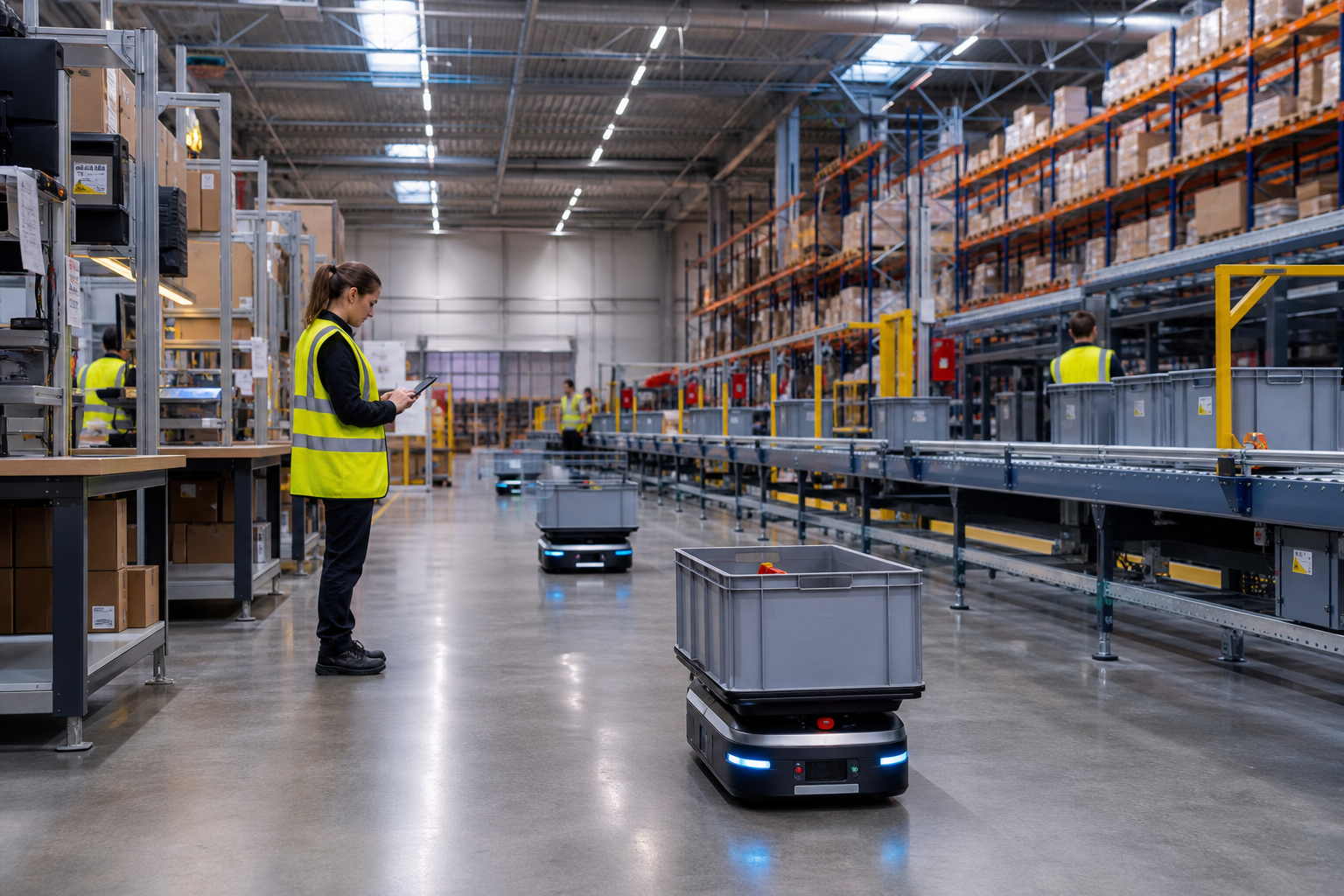
Autonomous mobile robots, usually called AMRs, are likely to be one of the most visible warehouse automation trends in 2026. They are attractive because they can often be introduced without rebuilding the whole warehouse. Instead of fixed conveyors or major civil works, AMRs use mapping, sensors, and fleet software to move totes, carts, or goods between locations.
The strongest use cases are repetitive internal transport tasks: moving picked totes to packing, taking replenishment stock to forward pick faces, supporting zone picking, or reducing walking in a goods-to-person layout. For many operators, the immediate gain is not that robots pick faster than people. It is that people spend less of the shift walking long distances.
AMRs are also scalable. A site can start with a small fleet, measure congestion and throughput, then add units if the process works. That makes them easier to justify than large fixed automation for operators with uncertain growth forecasts.
There are limits. AMRs need disciplined floor management, reliable Wi-Fi or network coverage, clean master data, clear charging routines, and sensible exception handling. If aisles are constantly blocked, stock is poorly located, and pack benches are not balanced, AMRs will simply move the bottleneck somewhere else.
AMRs are not a universal answer, but they are a useful first automation layer for many UK fulfilment sites because they target a real and visible waste: travel time.
Trend 2: Goods-to-Person and AS/RS for Space-Constrained Sites
Automated storage and retrieval systems, including shuttle systems, cube storage, mini-load cranes, and vertical lift modules, are gaining attention because they tackle both labour and space. Instead of pickers walking to stock, the system brings totes or items to a workstation.
This can be powerful in high-SKU, small-item environments such as beauty, electronics accessories, spare parts, medical supplies, and direct-to-consumer retail. The right system can improve pick density, reduce walking, protect stock, and create a more controlled process for replenishment and cycle counting.
The trade-off is commitment. AS/RS projects usually need more capital, more design work, and more operational discipline than AMR deployments. Slotting strategy, SKU velocity, tote dimensions, replenishment rules, maintenance access, and peak order profiles all need to be understood before a system is specified.
For UK operators, AS/RS should be assessed alongside lease terms and building constraints. If the site is leased for only a short period, a highly fixed installation may be hard to justify. If the site is strategically important for five to ten years, the cube utilisation and labour savings may make the investment credible.
Trend 3: Automated Sortation Becomes a Mid-Market Option
Parcel sortation used to feel like a technology reserved for major carriers and very large retailers. That is changing. Automated sorters, put walls, cross-belt systems, shoe sorters, and simpler conveyor-based routing are becoming relevant to 3PLs and higher-volume e-commerce warehouses that need to move orders from pick to pack to despatch with fewer manual decisions.
The business case is strongest where there are multiple carriers, service levels, despatch lanes, or customer destinations. If staff are manually reading labels, pushing parcels into cages, correcting routing errors, or rebuilding carrier manifests, sortation can remove friction.
Emerdis highlights automated parcel sortation as a major 2026 trend, especially as fulfilment networks handle more complex parcel profiles and tighter despatch windows.3 For UK sites dealing with Royal Mail, DPD, Evri, DHL, pallet networks, click-and-collect flows, and marketplace orders in the same building, that complexity is real.
Sortation is not only about speed. A good system can confirm that each parcel has the right label, route it to the right carrier lane, and give managers a live view of despatch progress. That reduces the end-of-day panic where supervisors discover late that a service lane is behind.
Trend 4: AI-Driven WMS Decisions, Not Just Dashboards
The practical version of AI in warehousing is better decision support inside warehouse management systems. That includes labour planning, pick path optimisation, dynamic slotting, replenishment timing, order batching, anomaly detection, and predictive maintenance signals.
This matters because many warehouses already have plenty of data but weak decisions. A WMS may know every stock movement, yet still release work in inefficient waves. It may track inventory accurately after the event, but not warn managers that a fast-moving SKU is about to cause pick-face failure. It may report yesterday’s productivity, but not help supervisors rebalance today’s shift.
AI-supported tools can recommend which SKUs should move closer to pick faces, group orders into better batches, identify unusual stock adjustments, or forecast labour demand by channel and cut-off. These are not glamorous use cases, but they are useful.
The constraint is data quality. If product dimensions are missing, locations are inaccurate, order types are poorly coded, or stock adjustments are used to hide process problems, the system will make poor recommendations. AI does not compensate for a weak operating model.
This is why the best software projects start with master data discipline. Check SKU dimensions, pack sizes, barcode quality, location naming, carrier service codes, order priority rules, and integration ownership.
Operators reviewing their systems should also consider the relationship between WMS capability and wider processes such as customs clearance for bonded or international stock, marketplace inventory feeds, and finance reporting. Warehouse automation is rarely isolated from the rest of the business.
Trend 5: Vision, Scanning, and Quality Control at the Point of Work
Not every automation project needs robots. Some of the strongest returns come from better scanning, weighing, dimensioning, labelling, and visual checks at the point where errors occur.
Machine vision can confirm that the right product is in the right tote, check label placement, verify carton condition, or capture evidence before despatch. Automated dimensioning can improve carrier rating and reduce parcel surcharge disputes. In returns, image capture can support grading decisions and customer-service evidence.
Logistics UK reports that automation can reduce picking errors substantially and improve fulfilment speed in high-volume environments.2 The precise result depends on the site, but the direction is credible: when systems validate work as it happens, fewer errors escape downstream.
For operators, the useful question is where an error becomes expensive. A mispick caught at the pick face costs a few seconds. A mispick found by a customer costs reshipment, refund handling, customer-service time, margin, and trust.
How to Build a Sensible Automation Business Case
The best automation business cases are specific. They do not start with “we need robots”. They start with a constraint that can be measured.
First, map the process. Follow a typical order, return, replenishment task, and inbound receipt through the building. Record touch points, walking distance, waiting time, rework, stock checks, exceptions, and manual decisions. If the team cannot describe the current process accurately, it is too early to automate it.
Second, quantify the baseline. Measure lines picked per labour hour, orders packed per hour, despatch accuracy, inventory accuracy, return cycle time, overtime hours, agency spend, space utilisation, and missed cut-offs. These metrics give the project a starting line.
Third, model the total cost. Include equipment, software licences, implementation, integration, training, maintenance, support, spare parts, network upgrades, downtime cover, and internal project time. Compare that with labour savings, avoided overtime, better space utilisation, fewer errors, higher throughput, and improved customer retention.
Fourth, stress-test the assumptions. Model peak week, low week, SKU growth, carrier change, channel mix change, and product range change. Automation that only works at average volume is fragile.
Fifth, define the operational owner. A project cannot remain a supplier-led installation forever. Someone inside the business must understand how work is configured, how exceptions are resolved, how maintenance is scheduled, and how performance is reviewed.
For businesses deciding between in-house automation and outsourced fulfilment, compare the result with the economics in what a 3PL does and the cost structure in UK 3PL pricing. Sometimes the right answer is to automate your own core warehouse. Sometimes it is to outsource volume that no longer fits your building.
A Practical 2026 Rollout Plan
For most UK operators, a phased rollout is safer than a single large transformation.
Start with one flow. That might be pick-to-pack movement, returns grading, replenishment, carrier sortation, or automated carton labelling. Choose a flow where the current pain is visible and the measurement is straightforward.
Run a controlled pilot. Keep the scope narrow enough that supervisors can manage it closely. Measure before and after performance, but also watch the softer signals: staff adoption, exception volume, maintenance burden, system confidence, and whether problems move elsewhere.
Fix the process before scaling. If the pilot exposes weak slotting, poor product data, fragile Wi-Fi, or unclear ownership, treat that as useful evidence. Do not scale a bad process just because the equipment technically works.
Build the integration properly. The WMS, ERP, carrier platform, marketplaces, and reporting layer need clear data ownership. Avoid manual workarounds that become permanent. If staff are exporting CSV files every day to keep the system alive, the project is not finished.
Train beyond button-pressing. Operators need to know what to do when the system behaves unexpectedly. Supervisors need to understand dashboards, configuration rules, exception queues, and escalation routes.
The Bottom Line
The most important UK warehouse automation trend in 2026 is maturity. Operators are becoming less interested in impressive demonstrations and more interested in systems that remove measurable constraints.
AMRs can reduce walking. AS/RS can improve density and goods-to-person productivity. Sortation can protect despatch performance. AI-supported WMS tools can improve decisions. Vision and scanning can stop errors before they leave the building. None of those tools works well in isolation from process discipline, data quality, and integration.
For UK logistics teams, the path is simple: identify the bottleneck, measure it, model the payback, pilot carefully, and scale only when the result is proven. Automation should make the warehouse calmer, more predictable, and easier to manage.
FAQ
What is the biggest warehouse automation trend in the UK for 2026?
Practical, phased automation rather than fully automated warehouses. UK operators are focusing on AMRs, goods-to-person systems, sortation, scanning, and WMS decision support where these tools solve a specific bottleneck.
Are warehouse robots worth it for small and mid-sized UK businesses?
They can be, but only where the business case is tied to a measurable problem such as excessive walking, missed cut-offs, labour shortages, high error rates, or space constraints.
How long does warehouse automation take to pay back?
Payback varies by technology, site, labour model, and volume. Simple scanning or labelling improvements may pay back quickly, while AS/RS and major sortation projects usually need a longer horizon.
What should a warehouse automate first?
Start with the clearest constraint. Common first projects include reducing picker walking, improving despatch sortation, adding verification scans, automating carton labelling, or improving replenishment control. Avoid automating processes with poor stock accuracy or weak master data.
Does automation replace warehouse staff?
Usually it changes the work rather than removing people entirely. Automation can reduce manual walking, sorting, and repetitive handling, but it increases the need for supervision, maintenance, exception handling, and process control.