Key Takeaways
- Four pressures converge on UK warehouses by 2030: energy and grid capacity, automation, workforce demographics, and property/ESG obligations.
- UKWA estimates UK warehouse rooftops could host up to 15GW of new solar — enough to double the country’s solar PV capacity — but grid connections take 6–18 months to secure.
- Only 13% of warehousing employers report no difficulty recruiting staff, and over half expect critical automation and robotics skills shortages within five years (UKWA Skills Survey 2025).
- Nearly a quarter of the logistics workforce is aged 55 or over, so succession and training pipelines are a 2030 risk, not a 2040 one.
- 86% of UK 3PL leasing deals in 2024 went to prime warehouses, up 22% on the previous year — buildings that lag on power, automation-readiness and ESG will lose tenants.
- Grid, solar and EV charging decisions are now lead-time decisions: a 500kWp solar array with 20 rapid chargers needs a connection above 1MW, and waiting is the most expensive option.
What “Warehouse 2030” Actually Means
By 2030, the typical UK warehouse will be shaped by four pressures arriving together: an energy transition that changes what a building needs from the grid, an automation wave that changes what happens inside it, a workforce demographic shift that changes who can run it, and tightening ESG and planning expectations that change what landlords and councils approve.
The scale sits in the numbers. UKWA’s 2026 workforce policy paper puts the sector’s contribution at £28.5 billion in gross value added, with warehousing employing more than 650,000 people and its footprint growing over 61% in the past decade — growth that happened when labour was comparatively available and power demand was modest. Neither condition holds now: UKWA’s Skills Survey 2025 found only 13% of warehousing employers report no difficulty recruiting, and over half anticipate critical automation and robotics skills shortages within five years.
By 2030, automation, AI forecasting and hybrid operations will be default configurations rather than pilots: an industry study by Impact Express, reported via ecommercenews.uk, projects that over 85% of UK fulfilment warehouses could be automated by 2030. Treat that figure as a projection rather than an official statistic, but the direction is corroborated by Savills Impacts and CBRE. Buildings and organisations that are not ready will feel it in the grid queue, the labour market and the leasing market.
This checklist breaks readiness into five areas: energy first, because its lead times are longest, then automation, workforce, property and ESG, and finally a consolidated action plan you can score your own site against. If part of your fulfilment is outsourced, the 3PL questions in our guide to what a 3PL actually does overlap with several of these items.
Energy and Grid Readiness
Start with the question that has the longest lead time: can your building get the power it will need in 2030, and how long will that take?
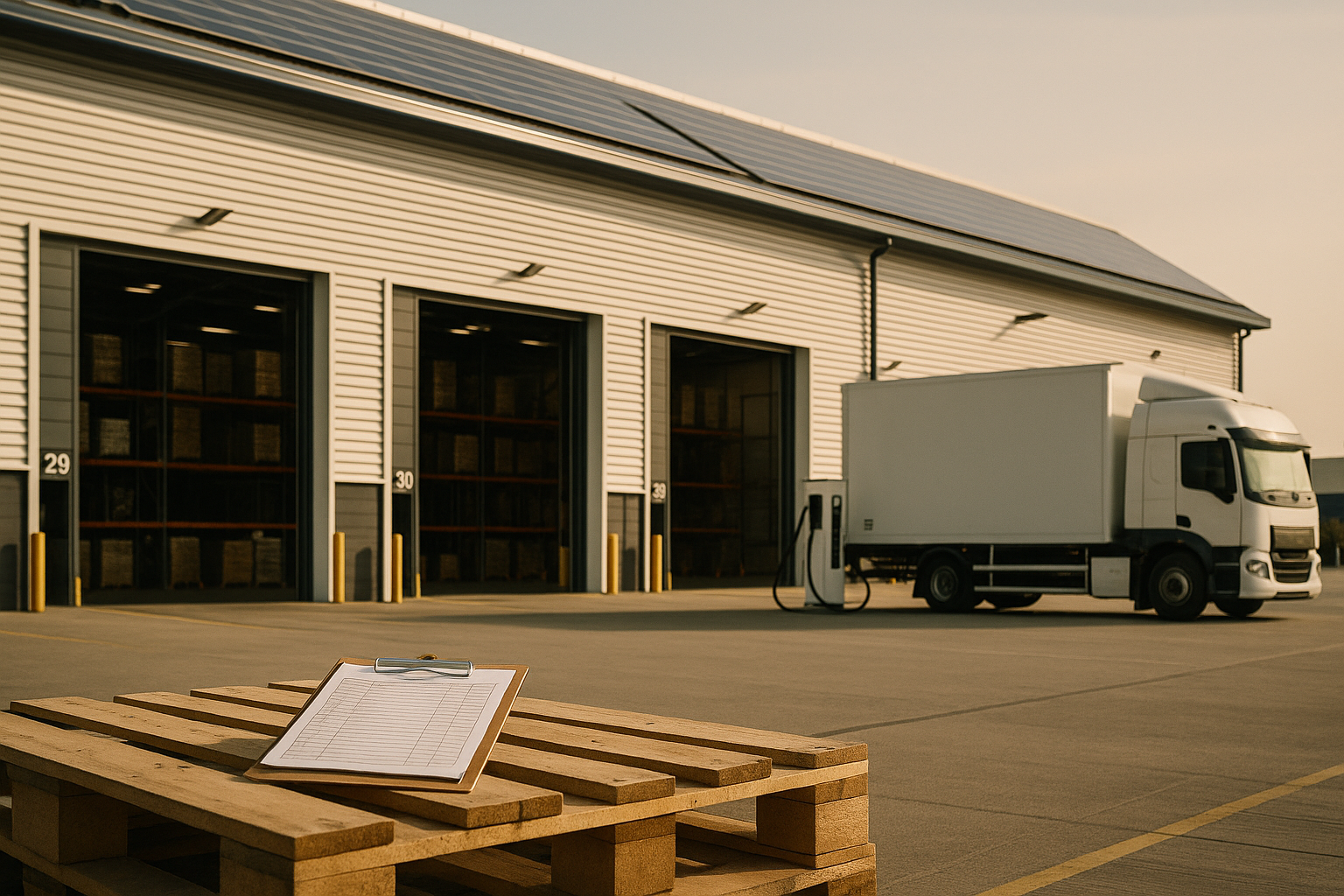
The scale of the opportunity is large. UKWA’s written evidence to Parliament estimates UK warehouse roof space could host up to 15GW of new solar capacity — roughly double the UK’s entire solar PV fleet. For an individual operator, a rooftop array turns dead roof space into a hedge against energy costs.
But solar alone is no longer the end of the energy question. Electrified fleets need depot charging, and charging at scale changes the size of the grid connection required. Per Commercial Solar Finance’s 2026 UK analysis, a representative configuration — a 500kWp solar installation paired with 20 × 50kW EV rapid chargers — needs a grid connection of 1MW or more, significantly larger than a solar-only application. DNO applications for connections at that scale take 6–18 months: if you will need that power in 2030, the application window is now or has already passed.
Use this five-point energy readiness check:
| Item | What “ready” looks like | Typical lead time |
|---|---|---|
| Grid capacity assessment | Current and 2030 load modelled; headroom quantified against your DNO supply | 1–3 months |
| Solar feasibility | Roof age, structure and orientation assessed; export/use split estimated | 2–4 months |
| DNO application | Connection application submitted for the 2030 load, not today’s | 6–18 months |
| EV charging plan | Charger count, positions and load management outlined for the fleet transition | 3–6 months |
| Smart energy management | Monitoring and load-shifting in place so solar, storage and charging work together | Continuous |
Two further points matter. First, the UK government’s Electric Vehicle Smart Charging Action Plan sets expectations for managed charging that reduces peak demand — software can cut the connection size you need, but only if it is specified in the charger plan; a depot plan that ignores load management will over-specify hardware and grid connection alike. Second, if your lease is approaching expiry or a landlord is refurbishing, raise grid capacity then: negotiating an upgrade into a lease event is far easier than applying standalone mid-term. Where the fleet sits outside your own four walls, the charging question often lands on the 3PL instead — our UK 3PL costs guide explains how to price that kind of requirement into a contract.
Automation Readiness
The automation question for 2030 is not “robots or no robots” — it is which mix of automation, AI planning and human labour your operation can support, and whether building and workforce are prepared for that mix.
CBRE UK’s analysis of occupier behaviour found that most occupiers favour a hybrid solution: conventional racking and manual handling for slow movers, goods-to-person systems or autonomous mobile robots (AMRs) for fast movers, with AI forecasting on top. Savills Impacts’ October 2025 market trends report reaches a similar conclusion — automation, AI and outsourced operations are being combined rather than replacing people. The Impact Express projection that 85% of UK fulfilment warehouses will be automated by 2030 is best read that way: most sites will have some automation, not most processes automated end to end.
This matters for readiness because hybrid automation imposes different demands on the building than a full build-out. AMRs need floor condition and clear aisles rather than fixed infrastructure, so decent floor and rack layout gets you surprisingly far. Goods-to-person and shuttle systems, by contrast, need height, slab loading capacity and fire suppression matched to taller storage — which is why prime buildings capture the investment. Per Savills, 86% of UK 3PL leasing deals in 2024 were for prime warehouses, up 22% on the previous year: automated operations concentrate into buildings that can physically host them.
Your automation readiness check:
- Map the automation candidates. Fast-moving SKUs and repetitive handling tasks are where hybrid automation pays first.
- Audit the building. Floor flatness, clear height, slab loading, aisle widths and fire strategy determine which systems install without a rebuild.
- Model the labour transition. Automation shifts roles from picking to operating, supervising and exception-handling; a training plan built on the 2025 role mix is wrong for 2030.
- Plan the data layer. AI forecasting and slotting need clean inventory data — sites with messy warehouse management data cannot automate usefully, whatever the hardware budget.
- Check the lease term. Automation investment usually needs a 5–10 year payback window; if your lease expires sooner, negotiate first, install second.
The workforce dimension deserves its own treatment — but if a move to a prime building is on the cards to host the automation, note that imported plant and machinery will pass through customs on the way in, which our customs clearance guide walks through step by step.
Workforce and Skills Readiness
UKWA’s 2026 workforce policy paper — drawing on its Skills Survey 2025 — sets out the position plainly: only 13% of employers report no recruitment difficulty; over half anticipate critical automation and robotics skills shortages within five years; nearly a quarter of the workforce is aged 55 or over; and 38% report leadership and management gaps, with Skills England classifying warehouse managers as in “critical demand”. A sector where the workforce is ageing, the technology is changing and the recruiting is difficult faces a succession problem, not just a hiring one.
The training system is not compensating. UKWA reports that for every £1 warehousing employers pay into the Apprenticeship Levy, they recover only 32 pence in funded training. Some 60% of employers want levy-funded short courses covering forklift operation and technology training, 67% support a warehousing T Level, and only 18% say the apprenticeship system meets their skills needs well. For smaller firms the skew is sharpest: SMEs make up 99.7% of logistics businesses, and they are precisely the firms least able to navigate a levy system that returns a third of what it takes.
The strategic case is quantified, too. Oxford Economics estimates, in research cited by UKWA, that optimising logistics policy could unlock up to £8 billion per year in productivity gains for the sector — and the operators who build training pipelines now are positioned to capture a share of it. UKWA’s campaign for skills reform, including a warehousing T Level and levy reform, will change what funding is available mid-decade.
Property, Planning and ESG Readiness
The third readiness front is the building itself and the obligations attached to it — and the direction of travel is already visible in the leasing market. Savills reports that 86% of UK 3PL leasing deals in 2024 were for prime stock, a 22% rise year on year. Addleshaw Goddard’s August 2026 briefing on “The 2030 Warehouse” frames the same shift from the legal side: occupiers and landlords are negotiating green lease addenda, energy-performance obligations and data-sharing clauses that would have been rare five years ago. ESG expectations have moved from marketing language into lease terms, planning conditions and lender requirements.
Your property and ESG readiness check:
- Minimum Energy Efficiency Standards (MEES). Confirm your building’s EPC rating and the trajectory of tightening rules; substandard stock becomes harder to lease and harder to finance.
- Green lease readiness. Check whether your lease allows solar installation, EV charger works and energy data-sharing — retrofit consents are easier to negotiate at renewal than mid-term.
- Planning position for electrification. Charger installations, battery storage and substation works may need planning permission; start with the local authority before the DNO application, not after.
- Biodiversity conditions. New-build and major refurbishment schemes increasingly carry biodiversity net-gain requirements; factor them into any expansion timeline.
- Insurance and lender expectations. Insurers are pricing flood, heat and fire risk on taller automated storage more precisely; involve brokers early in automation plans.
One cross-cutting note: energy, property and ESG readiness interact. A rooftop solar array improves EPC ratings, supports lease negotiations and reduces the grid headroom needed for electrification — sequencing them together is cheaper and faster than tackling each in isolation.
The Consolidated 2030 Readiness Checklist
Score your site honestly against each line. Anything unstarted with a lead time over six months is a 2026 action, not a 2028 one.
| Area | Checklist item | Lead time | Started? |
|---|---|---|---|
| Energy | 2030 grid load modelled and headroom quantified | 1–3 months | ☐ |
| Energy | DNO connection application submitted for 2030 load | 6–18 months | ☐ |
| Energy | Rooftop solar feasibility completed | 2–4 months | ☐ |
| Energy | EV charging and smart-load-management plan drafted | 3–6 months | ☐ |
| Automation | Hybrid automation candidates mapped (fast movers, repetitive handling) | 1–2 months | ☐ |
| Automation | Building audit: floor, height, slab, fire strategy | 1–2 months | ☐ |
| Automation | Clean inventory/WMS data programme under way | Continuous | ☐ |
| Workforce | Skills audit aligned to automation roadmap; succession plan for 55+ cohort | 3–6 months | ☐ |
| Workforce | Apprenticeship Levy strategy and management development reviewed | 1–6 months | ☐ |
| Property | EPC rating and MEES trajectory confirmed | 1 month | ☐ |
| Property | Green-lease and consent position for solar/EV works reviewed | 2–3 months | ☐ |
| Property | Planning position for chargers and storage checked | 3–6 months | ☐ |
Sequence in the first 6 months: skills audit, building audit, EPC and lease review — cheap, fast, and they shape everything else.
Sequence in the following 6–12 months: DNO application, solar feasibility, EV charging plan, automation pilot on mapped fast-movers.
Sequence by 2030 — 12 months and beyond: install the automation mix your audits justified, execute the energy build-out as the connection lands, and run the training pipeline so people and systems arrive together.
The lead times in this checklist are not estimates of difficulty — they are clock times set by DNO queue lengths, planning processes and hire-and-train cycles. Everything on this list is cheaper to do early, and most of it is impossible to do late.
Frequently Asked Questions
What is a “2030-ready” warehouse? A warehouse that can support the operations, energy demand and workforce mix expected by 2030: a grid connection sized for solar and EV charging, building fabric suited to hybrid automation, training covering automation-supervisor roles, and lease and ESG terms that permit the works.
How much rooftop solar could UK warehouses generate? UKWA’s written evidence to Parliament estimates UK warehouse roof space could host up to 15GW of new solar capacity — roughly double the UK’s existing solar PV capacity. For an individual site, feasibility depends on roof age, structure and the split between self-use and export.
How long does a grid connection for solar and EV charging take? Per Commercial Solar Finance’s 2026 analysis, DNO applications for large connections take 6–18 months, and a 500kWp solar array combined with 20 × 50kW rapid chargers needs a connection of 1MW or more.
Will most UK warehouses really be automated by 2030? An Impact Express study projects over 85% of UK fulfilment warehouses will be automated by 2030, but treat this as an industry projection, not an official figure. CBRE and Savills research suggests the realistic pattern is hybrid: automated systems on fast movers, with manual handling retained where it is economic.
What should a warehouse skills plan cover before 2030? Four things: a skills audit mapped to your automation roadmap, an internal pipeline for automation and supervisory roles, knowledge capture for the workforce cohort aged 55 or over (nearly a quarter of UK logistics workers, per UKWA), and a deliberate Apprenticeship Levy strategy — employers recover just 32p per £1 paid in, so default levy spending is poor value. Do I need to move to a prime warehouse to automate? Not necessarily, but the market is concentrating: 86% of UK 3PL leasing deals in 2024 were for prime buildings, up 22% year on year per Savills. If you stay in secondary stock, a building audit — floor flatness, clear height, slab loading, fire strategy — determines which hybrid automation you can install.