Key Takeaways
- Cross-docking moves goods from inbound to outbound trailers in hours, eliminating or drastically reducing storage time and cutting warehousing costs by up to 18%.
- Pre-distribution cross-docking suits predictable demand; post-distribution offers flexibility but requires sophisticated WMS and real-time data.
- Food and drink, ecommerce, manufacturing (JIT), and retail chains benefit most from cross-docking due to perishability, speed requirements, or high-volume throughput.
- Implementation demands precise timing synchronisation, reliable carrier partnerships, WMS capability, and trained staff — it is not a low-complexity solution.
- UK operators should validate product suitability, map inbound/outbound flows, and pilot with one product line before scaling across the warehouse.
What Is Cross-Docking?
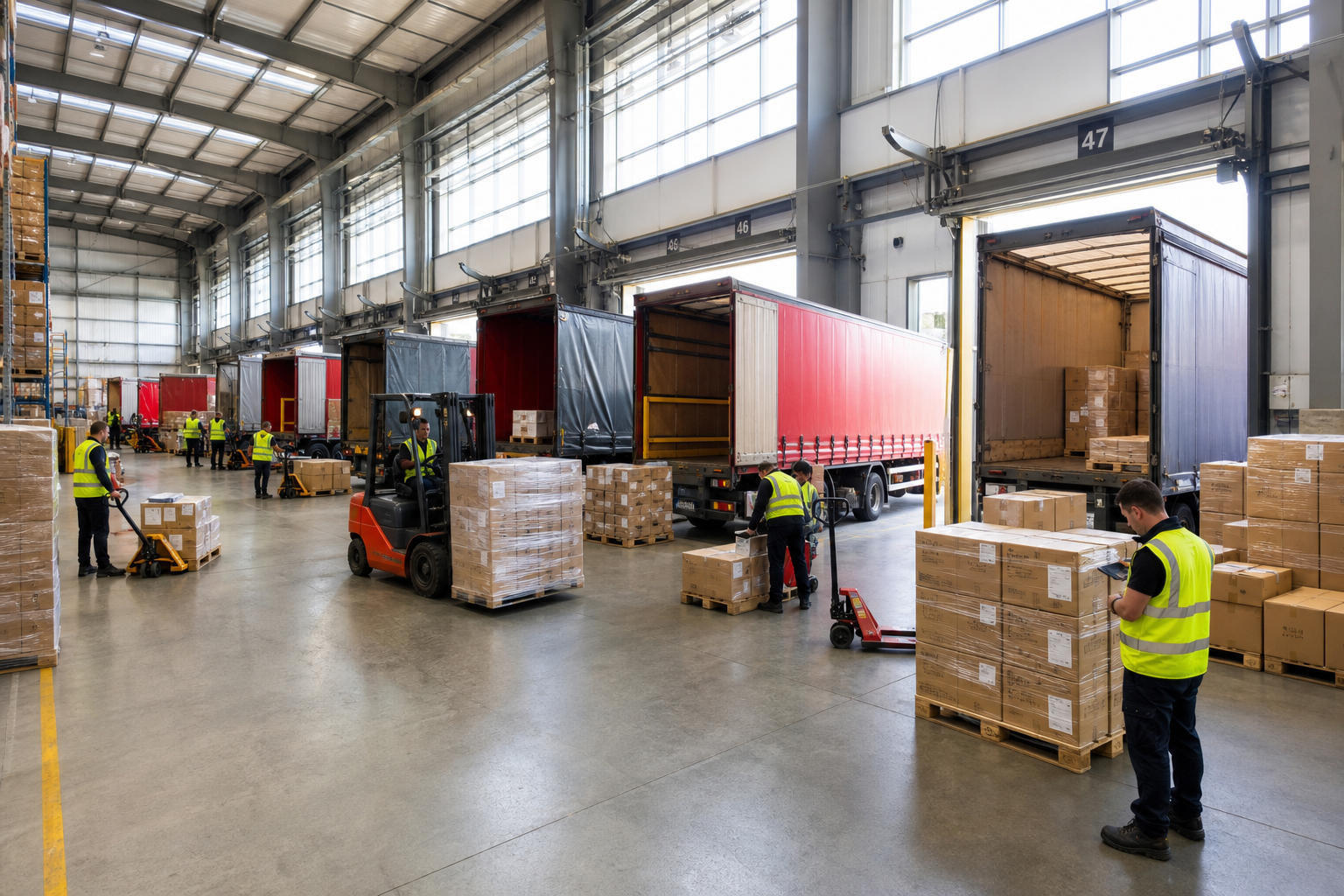
Cross-docking is a warehouse operation where incoming goods are unloaded from inbound trailers, sorted, and reloaded onto outbound trailers with minimal or no storage time in between. Instead of putting products into racking for days or weeks, goods move across the dock floor — often in under 24 hours — and leave on the next available outbound vehicle.
The core concept is simple: treat the warehouse as a flow-through point rather than a storage facility. Goods arrive, get consolidated or deconsolidated as needed, and depart. This eliminates the traditional warehousing cycle of put-away, storage, pick, and pack.
According to Maersk, companies implementing cross-docking achieve approximately 18% warehousing cost savings and a 22% reduction in inventory levels, based on CSCMP (Council of Supply Chain Management Professionals) research. A 2024 study on cross-dock planning in retail supply networks found that well-designed cross-docks can save more than 6% of related logistics costs.
For UK importers and distributors, cross-docking offers a way to reduce real estate requirements, lower inventory carrying costs, and accelerate order fulfilment — particularly valuable given the high cost of industrial warehouse space in the South East and Midlands. Industrial rents in the Golden Triangle (Northamptonshire, Leicestershire, Warwickshire) have risen sharply, making space-efficient operations increasingly attractive. For more on warehouse space costs, see UK Warehouse Rental Rates Q1 2026.
Types of Cross-Docking Operations
Cross-docking is not a single model. Different configurations suit different supply chain structures, product types, and demand patterns. Understanding the distinctions helps operators select the right approach.
Pre-Distribution vs Post-Distribution
Pre-distribution cross-docking means the final destination for each item is decided before goods arrive at the cross-dock facility. The manufacturer or supplier labels and routes products according to known demand — for example, a retail chain’s distribution centre knows exactly how many units each store needs, and the supplier palletises accordingly. This suits stable, predictable demand environments where sales data is reliable.
Post-distribution cross-docking means sorting and allocation happens at the cross-dock terminal itself. Goods arrive without final destination labels, and the cross-dock operator decides where each pallet or carton goes based on real-time demand signals. This offers flexibility to respond to demand fluctuations but requires more sophisticated warehouse management systems (WMS) and real-time data accuracy. For guidance on selecting a WMS, see WMS Software Selection: Choosing the Right System. Whistl notes that post-distribution cross-docking is favoured by operators serving multiple retail banners or ecommerce channels where demand shifts daily.
Continuous, Consolidation, and Deconsolidation
Beyond the pre/post distinction, cross-docking operations fall into three functional types:
Continuous cross-docking involves direct transfer from inbound to outbound docks with minimal or no intermediate storage. This is ideal for high-demand perishables (food and drink), time-sensitive pharmaceuticals, or fast-moving consumer goods where the inbound and outbound trailers are scheduled to arrive within hours of each other.
Consolidation cross-docking combines multiple smaller shipments into larger outbound loads. This is common among less-than-truckload (LTL) carriers and distributors serving regional retail chains. Multiple inbound deliveries from different suppliers are merged into full truckloads heading to the same destination, reducing transport costs per unit.
Deconsolidation cross-docking splits large inbound shipments into smaller outbound deliveries. This is typical for parcel carriers, retail chains receiving full container loads from overseas suppliers, and importers distributing to multiple regional warehouses. A single 40-foot container from China might be deconsolidated into five outbound trailers destined for different UK regions.
Benefits of Cross-Docking for UK Operators
Cross-docking delivers measurable advantages when applied to suitable product categories and supply chain structures.
Cost Reduction
Eliminating storage reduces or removes several cost lines:
- Warehousing space: Less racking, smaller footprint, lower rent. Cross-docking facilities can operate with 30-50% less floor space than traditional warehouses handling equivalent throughput.
- Inventory carrying costs: Capital is not tied up in stored goods. The CSCMP-cited 22% inventory reduction translates directly into improved cash flow.
- Labour: No put-away or storage-location picking. Labour is concentrated on receiving, sorting, and loading — tasks that are easier to automate or make more efficient. For more on warehouse labour efficiency, see Warehouse Picking Strategies: Batch, Zone & Wave Picking.
- Damage and shrinkage: Goods spend less time in the warehouse, reducing handling touches and exposure to loss or damage.
Speed and Responsiveness
Cross-docking accelerates order-to-delivery cycles. Goods received in the morning can be on outbound trailers by afternoon. This matters for:
- Ecommerce fulfilment: Same-day or next-day delivery promises require rapid throughput.
- Retail replenishment: Stores running lean inventory depend on frequent, fast replenishment.
- Perishables: Food and drink distributors must move products quickly to preserve shelf life.
Centralised Handling
Cross-docking enables consolidation of products from multiple suppliers before final delivery. A UK retailer can receive shipments from ten different manufacturers at one cross-dock, then send consolidated trailers to each store — reducing the number of deliveries each store receives and simplifying inbound logistics at the retail end.
Environmental Benefits
Fewer storage touches and consolidated outbound loads can reduce the carbon footprint of warehouse operations. By minimising handling equipment usage (forklifts, conveyors running for extended periods) and improving the efficiency of outbound loads, cross-docking contributes to sustainability targets — increasingly important for UK operators reporting under Streamlined Energy and Carbon Reporting (SECR) requirements.
Which Businesses Should Use Cross-Docking?
Cross-docking is not universal. It suits specific industries and operational profiles.
Food and Drink
Perishability makes cross-docking almost essential for temperature-controlled distribution. Dairy, fresh produce, and chilled meats move through cross-docks daily. The UK’s cold-chain infrastructure relies heavily on cross-docking to maintain product integrity from importer to retailer. Major retailers such as Tesco, Sainsbury’s, and Asda operate extensive cross-docking networks for fresh produce.
Ecommerce and Retail
High-volume, fast-moving SKUs benefit from cross-docking’s speed. Ecommerce operators serving next-day delivery commitments use cross-docking to sort inbound supplier shipments directly into outbound customer parcels or regional courier loads. Retail chains with hundreds of stores depend on cross-docking for store replenishment. Amazon’s UK fulfilment network uses cross-docking extensively to move goods between fulfilment centres and last-mile delivery stations.
Manufacturing (Just-in-Time)
Manufacturers operating JIT production lines require components to arrive precisely when needed. Cross-docking allows suppliers to deliver to a consolidation point near the factory, with components cross-docked into sequenced kits that match the production schedule. This reduces line-side inventory and production stoppages. The automotive sector, particularly plants in the West Midlands and North East, relies heavily on cross-docking for JIT component delivery.
Pharmaceutical and Healthcare
Temperature-sensitive medicines and medical devices often move through cross-docking networks to maintain cold-chain integrity and meet tight delivery windows for hospitals and pharmacies. The NHS supply chain uses cross-docking for distribution of time-critical medical products.
Third-Party Logistics Providers
3PLs serving multiple clients often operate cross-docking facilities as part of their service offering. This allows them to consolidate shipments from different clients heading to similar destinations, improving load utilisation and reducing transport costs for all parties.
Challenges and Prerequisites
Cross-docking introduces complexity that operators must be prepared to manage.
Timing Synchronisation
Inbound and outbound trailers must be tightly scheduled. If an inbound trailer arrives late, outbound trailers may depart without their full load — or worse, wait idle, burning driver hours and dock capacity. This demands reliable carrier partnerships and contingency plans for delays. Appointment scheduling systems and real-time carrier communication are essential.
Data Accuracy and WMS Capability
Post-distribution and consolidation cross-docking require real-time visibility into inventory, orders, and trailer schedules. A warehouse management system capable of tracking accumulated product, allocating to outbound loads, and generating loading instructions is essential. Whistl emphasises that WMS capability is the single most critical enabler for sophisticated cross-docking operations. Systems must handle exceptions gracefully — short shipments, damaged goods, mislabelled pallets — without disrupting the entire flow.
Skilled Workforce
Cross-docking staff must understand sorting logic, loading sequences, and exception handling. Training requirements are higher than for traditional put-away/pick operations because mistakes have immediate downstream consequences — a mis-sorted pallet may not be caught until it reaches the wrong store. Staff turnover can be particularly damaging in cross-docking operations, as experienced operators develop intuition for handling exceptions quickly.
Coordination Complexity
Cross-docking requires coordination across suppliers, carriers, and customers. Suppliers must label and palletise correctly. Carriers must adhere to appointment windows. Customers must accept delivery schedules. Any weak link disrupts the flow. This coordination burden is higher than traditional warehousing, where storage provides a buffer against supply chain variability.
Infrastructure Requirements
Cross-docking facilities need more dock doors than traditional warehouses to handle simultaneous inbound and outbound trailers. Staging areas must be large enough to sort goods without congestion. Some operations benefit from conveyor systems, sortation equipment, or automated guidance vehicles — capital investments that require justification through throughput volumes.
Implementation Checklist for UK Operators
If cross-docking suits your operation, follow these steps to implement it systematically.
1. Validate Product Suitability
Not all products are cross-dock candidates. Start with SKUs that have:
- Stable, predictable demand
- High turnover rates
- Standardised packaging and labelling
- Low damage risk during handling
Exclude slow-movers, irregular shapes, or products requiring special storage conditions until the operation is proven. A good rule of thumb: if a product sits in storage for more than 14 days on average, it is probably not a cross-dock candidate.
2. Map Inbound and Outbound Flows
Document every inbound source (supplier, port, regional warehouse) and every outbound destination (store, customer region, courier hub). Identify natural consolidation points and peak throughput windows. This mapping informs dock door allocation and labour scheduling. Create a flow diagram showing how goods move from each inbound source to each outbound destination — this visualisation often reveals optimisation opportunities.
3. Assess WMS Requirements
Confirm your warehouse management system can:
- Track inbound receipts in real time
- Allocate inventory to outbound orders before physical put-away
- Generate loading plans by outbound trailer
- Handle exceptions (short shipments, damaged goods, mislabels)
If your current WMS lacks these capabilities, budget for upgrades or replacement before proceeding. Some operators find it more cost-effective to partner with a 3PL that already has cross-docking-capable systems rather than investing in new technology.
4. Pilot with One Product Line
Do not convert the entire warehouse at once. Select one product category or customer segment and run a cross-docking pilot for 4-6 weeks. Measure throughput times, error rates, labour productivity, and cost per unit handled. Use the pilot to refine processes before scaling. Document lessons learned — what worked, what failed, what adjustments were needed.
5. Train Staff and Document Procedures
Cross-docking requires different workflows than traditional warehousing. Document standard operating procedures for receiving, sorting, staging, and loading. Train staff on exception handling — what to do when a pallet is mislabelled, a trailer is late, or an order is cancelled mid-shift. Create visual work instructions at each station to reduce training time for new staff.
6. Establish Carrier Partnerships
Work with carriers who understand cross-docking requirements. Agree on appointment windows, turnaround times, and communication protocols. Consider penalties for no-shows or late arrivals that disrupt outbound schedules. Some operators implement a tiered carrier programme, giving priority dock access to carriers with the best on-time performance.
7. Monitor and Adjust
Track key performance indicators:
- Dock-to-dock time (inbound unload to outbound load)
- Percentage of goods cross-docked vs. put into storage
- Labour productivity (units handled per hour)
- Error rate (mis-sorted pallets, loading mistakes)
- Cost per unit handled
Review metrics weekly during the first quarter, then monthly. Adjust staffing, dock allocation, or WMS configuration based on data. Cross-docking operations typically require 3-6 months to stabilise as staff gain experience and processes are refined.
When Cross-Docking Is Not the Answer
Cross-docking is not appropriate for every operation. Avoid it if:
- Demand is highly unpredictable or seasonal
- Products require long-term storage (slow-movers, archival inventory)
- Supplier lead times are unreliable
- Your WMS cannot support real-time allocation
- Labour turnover is high and training capacity is limited
- Your facility lacks sufficient dock doors or staging space
In these cases, traditional warehousing with flexible storage capacity may be more resilient. A hybrid approach — cross-docking fast-movers while storing slow-movers traditionally — often delivers the best of both worlds for UK operators with diverse product portfolios.
Frequently Asked Questions
What is the difference between cross-docking and traditional warehousing? Traditional warehousing stores goods for days, weeks, or months before picking and shipping. Cross-docking moves goods from inbound to outbound trailers in hours, with minimal or no storage. Cross-docking reduces inventory carrying costs and accelerates fulfilment but requires tighter scheduling and more sophisticated systems.
How much warehouse space do I need for cross-docking? Cross-docking facilities typically require 30-50% less floor space than traditional warehouses handling equivalent throughput, because racking and storage aisles are eliminated. However, you need more dock doors and larger staging areas to handle simultaneous inbound and outbound trailers. A typical cross-dock might have 20-50 dock doors depending on throughput volume.
What technology do I need to run cross-docking? At minimum, you need a warehouse management system (WMS) capable of real-time inventory tracking, order allocation, and loading plan generation. Barcode scanning, dock door scheduling software, and carrier communication platforms are also valuable. Post-distribution cross-docking demands more advanced WMS capability than pre-distribution. Some operators add conveyor systems or sortation equipment for high-volume operations.
Can small operators use cross-docking? Yes, but scale matters. Small operators may benefit from using third-party logistics (3PL) providers that already operate cross-docking networks, rather than building their own. Alternatively, a hybrid model — cross-docking fast-movers while storing slow-movers traditionally — can deliver benefits without full conversion. Even cross-docking one or two product lines can generate meaningful cost savings.
What are the biggest risks in cross-docking? The primary risks are timing failures (inbound delays disrupting outbound schedules), data errors (mis-sorted goods due to incorrect labels or WMS glitches), and labour shortages (insufficient trained staff to handle peak throughput). Mitigation requires reliable carrier partnerships, reliable WMS, and contingency staffing plans. Having backup carriers and cross-trained staff provides resilience when disruptions occur.
Related reading: For more on warehouse operations and 3PL selection, see our guide to 3PL services in the UK and our comparison of 3PL costs. If you need help classifying products for import duty purposes, our commodity codes guide covers tariff classification step-by-step.