Key Takeaways
- Order picking accounts for 50-55% of total warehouse operating costs, making it the single largest cost centre in any distribution operation
- Six core strategies exist: piece, batch, zone, wave, goods-to-person, and pick-to-box — each suits different order profiles, SKU counts and volume patterns
- No single strategy is “best” — the right choice depends on order size, SKU range, seasonality, labour costs and capital available for automation
- Combining strategies is common practice in UK warehouses — piece picking for high-value or oversize items, batch picking for high-volume standard lines
- WMS technology, pick-to-light, voice picking and AMRs are transforming pick accuracy and throughput across UK distribution centres
- Manual handling remains the top cause of reportable warehouse accidents in the UK, making picking strategy a health and safety decision as well as an operational one
Why Picking Strategy Matters
Order picking is the most labour-intensive activity in any warehouse. According to widely cited industry benchmarks, picking accounts for 50-55% of total warehouse operating costs — more than receiving, put-away and despatch combined. Every metre a picker walks without picking is wasted money. Every mis-pick that reaches a customer is a cost twice over: the return, the re-pick, and the damage to service reputation.
Choosing the right picking strategy is therefore the most consequential decision a warehouse manager can make. The strategy determines how pickers move through the building, how orders are grouped and sequenced, how much travel time is incurred, and how accurately each shipment leaves the dock. In UK distribution centres — where labour costs are rising and the HGV driver shortage is pushing up wages across the entire logistics sector — inefficient picking directly erodes margin.
The strategy also intersects with warehouse KPIs that determine whether a facility is hitting its contractual service levels. Pick accuracy, lines per hour, and cost per pick are all downstream of the strategy chosen. A warehouse running piece picking when it should be batch picking will see those metrics suffer.
The Six Core Picking Strategies
Each strategy has a specific profile. Matching the strategy to the operation’s order characteristics — not to the latest industry fashion — is what drives results.
Piece Picking (Picker-to-Part)
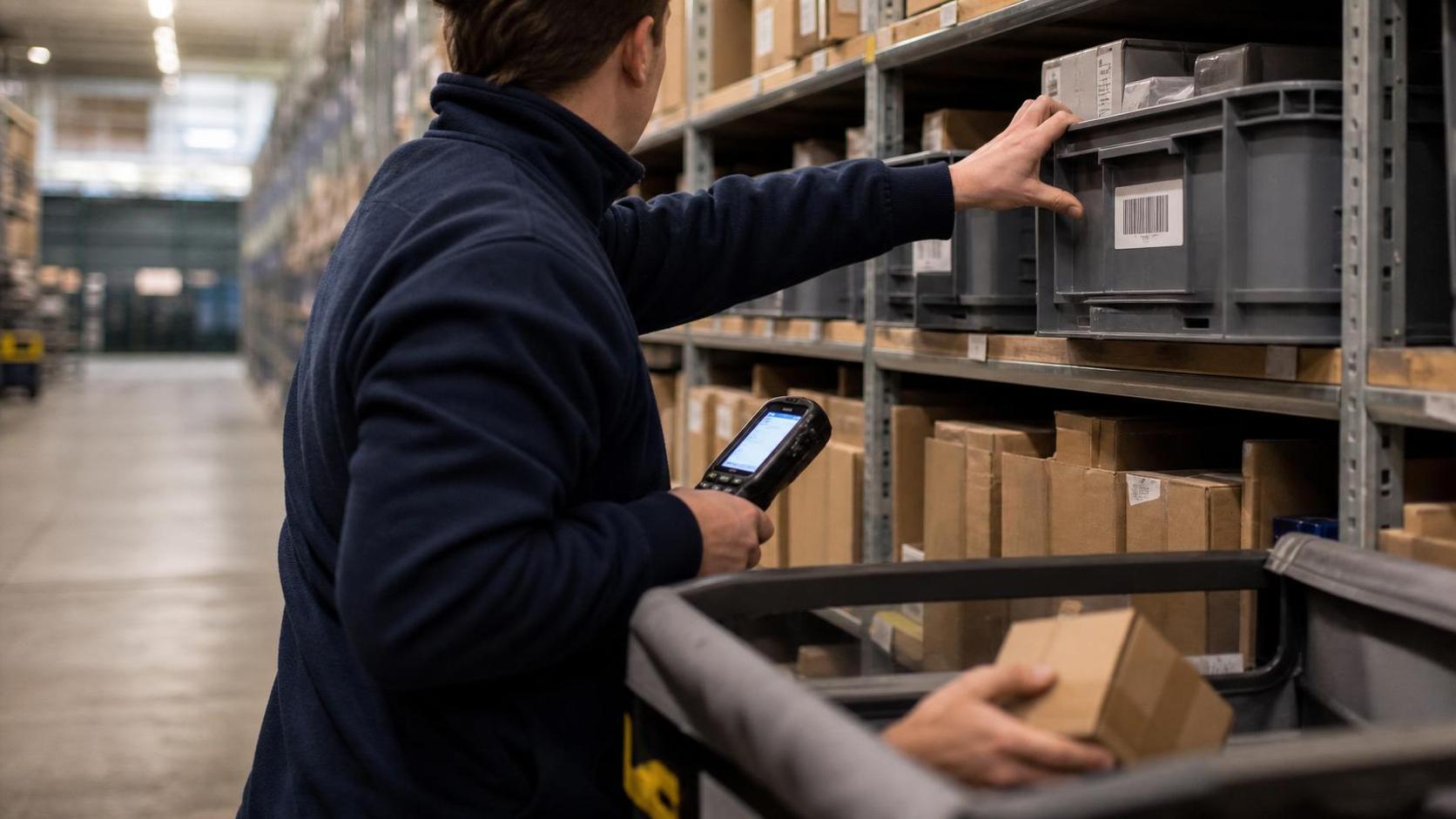
Piece picking is the simplest method: a picker takes a single order list, walks the warehouse collecting each item in sequence, and brings the completed order to packing. One order, one picker, one trip.
This method works well for operations with a large SKU base, low quantities per order line, and high order variability — classic ecommerce and spare parts distribution. The drawback is travel time: a picker walking a 10,000-square-metre DC may spend 60-70% of their shift in transit, not picking. Piece picking is the default starting point for most small UK warehouses. As volume grows, travel inefficiency drives adoption of more sophisticated strategies.
Batch Picking
Batch picking sends a picker out with multiple orders simultaneously. The picker follows an optimised route through the warehouse, picking items for several orders at once. At the packing station, items are sorted into individual orders.
The advantage is reduced travel time per order line. Instead of walking the same aisle six times for six orders, the picker walks it once. The key metric shifts from “orders per hour” to “lines per hour” — a more accurate productivity measure.
Batch picking suits operations with stable, high-volume order profiles where many orders share common SKUs. UK e-fulfilment centres handling standardised product ranges often default to batch picking. The trade-off is the sorting step: if orders share few SKUs, sorting cost can offset the travel savings.
Zone Picking
In zone picking, each picker is assigned a specific area of the warehouse and only picks items within that zone. Orders move between zones on conveyors, tote systems, or by hand. At the final station, all items for an order are consolidated.
This method suits large warehouses with diverse product ranges. A picker in the heavy-goods zone operates a powered pallet truck; a picker in the small-items zone works on foot. Each zone can be optimised independently for its product type, storage equipment, and pick method.
Zone picking reduces training time and improves safety by keeping pickers in a defined area, reducing pedestrian-vehicle interactions. The limitation is bottlenecks: if one zone is overloaded while another is idle, throughput drops. Balanced zone workload distribution is essential.
Wave Picking
Wave picking combines zone and batch picking. Batches of orders are released in timed “waves” — often aligned to carrier collection times or shift patterns. Pickers in each zone pick their portion of the wave’s orders simultaneously. The wave is consolidated, sorted, and despatched before the next wave begins.
This is the most complex manual picking strategy, but it offers the best balance of throughput, accuracy and timing control. UK third-party logistics providers serving retail clients often use wave picking to meet specific delivery windows — morning waves for same-day courier despatch, afternoon waves for next-day parcel networks.
Wave picking requires a capable warehouse management system to coordinate wave release, zone allocation and consolidation. Without the WMS driving the schedule, wave picking degrades into unstructured zone picking with no timing benefit.
Goods-to-Person Picking
Goods-to-person systems eliminate picker travel entirely. Automated storage and retrieval systems (AS/RS), autonomous mobile robots (AMRs), or conveyor networks bring the required SKUs to a stationary pick station. The picker picks the item, scans it, and the tote returns to storage.
Throughput at a goods-to-person station can reach 500-800 lines per hour — three to five times what a walking picker achieves. Accuracy improves because the picker stays in one position with screen-guided instructions and pick-to-light confirmation.
The barrier is capital expenditure. A goods-to-person system requires significant upfront investment in automation, WMS integration, and maintenance. UK adoption has been concentrated in large e-fulfilment centres where volume justifies the spend. Mid-market warehouses are increasingly exploring AMR-based goods-to-person as a lower-cost entry point, as covered in our guide to warehouse automation ROI.
Pick-to-Box
Pick-to-box is a variation where items go directly into the final shipping container during the pick process, eliminating a separate packing step. The WMS calculates the correct box size before picking begins — a process called cartonisation — and the picker places items straight into the despatch-ready carton.
This method works best when products have predictable dimensions and do not need protective wrapping. It eliminates a full labour step (packing) and reduces consumable costs. UK operations shipping standardised products — books, boxed electronics, apparel in polybags — can benefit significantly.
The limitation is product diversity. If an order contains items of wildly varying sizes, fragile goods, or products requiring dunnage, pick-to-box fails. The WMS cartonisation algorithm must be accurate — if it selects the wrong box size, the order either cannot be sealed or ships with excessive void space.
Choosing the Right Strategy
No single picking strategy is universally superior. The decision depends on concrete operational factors:
Order profile. How many lines per order? How many units per line? Orders with one or two lines suit piece picking; orders with 15-20 lines from diverse SKUs suit batch or wave picking.
SKU count and velocity. A warehouse with 500 fast-moving SKUs and 5,000 slow-movers needs a mixed approach. Fast SKUs in a zone near despatch with batch picking; slow SKUs in a remote zone with piece picking.
Volume pattern. Stable, predictable daily volume supports wave picking with fixed cut-off times. Highly variable or seasonal volume may require the flexibility of piece picking supplemented by batch picking during peaks.
Labour availability and cost. In UK regions where warehouse labour is scarce or expensive, strategies that reduce walking time — batch, zone, goods-to-person — deliver faster payback. Where labour is more available, the labour-saving benefit of automation is less compelling.
Capital budget. Piece, batch, zone and wave picking can be implemented with trolleys, pick lists and a mid-range WMS. Goods-to-person requires significant capex. Pick-to-box sits in between — it needs WMS cartonisation capability but no physical automation.
Building layout. Zone picking requires a warehouse large enough to justify dedicated zones. In a 2,000-square-metre facility, zones may overlap to the point where the method adds complexity without benefit. The warehouse layout design determines whether zone boundaries are practical.
Most UK warehouses combine two or three strategies. A common pattern: piece picking for single-line or oversize orders, batch picking for the high-volume core, and zone picking for the geographically separated fast-pick and slow-pick areas.
Technology That Improves Picking
Several technologies enhance picking performance regardless of the base strategy chosen:
Warehouse Management Systems (WMS). A WMS generates optimised pick paths, allocates stock to orders, and tracks completion. Without a WMS, batch and wave picking are effectively impossible. The WMS is the orchestration layer that makes every other technology useful.
Pick-to-light. LED indicators mounted on rack locations show the picker exactly where to pick and how many units. A confirmation button at each location closes the pick. Pick-to-light can achieve 99.9% accuracy rates and 300-450 lines per hour — significantly faster than paper-based picking.
Voice picking. The picker wears a headset and receives spoken pick instructions. Voice-directed picking leaves both hands free for handling product, which is particularly useful for heavy or bulky items. It also suits cold stores where gloves make handheld scanners impractical.
RF scanning. Handheld barcode scanners confirm each pick against the WMS. This is the baseline technology for most UK warehouses — affordable, accurate, and compatible with any picking strategy. Scanning adds a few seconds per line but catches mis-picks before they leave the building.
Autonomous mobile robots (AMRs). AMRs can support goods-to-person picking by fetching racks or totes to pick stations. They can also assist batch picking by following the picker and receiving items directly, eliminating the need to push a trolley. AMR deployment in UK warehouses is growing rapidly as costs fall and reliability improves.
Each technology should be evaluated against the operation’s specific pain points. A warehouse with 98% pick accuracy but low lines-per-hour needs a strategy change or route optimisation, not pick-to-light. A warehouse with high throughput but persistent mis-picks may benefit more from RF scanning than voice picking.
Health and Safety Considerations
Picking is one of the highest-risk activities in a UK warehouse. The HSE identifies manual handling as the leading cause of reportable accidents in warehousing and storage — encompassing musculoskeletal injuries from repetitive lifting, twisting and carrying during pick operations.
The HSE’s guidance document HSG76 sets out the regulatory expectations for warehouse operators. Key picking-related requirements include:
- Minimising manual handling through mechanical aids (trolleys, conveyors, powered pallet trucks) wherever reasonably practicable
- Separating pedestrian pickers from MHE traffic through marked walkways, barriers, or zoning
- Training pickers in correct lifting technique and providing task-specific manual handling assessments
- Maintaining clear, unobstructed pick aisles — clutter is a trip hazard and a fire risk
Picking strategy affects safety outcomes. Zone picking keeps pickers in familiar areas. Batch picking reduces trips through high-traffic aisles. Goods-to-person eliminates travel entirely. Piece picking in a poorly laid out warehouse maximises both travel time and exposure to vehicle-pedestrian conflict.
The UK warehouse safety regulations updated for 2026 reinforce these obligations. A picking strategy that creates unnecessary manual handling risk is not just operationally suboptimal — it is a compliance issue.
Measuring Picking Performance
Whatever strategy is deployed, measuring performance is essential. The core KPIs for picking operations are:
Lines per hour (LPH). The number of order lines picked per picker per hour. This is the primary productivity metric. A typical UK warehouse picker achieves 80-150 LPH on foot with RF scanning; 200-300 with batch picking and optimised routes; 400+ with pick-to-light or goods-to-person.
Pick accuracy rate. The percentage of picks completed correctly, measured by post-pick audit or customer returns. Target: 99.5% or higher. Below 99% indicates a systemic problem — usually training, labelling, or WMS data quality.
Travel time percentage. The proportion of a picker’s shift spent walking rather than picking. In a well-designed piece-picking operation, 50-60% travel time is typical. In batch picking, 30-40%. In goods-to-person, under 10%. High travel time is the primary signal that a strategy change is needed.
Cost per pick. Total picking cost (labour, equipment, consumables) divided by total lines picked. This is the bottom-line metric for strategy evaluation. If a new strategy does not reduce cost per pick, it is not delivering value.
These metrics should be tracked in the WMS and reviewed weekly. Sudden drops in LPH or accuracy often indicate a process problem — a congested aisle, a new product line with poor labelling, or a WMS routing glitch. Gradual declines may signal training drift or volume mix changes. For a broader framework, see our guide to warehouse KPIs that actually matter.
Frequently Asked Questions
What is the difference between batch picking and wave picking? Batch picking collects items for multiple orders in a single trip, then sorts them at the packing station. Wave picking combines batch and zone picking — batches of orders are released in timed waves, with pickers in different zones picking simultaneously. Wave picking adds timing control and zone specialisation on top of batch picking’s travel efficiency.
Which picking strategy is best for a small UK warehouse? For warehouses under 2,000 square metres with moderate SKU counts, piece picking with RF scanning is usually the practical starting point. Batch picking becomes worthwhile once order volume consistently exceeds 200-300 lines per day and multiple orders share common SKUs. Zone picking requires enough floor area to justify discrete zones.
How much does pick-to-light cost to install? Pick-to-light hardware typically costs £100-300 per pick face, plus WMS integration and installation. A medium UK warehouse with 2,000 pick faces would face £200,000-600,000 in hardware alone. The payback period depends on pick volume and the cost of mis-picks — high-volume operations can see ROI in 18-24 months.
Is goods-to-person picking worth the investment? Goods-to-person systems deliver the highest throughput and accuracy but require capital expenditure running into hundreds of thousands or millions of pounds. They make economic sense for high-volume operations (typically 10,000+ lines per day) where labour savings offset the investment within 3-5 years. AMR-based systems are reducing the entry cost, making goods-to-person viable for mid-market operations.
How does picking strategy affect warehouse safety? Strategies that reduce travel — zone, batch, and goods-to-person — also reduce pedestrian-vehicle interactions, which are a major safety risk. Piece picking sends pickers through the entire building, maximising exposure to forklift and pallet truck traffic. HSE guidance under HSG76 expects operators to minimise manual handling and separate people from vehicles wherever practicable.
Can I combine picking strategies in the same warehouse? Yes — most UK warehouses do. A common approach uses zone picking for the main storage area, batch picking within each zone for standard orders, and piece picking for single-line or oversize orders that do not fit the batch profile. The WMS must be configured to route each order to the correct strategy based on its characteristics.